

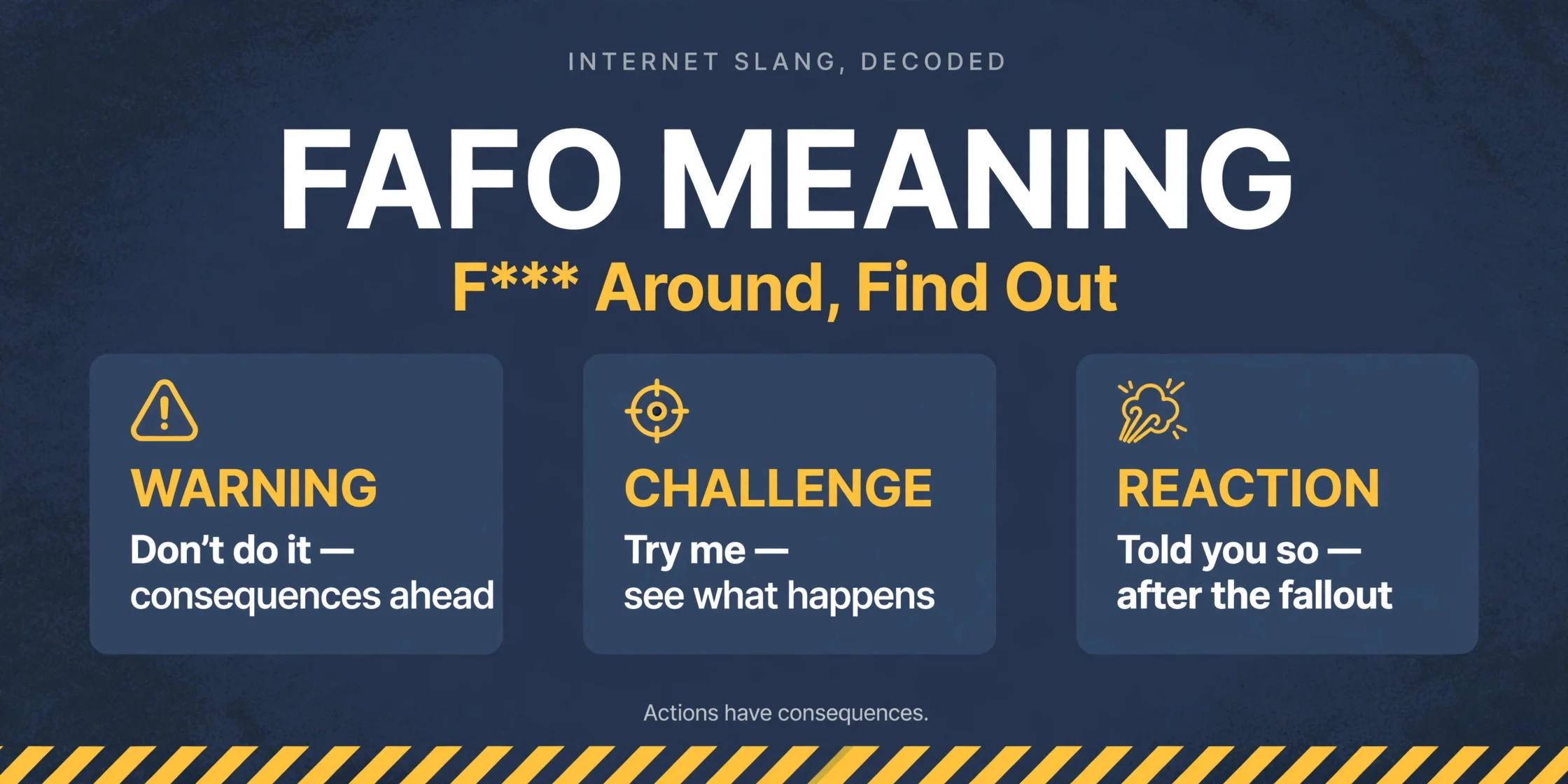
If you have seen the four letters FAFO in a comment section and wondered about the fafo meaning, you are not alone. FAFO pops up everywhere right now — TikTok captions, X replies, gaming lobbies, group chats, and even political headlines — and it always seems to arrive right at the moment someone is about to learn a hard lesson.
At its simplest, FAFO is a warning: push too far, and you will face the consequences. However, the same four letters can be a joke between friends, a bold challenge, or a satisfied “told you so” after the damage is done. This guide breaks down exactly what FAFO signals, where it came from, how to read its tone in any conversation, and when to leave it out of your messages entirely.
FAFO Meaning: The Direct Answer
FAFO stands for “F*** Around, Find Out” — a blunt way of saying that risky or foolish behavior leads to consequences. In polite company, people usually swap in “Fool Around, Find Out,” which carries the same message without the profanity. Dictionaries classify the full phrase as vulgar slang, yet the abbreviation itself reads as edgy rather than shocking, which is exactly why it spread so fast online.
The fafo meaning in everyday use always comes back to cause and effect. Someone tests a boundary, ignores a warning, or acts recklessly — and then the outcome teaches the lesson. Think of it as the internet’s shortest morality tale: the first half is the mistake, and the second half is the bill coming due.
It helps to notice, as a result, that FAFO is almost never neutral. People do not drop it into calm, factual discussions. Instead, it shows up where stakes, pride, or humor are involved, which is why reading the tone correctly matters so much.
Where the FAFO Meaning Comes From: A Quick Origin Story
The phrase behind the acronym is older than the meme. Linguists trace “f*** around and find out” back to African American Vernacular English, with printed uses going back to at least the 2000s. Early on, it also circulated as biker slang and later as military and law enforcement shorthand — a no-nonsense way to warn that provocation would be answered.
The acronym itself took longer to catch on. It bubbled through Reddit threads and meme pages in the late 2010s, then surged into the mainstream in late 2022 after a viral post brought it to a much wider audience. Dictionaries took notice soon after: both Merriam-Webster and Dictionary.com now carry FAFO entries, which is usually the moment internet slang graduates from niche joke to established vocabulary.
Since then, however, the fafo meaning has stretched well beyond its origins. It appears in TikTok trends, sports commentary, workplace jokes, parenting memes, and political slogans — sometimes playful, sometimes pointed, but always carrying that same core warning about consequences. In other words, a phrase that started in specific subcultures now belongs to the mainstream internet.
The Three Jobs FAFO Does in a Conversation
Here is the framework that makes FAFO easy to decode. Nearly every use falls into one of three jobs: a warning, a challenge, or a reaction. Once you know which job it is doing, the tone becomes obvious.
Job 1: FAFO as a Warning
This is the original and most common use. Someone sees risky behavior coming and flags it in advance. A friend about to text their ex at 2 a.m. might hear “FAFO” from the group chat — shorthand for “go ahead, but do not say we did not warn you.” The tone here is protective, often affectionate, and the speaker genuinely hopes the listener backs off. In other words, the speaker is on your side — at least for now.
Job 2: FAFO as a Challenge
Sometimes the speaker is the one drawing the line. “Touch my fries and FAFO” is not a prediction; it is a dare with the consequence left deliciously unspecified. In gaming lobbies and sports rivalries, this version carries swagger — the speaker is confident they can back up the threat. Context tells you whether it is playful trash talk or something genuinely heated.
Job 3: FAFO as a Reaction
The third job happens after the fact. Someone ignored every warning, made the mistake anyway, and is now dealing with the fallout. A single “FAFO” in the replies captures the whole arc — part sympathy, part schadenfreude, part “we literally told you.” This is the version that dominates TikTok comment sections under fail videos.
FAFO Meaning in Text and on TikTok
The fafo meaning shifts slightly depending on where you meet it, because each platform has its own culture around the term.
FAFO in Texting and Group Chats
In private chats, FAFO is almost always playful. Friends use it the way they use “good luck with that” — a teasing heads-up rather than a real threat. Because everyone knows each other, the profanity edge softens into humor. If a stranger texts you “FAFO” out of nowhere, though, read it as genuinely confrontational; the friendliness comes from the relationship, not the word.
FAFO on TikTok and Short-Form Video
On TikTok, FAFO is primarily a caption and comment phenomenon. Creators tag videos of risky stunts, pranks backfiring, or scammers getting caught with #fafo, and commenters deploy it as instant verdict: this is what happens when you push your luck. Meanwhile, related trends like “FAFO parenting” — where parents let kids face small, safe consequences of their choices — show how flexible the format has become. As a result, the acronym now works as cultural shorthand far beyond its original warning job.
FAFO in Gaming and Online Communities
Gaming gave FAFO some of its earliest online momentum. In lobbies and forums, it works as both trash talk and genuine warning: rush the objective alone and FAFO, or as Dictionary.com even notes, to “seek by trial and error to find out how something works.” Reddit communities, from meme subs to political forums, use it as shorthand for consequences playing out in real time.
Reading the Tone: When FAFO Is a Joke vs. a Real Threat
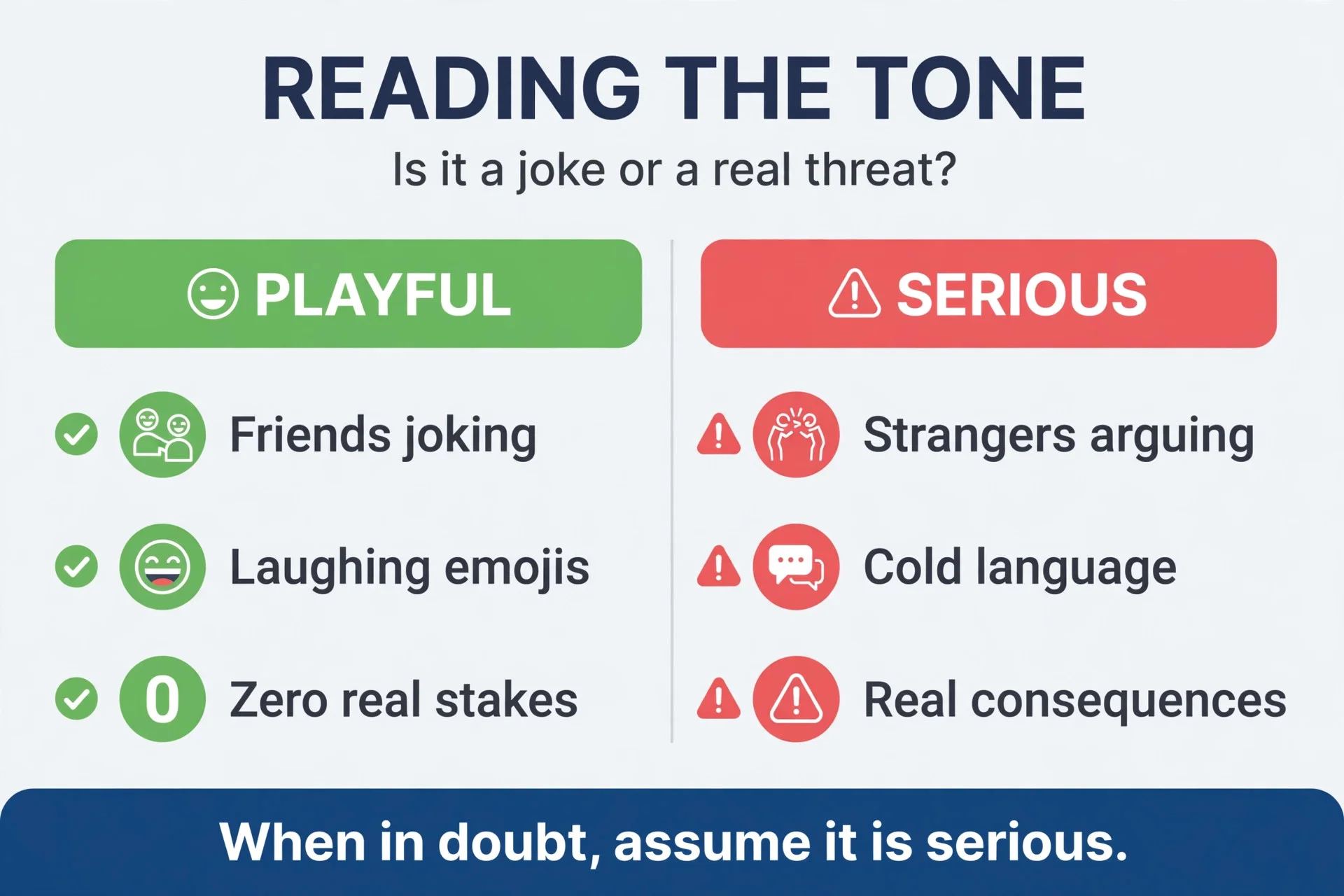
Because FAFO can be funny or fierce, misreading it causes most of the confusion. Use these two checks before you react. Consequently, a ten-second tone check prevents nearly every FAFO misunderstanding — and it also tells you whether to laugh along or tread carefully.
Signs It Is Playful
When friends use FAFO, it usually comes wrapped in humor — laughing emojis, obvious exaggeration, or a situation with zero real stakes. “Eat the last slice and FAFO” is not a threat; it is dinner-table theater. The relationship does the heavy lifting here: people who like each other use edgy words gently.
Signs It Is Serious
Take FAFO seriously when it comes from someone you do not know well, when the stakes are real (money, safety, reputation), or when the surrounding language is cold rather than joking. Political and confrontational uses fall squarely in this camp — the speaker means the warning literally. When in doubt, assume seriousness; you can always relax later, but you cannot unsend a flippant reply to a real threat.
When NOT to Use FAFO
FAFO’s edge is the whole point, which also makes it wrong for plenty of situations. Skip it in these four settings.
At Work and in Professional Messages
Even the abbreviation reads as unprofessional to many managers and clients. Performance reviews, client emails, and team chats are not the place for vulgar-adjacent slang. If you want the same energy professionally, try “let’s think through the consequences first.”
At School and With Teachers
Teachers and administrators generally hear the uncensored expansion, not the clever acronym. Using FAFO in class, in essays, or toward school staff risks disciplinary trouble that a milder phrase would never cause.
With Strangers, Elders, and in Formal Writing
With people who do not know your humor, FAFO lands as aggression, not wit. The same goes for elders, who are more likely to hear disrespect than playfulness. In formal writing — applications, official documents, published work — it undermines your credibility instantly.
When Someone Is Genuinely Upset
If a friend is actually in trouble, “FAFO” reads as mocking their pain. Schadenfreude is for comment sections, not for people you care about. Offer help first; save the acronym for stories told much later, with permission.
Polite Alternatives to FAFO
Sometimes you want the message without the edge. These substitutes keep the cause-and-effect meaning while staying clean:
- “Play stupid games, win stupid prizes” — the classic full-sentence cousin, equally vivid but profanity-free.
- “Actions have consequences” — the straightforward, all-ages version that works at work and at home.
- “You were warned” — perfect for the after-the-fact reaction job.
- “Proceed at your own risk” — the formal warning, ideal for professional settings.
- “Fool around and find out” — the direct polite swap that keeps the acronym’s rhythm.
Each of these does one of FAFO’s three jobs without the vulgarity tax, so pick the one that fits your audience.
FAFO vs Similar Slang: Clearing Up the Confusion
FAFO belongs to a whole family of consequence-flavored slang, and the overlaps trip people up.
FAFO vs “play stupid games, win stupid prizes”: These are near-synonyms. The longer phrase is the folksy proverb; FAFO is its internet-age compression. Use the proverb when you want warmth or humor, and FAFO when you want punch.
FAFO vs “around and find out”: Some people shorten it further, but FAFO is the standard form. Dictionaries list FAFO (and the verb forms FAFOed and FAFOing), so stick with the recognized acronym.
FAFO vs “FAAFO”: You may see an extra A (“f*** around AND find out”). It means the same thing; the four-letter version won the popularity contest.
FAFO vs IMO-style hedges: Unlike softeners such as IMO or IIRC, FAFO never softens anything. It hardens. If your goal is to gentle a statement, FAFO is the wrong tool entirely — which is a mistake worth avoiding.
Frequently Asked Questions
Is FAFO considered vulgar or a swear?
Merriam-Webster classifies FAFO as slang built from a profane phrase, so yes, the uncensored expansion counts as vulgar. In practice, most people treat the abbreviation itself as edgy rather than shocking, and the “fool around” variant is widely accepted as the polite substitute in workplaces and news coverage.
How do you pronounce FAFO?
There is no settled agreement yet. Some people say it as an acronym, “FAFF-oh,” while others pronounce each letter individually. Both are heard online, so either works — the written form is far more common than the spoken one.
What is the “FAFO parenting” trend?
It refers to a parenting style, popular in short-form video, where parents let children experience small, safe, natural consequences of their choices instead of rescuing them — forget the jacket, feel the cold. The label is tongue-in-cheek; the underlying idea is teaching cause and effect early.
Has FAFO been used as a political slogan?
Yes. In recent years the phrase has appeared on banners, merchandise, and in speeches across the political spectrum, used both as a warning to opponents and sarcastically to describe political missteps. This mainstream political use helped cement it beyond meme culture.
Can I use FAFO in a work chat if everyone is casual?
Even in relaxed workplaces it is risky, because the vulgar expansion is one screenshot away. Colleagues, HR, and future employers may not share your team’s humor. The polite alternatives above give you the same meaning with none of the career risk.

The Bottom Line on FAFO
FAFO compresses a timeless lesson into four letters: actions have consequences, and testing boundaries teaches that fast. Whether it arrives as a friend’s teasing warning, a gamer’s trash talk, or a commenter’s verdict on a viral fail, the fafo meaning stays anchored to cause and effect.
Use it where the edge fits — among friends, in casual online spaces, when everyone is in on the joke. Reach for a cleaner alternative at work, at school, and with strangers. Read the tone before you react, and you will never be the one finding out the hard way.