

If you have ever stared at a message with those three capital letters and wondered about the imo meaning in text, you are in good company. IMO, for instance, pops up everywhere in digital conversations — WhatsApp chats, Instagram comments, gaming lobbies, Reddit threads, and group messages — and most people learn it the same way you just did: by seeing it and guessing.
At its simplest, IMO stands for “in my opinion.” However, those three letters do more than save a few keystrokes. They quietly change how your message feels to the reader, softening statements that might otherwise sound blunt. This guide explains exactly what IMO signals, how to use it naturally, when to leave it out, and what to say instead.
Did someone just reply “IMO” and you are unsure how to take it? Are you wondering whether it sounds polite, rude, or completely neutral? Or maybe you want to know the difference between IMO and IMHO before using one yourself. You will find clear answers below, with real conversation examples you can actually picture.
IMO Meaning in Text: The Direct Answer
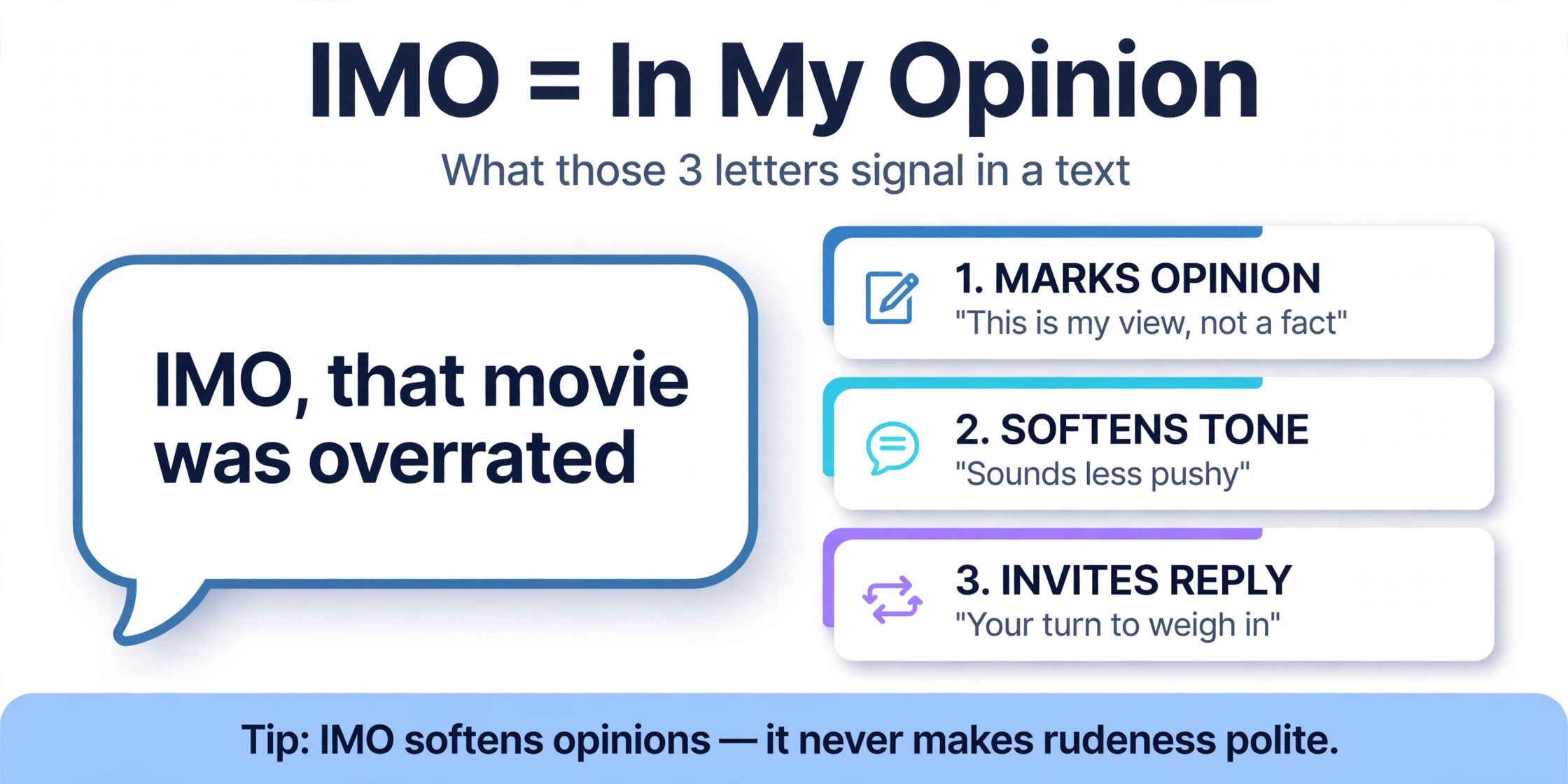
IMO means “in my opinion.” In other words, it is a texting abbreviation people use to mark a statement as their personal view rather than an established fact. For example, “IMO, the new season was better than the last one” tells the reader that a subjective take is coming — not a piece of news.
Grammar resources like ProWritingAid note that IMO can occasionally stand for other things, such as the International Maritime Organization, in completely different contexts. In everyday texting, though, the meaning is almost always “in my opinion,” and that is the meaning this guide covers.
The 3 Jobs IMO Does in Every Message
IMO earns its place in a message by doing three things at once. First, it marks the statement as an opinion, which separates “I think this” from “this is true.” Second, it softens the tone — “That restaurant is overrated, IMO” lands more gently than the same sentence without it. Third, it invites a reply by framing the message as one side of a conversation rather than a final verdict.
Why People Write IMO Instead of “In My Opinion”
The honest answer is speed and rhythm. Texting rewards brevity, and “IMO” takes a fraction of a second to type. In addition, the abbreviation has become a social signal of its own: it tells the reader you are speaking casually and do not expect your view to be treated as gospel. Writing out the full phrase in a fast-moving chat can feel oddly formal by comparison.
IMO Meaning in Chat: Real Conversation Examples
In fact, seeing IMO in action makes its meaning click faster than any definition. Below are the situations where it shows up most.
In a Friendly Debate
A: “The finale was perfect, no notes.”
B: “IMO it dragged in the middle, but that last scene saved it.”
For instance, B disagrees here without starting a fight. The IMO cushions the disagreement and keeps the tone friendly.
In a Group Chat
“IMO we should book the cabin for Friday night instead of Saturday — prices look lower.”
Similarly, in group chats, IMO helps one suggestion stand out as a personal preference rather than a decision everyone must follow. As a result, people feel freer to counter with their own takes.
On Social Media Comments
“IMO this is the most underrated album of the year.”
On Instagram or TikTok, for example, IMO works like a small shield. It says “this is just my take” in spaces where strangers love to argue, which often reduces hostile replies.
In Gaming and Online Communities
“IMO the new patch ruined snipers.”
Gaming chats move fast, and IMO lets players drop hot takes without typing full sentences. Meanwhile, readers instantly understand the message is one player’s view, not a patch note.
In addition, if you enjoy decoding texting shorthand, our guide to SOS meaning in text walks through another classic abbreviation with the same kind of real-message breakdowns.
IMO Meaning in Text vs. IMHO: What’s the Difference?
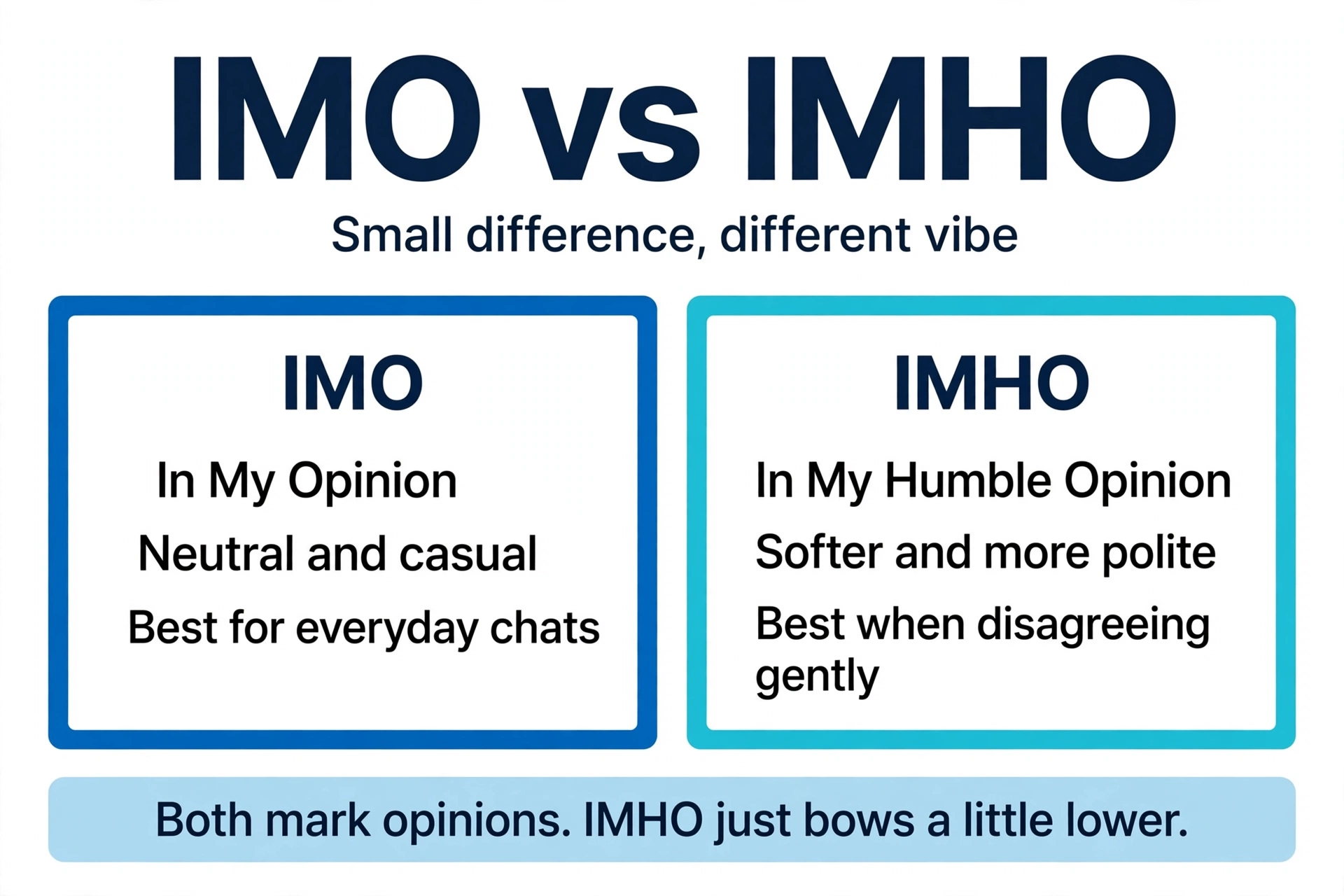
IMHO means “in my humble opinion” (sometimes read as “in my honest opinion”). However, it does the same job as IMO with one extra ingredient: humility. Adding that H tells the reader you are deliberately keeping your ego out of the statement.
What the “Humble” Actually Adds
For example, use IMHO when the topic is sensitive or when you are talking to someone you want to be extra careful with. “IMHO, the design needs more work” sounds gentler than “IMO, the design needs more work” — even though the literal difference is a single word. In practice, many people treat the two as interchangeable, so do not overthink it in casual chats.
Other Variations Worth Knowing
In addition, a few cousins of IMO appear in the wild. IMNSHO (“in my not-so-humble opinion”) is the jokey opposite of IMHO — it announces confidence rather than humility. IME (“in my experience”) is different altogether: it backs the statement with personal experience instead of pure opinion. You will see these far less often than IMO and IMHO, but recognizing them keeps you from being confused.
Getting the IMO Meaning in Text Wrong: Common Mistakes
Most IMO mistakes, however, come from using it in the wrong place rather than spelling it wrong. Here are the three to avoid.
Using IMO to State a Fact
For instance, “IMO, water boils at 100°C” makes no sense — that is a fact, not an opinion, and opinions do not apply to it. As a result, when you attach IMO to something objectively true, readers get confused about what you are actually claiming. Save IMO for judgments, tastes, predictions, and preferences.
The “IMO Shield” — Hiding Rudeness Behind It
This, however, is the biggest IMO trap. Adding IMO to the end of an insult does not make the insult polite: “Your cooking is terrible, IMO” is still rude. In other words, IMO softens the *framing* of an opinion, but it cannot rescue a message whose content is mean. If the sentence would sting without those three letters, it will sting with them.
Dropping IMO Into Professional Messages
For example, “IMO we should push the deadline” might fly in a relaxed team chat, but it looks sloppy in a client email or a formal proposal. Professional settings expect you to own your views with complete sentences, not abbreviations. More on that below.
When NOT to Use IMO: A Simple Rulebook
Therefore, if the setting is formal or the content is factual, leave IMO out.
At Work: Slack, Teams, and Email
In casual internal chats with teammates you know well, an occasional IMO is harmless. In contrast, emails, client messages, performance reviews, or anything your manager’s manager might read demand the full thought instead: “In my view, we should…” reads as confident and professional, while “IMO we should…” reads as casual to the point of careless.
In Serious or Sensitive Conversations
Similarly, when someone is upset, grieving, or discussing something personal, IMO can sound cold and dismissive — as if you are grading their feelings. “IMO you’ll get over it” is the kind of message people screenshot. In emotional moments, drop the abbreviation and speak plainly and kindly.
15 Polite Alternatives to IMO
Sometimes you want the same softening effect with different wording. Pick from the list below based on how formal you need to sound. The casual options fit fast-moving chats with friends, the polite ones work when you want to sound considerate around acquaintances, and the professional ones belong in writing that represents you formally.
Casual (friends, group chats):
- “I think…”
- “I feel like…”
- “Personally…”
- “If you ask me…”
- “Just my two cents…”
Polite (acquaintances, mixed company):
- “From my perspective…”
- “The way I see it…”
- “I’d say…”
- “In my experience…”
- “As far as I can tell…”
Professional (work, formal writing):
- “In my view…”
- “From where I stand…”
- “My assessment is…”
- “It seems to me that…”
- “One could argue that…”
Therefore, each of these does IMO’s main job — marking a statement as opinion — while fitting the room you are in.
Other Meanings of IMO You Might See
Nevertheless, outside of texting, IMO has a couple of unrelated meanings worth knowing so you are never confused. For example, the International Maritime Organization is a United Nations agency that regulates shipping — you will see this IMO in news about maritime law, never in a chat. “In memory of” is another occasional expansion, used in tributes and memorials. Context always tells you which one applies: if it is a text message, it is “in my opinion.”
How to Reply When Someone Texts You “IMO”
In addition, knowing the imo meaning in text helps you respond well. When someone writes “IMO, X,” they have marked their message as an opinion — so treat it as an invitation to share yours. A simple “Fair point — IMO, though, …” keeps the exchange balanced. If you disagree strongly, on the other hand, acknowledge first (“I see where you’re coming from”) and then give your view; the IMO already did the softening work for them, so you do not need to tiptoe. And if the IMO was attached to something rude, remember the shield rule: you are allowed to address the content, not the abbreviation.
When the IMO Feels Off: Trust Your Gut
However, sometimes a message follows the rules but still feels wrong. “IMO you’re overreacting” has the abbreviation in the right place, yet the content dismisses your feelings. In cases like this, respond to what was actually said, not the packaging. A calm “That felt dismissive — can we talk about what happened?” addresses the real issue directly. Keep in mind that tone is genuinely hard to read in text; if you are unsure whether someone meant to be harsh, ask before assuming the worst. Most of the time, one quick clarification prevents a pointless argument.
FAQ
How do you pronounce IMO?
Say each letter separately: “I-M-O.” People do not pronounce it as a single word. In casual speech, however, you might hear “eye-em-oh” run together quickly — but letter-by-letter is the standard.
Is there a formal version of IMO?
In fact, there is no formal abbreviation that works the same way. In professional writing, use the full phrase instead: “in my view,” “from my perspective,” or “my assessment is.” These carry the same meaning with the polish that formal settings expect.
What’s the difference between IMO and TBH?
IMO marks a statement as your opinion; TBH (“to be honest”), on the other hand, marks a statement as candid or confessional. “IMO, the movie was too long” shares a judgment, while “TBH, I fell asleep during the movie” admits something personal. They often appear together — “TBH, IMO it wasn’t worth the hype” — but they do different jobs.
Does IMO need a comma after it?
Usually, yes. “IMO, the pizza was great” reads more naturally than “IMO the pizza was great,” because the comma mirrors the pause you would make when speaking. At the end of a sentence (“The pizza was great, IMO”), the comma before it is also standard. That said, casual chats forgive missing commas everywhere.
Why do some people write “imo” in lowercase?
In fact, lowercase “imo” is simply casual style — the same reason people type “lol” instead of “LOL.” It does not change the meaning. Some people feel lowercase looks less shouty in a relaxed chat. In short, “IMO” and “imo” mean exactly the same thing.

Conclusion
The imo meaning in text is simple — “in my opinion” — but the abbreviation carries real social weight. It marks your words as a personal view, softens statements that could sound harsh, and invites the other person to share their take. Used well, it keeps digital conversations friendly; used carelessly, on the other hand — to state facts, shield rudeness, or dress down a professional message — it backfires.
Now you know not just what IMO means, but how it feels to the person reading it. As a result, the next time those three letters pop up in your chats, you will read the message behind the message — and you will know exactly how to reply.