

If you have ever opened a message, stared at three capital letters, and wondered about the smh meaning, you are in good company. SMH shows up everywhere in digital life — text messages, TikTok comments, tweets, Instagram captions, Reddit threads, and group chats — and most people learn it the same way you just did: by seeing it and guessing.
At its simplest, SMH stands for “shaking my head.” However, those three letters carry more weight than a simple definition suggests. They can sound playful in one conversation and cold in another, which is exactly why so many people search for the smh meaning in text after receiving it. This guide explains what SMH signals, how to read its tone in any message, when to use it yourself, and what to send back when it lands on your screen.
Are you unsure whether someone is annoyed with you or just joking around? Do you want to know the difference between SMH, SMDH, and SMFH before you use one yourself? Are you wondering whether it is safe to type SMH at work? You will find clear answers below, with real conversation examples you can actually picture — so by the end, you will never misread those three letters again.
SMH Meaning: The Direct Answer
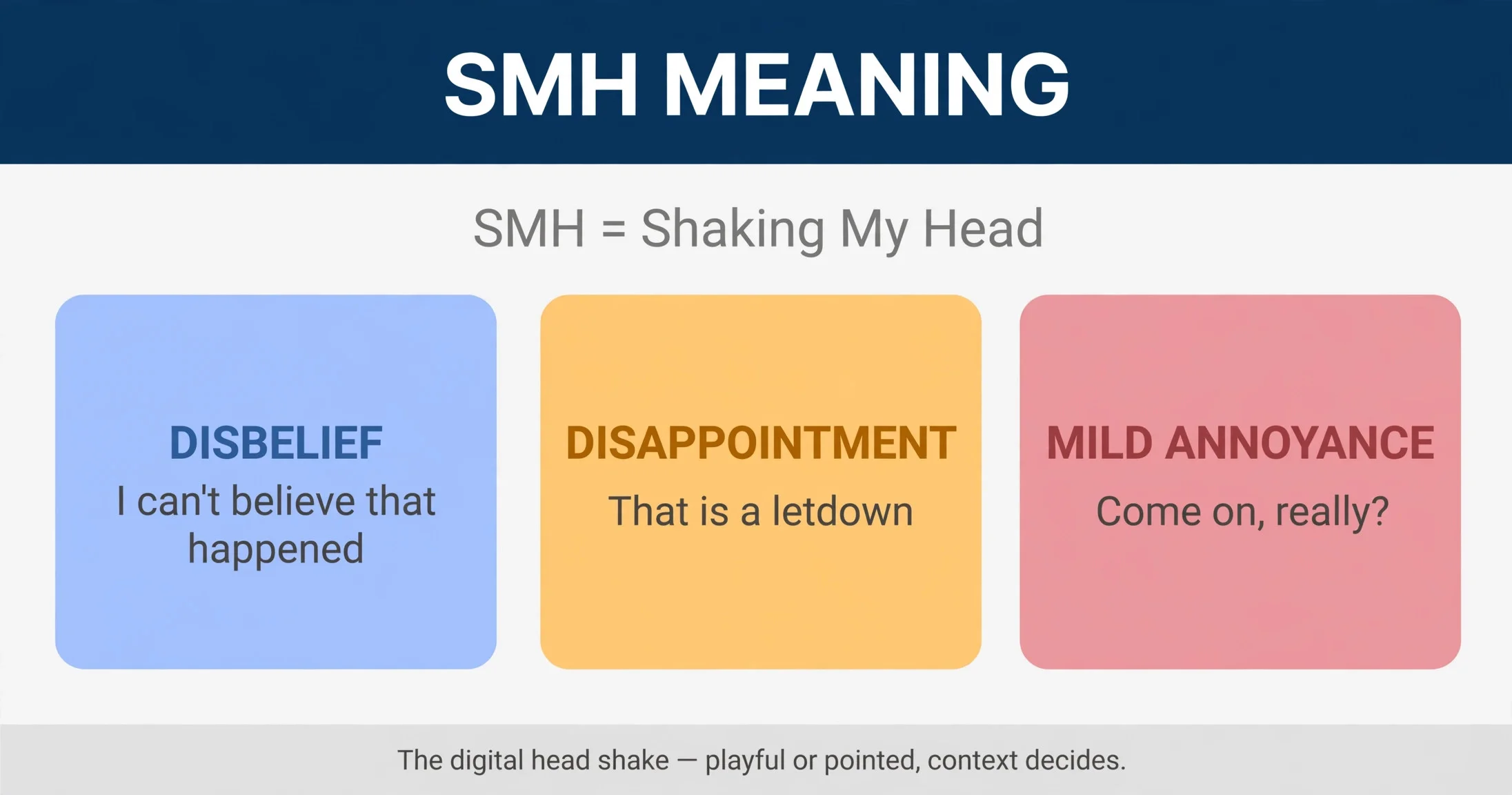
SMH means “shaking my head.” People type it in texts, comments, and chats when something feels so silly, disappointing, or unbelievable that a real head shake is the only fitting reaction. In other words, it is the digital version of that slow, tired head shake you give a friend across the table.
The gesture behind it is universal. In many cultures, shaking your head from side to side signals “no,” disbelief, or “I can’t believe this.” SMH compresses that entire physical reaction into three letters, so you never have to type a full sentence. Because of that, it works as a standalone reaction — you can drop it at the end of a sentence, send it alone, or pair it with an emoji.
It is worth knowing that SMH has been around far longer than most people assume. One of the earliest Urban Dictionary entries for the term dates to February 2004, when it spread through forums and instant messaging. Grammar references agree on the definition — for instance, Quillbot’s SMH guide defines it plainly as “shaking my head,” used to show disapproval or frustration. More than two decades later, it is still going strong on TikTok, X, and WhatsApp — a rare survivor in the fast-churn world of internet slang.
The Three Feelings Behind Every SMH
Nearly every SMH you encounter traces back to one of three feelings. Learning to tell them apart is the fastest way to read the smh meaning in text correctly, because the same three letters can carry very different emotional weight depending on which feeling is driving them.
Disbelief: “I Cannot Believe That Just Happened”
This is the most common driver. Someone shares a fact so absurd, surprising, or illogical that the only response is a head shake. For example, a friend texts, “He said the Wi-Fi bill is somehow $400 this month,” and you reply, “SMH.” Nothing hostile is happening here — you are simply registering that reality has outdone itself.
Disbelief-driven SMH often comes with laughing emojis or exclamation marks, which soften it further. When you see “smh 😂” or “SMH, that’s wild,” the sender is amused more than upset. As a result, this is the safest and friendliest version of the three.
Disappointment: “That Is a Letdown”
The second feeling is quieter. Disappointment SMH shows up when something falls short of expectations — a canceled plan, a bad decision by someone you like, news that stings a little. For instance: “They postponed the concert again. SMH.” The tone here is heavier, closer to a sigh than a laugh.
You can usually spot this version by what surrounds it. There are fewer emojis, the sentences are shorter, and the topic is something the sender actually cared about. Consequently, this SMH deserves a gentler reply — which we will cover in the reply playbook later.
Mild Annoyance: “Come On, Really?”
The third feeling sits between the other two. Mild-annoyance SMH reacts to small frustrations: a store charging $8 for a dozen eggs, a friend forgetting their keys for the third time, traffic that makes no sense. It is the textual equivalent of an eye roll — irritated, but not angry.
Context is everything here. “Left my windows down and it’s raining. SMH” is self-directed and harmless. “You forgot. Again. SMH” is aimed at someone, and it stings a little. Therefore, before you use SMH yourself, it helps to check which direction it is pointing — a distinction we will unpack in its own section.
How to Read the SMH Meaning in Any Message
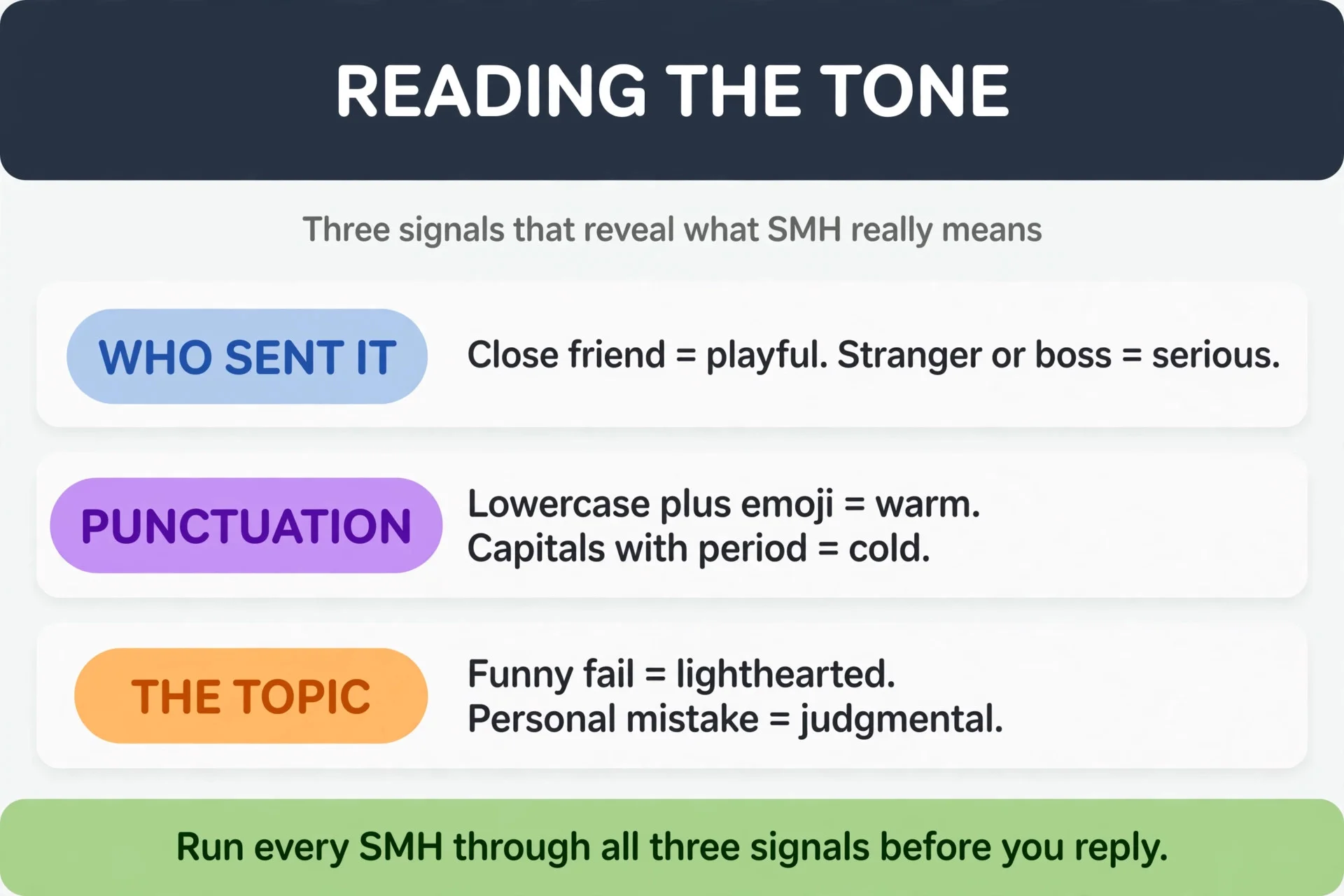
Here is the practical skill most guides skip: decoding tone. Because SMH can be playful, disappointed, or judgmental, you need a quick test. Run every SMH through these three signals, and you will read it correctly in seconds.
Signal 1: Who Sent It and Your History With Them
Relationship is the strongest clue. A best friend who sends “smh” after your goofy story is almost certainly teasing you affectionately. Meanwhile, the same message from a coworker you barely know, or someone you argued with yesterday, carries real edge.
As a rule of thumb, the closer the relationship, the lighter the SMH. Close friends have earned the right to head-shake at each other. Strangers, supervisors, and new acquaintances have not — so if SMH arrives from one of them, take it more seriously.
Signal 2: Punctuation, Capitalization, and Formatting
Tiny formatting choices change everything. Compare these:
- Lowercase plus emoji (“smh 😂”) reads as playful and warm.
- Capitals with a hard period (“SMH.”) read as cold and final.
- Trailing dots (“smh…”) suggest tired resignation, like a long sigh.
- Capitals with exclamation marks (“SMH!!!”) usually signal amused disbelief, not anger.
In short, lowercase and emojis soften SMH, while capitals and periods harden it. This pattern holds across most texting slang, so it is a reliable habit to build.
Signal 3: What the SMH Is Reacting To
Finally, look at the topic itself. SMH reacting to a silly meme, a typo, or a funny fail is obviously lighthearted. On the other hand, SMH reacting to a personal mistake you made, a sensitive topic, or someone’s appearance leans judgmental.
Ask yourself one question: “Would a reasonable person laugh about this, or feel stung by it?” Your gut answer is usually right. When the topic is trivial, the SMH is trivial. When the topic is personal, the SMH is personal.
SMH at Yourself vs SMH at Someone Else
This distinction deserves its own section because it changes the entire meaning. SMH pointed inward and SMH pointed outward are practically two different expressions.
Pointing it at yourself is self-deprecating and warm. “I just waved at someone who wasn’t waving at me. SMH.” Nobody reads this as hostile — it is you laughing at your own blunder, inviting the other person to laugh along. In fact, self-directed SMH is one of the most likable uses of the term, because it shows you do not take yourself too seriously.
Aiming it at someone else is where the judgment lives. “He wore sandals to the interview. SMH.” Even when it is funny, there is a target, and the target can feel it. This version is fine among close friends who roast each other, but it lands badly with acquaintances, in group chats where the target is present, or anywhere the power dynamic is uneven.
The practical takeaway is simple: aim SMH at yourself freely, aim it at close friends carefully, and aim it at anyone else rarely or never. That single habit will keep you out of nearly every SMH misunderstanding.
SMH Meaning Across Platforms
The core smh meaning in text stays the same everywhere, but each platform flavors it slightly differently. Knowing the local dialect helps you use it naturally and read others accurately.
TikTok and X (Twitter): Playful and Performative
On TikTok, SMH lives in comments under fail videos, absurd skits, and “storytime” disasters. It is almost always playful here — “Bro tried to parallel park for 10 minutes… smh 😭” — and it often piles up in threads where everyone is riffing on the same joke.
On X, the tone skews more sarcastic and critical. “Politicians arguing about the same thing again… smh” is classic X usage: weary, judgmental, aimed at public figures rather than friends. Because posts are public, X users also deploy SMH as a compact way to signal which side they are on without writing an essay.
Instagram and Snapchat: Dramatic and Personal
Instagram SMH shows up in story replies, comment sections, and captions — often with dramatic flair. “She posted another 5-minute rant. SMH 🙄” carries more theatrical annoyance than the same message would on TikTok. The visual nature of Instagram means SMH frequently accompanies screenshots and memes, where it functions as a caption-length reaction.
Snapchat usage is the most casual of all. Because snaps disappear, people use SMH loosely and quickly — a rapid-fire reaction to whatever their friends just sent. Lowercase “smh” dominates here, and it is rarely meant harshly.
Reddit and WhatsApp: Context Is King
Reddit’s SMH is community-flavored. “OP didn’t read the rules before posting. Smh” is mild, communal frustration — the digital equivalent of a collective sigh. Each subreddit has its own tolerance level, so lurk before you SMH in a new community.
WhatsApp is where SMH gets most personal, because the chats are private and the relationships are real. Family groups, friend circles, and couples all use it — which means misreads hurt more here. A good habit on WhatsApp: if the SMH could sting, add an emoji or a follow-up line to make your tone unmistakable.
The SMH Intensifier Ladder: SMH vs SMDH vs SMFH
SMH has stronger cousins, and mixing them up is a common mistake. Think of them as rungs on an intensity ladder — each step up adds force, and the top rungs are not safe for polite company.
SMH (shaking my head) is the base level. Mild, versatile, and acceptable in most casual contexts. This is the one to default to.
SMDH (shaking my damn head) is one notch stronger. The added word turns up the frustration from “mildly annoyed” to “genuinely fed up.” It is still common among friends, but the mild profanity means you should keep it out of work chats, family groups with elders, and any conversation where you want to stay polished.
SMFH goes further still, using a much stronger profanity in place of “damn.” At this point the head-shake is gone and raw anger has taken over. Because of the explicit language, it is never appropriate at work, with strangers, or around kids. Many people also find it aggressive even among friends, so treat it as a high-risk option.
The ladder matters because people escalate without thinking. If a plain SMH already feels borderline in a given chat, climbing to SMDH will not help — it will only make the message harsher. When in doubt, stay on the bottom rung.
When Not to Use SMH
SMH is casual slang, and casual slang has boundaries. Here are the situations where it does not belong, no matter how tempting it feels.
At Work and in Professional Messages
This is the biggest one. Dropping “smh” in a message to your manager, a client, or a hiring manager reads as dismissive and unprofessional — even if you meant it lightly. Workplace communication has no reliable tone decoder, so the reader will assume the harshest version. If a work situation frustrates you, write the frustration out properly or save it for friends.
In Formal Writing
Essays, applications, official emails, and published work are no place for SMH. It instantly lowers the register of your writing and signals to the reader that you are not taking the format seriously. There is always a plain-English alternative: “That is disappointing,” or “I find that hard to believe.”
With Strangers and New Acquaintances
SMH presumes a level of comfort you have not earned yet with someone new. A stranger who receives “smh” from you has no shared history to soften it, so they will read the judgmental version by default. Wait until the relationship is warm before you head-shake at each other.
Around Serious or Sensitive Topics
SMH trivializes whatever it touches. Using it about someone’s grief, health problems, financial trouble, or any genuinely painful situation comes across as cruel — even if you only meant “that’s unfortunate.” Serious topics deserve real words, not three-letter reactions.
How to Reply When Someone Sends You SMH
Getting an SMH can feel like a tiny judgment landing on your phone. What you send back depends entirely on which version you received — so run the three-signal tone test first, then pick your lane.
If It Was Playful
When a friend SMHs your funny fail, play along. The best replies keep the joke rolling:
- “I know, I know 😅”
- “Don’t shake too hard, you’ll hurt yourself”
- “It gets worse — wait for part two”
Humor defuses everything here. Moreover, matching their light energy shows you are secure enough to laugh at yourself, which most people find genuinely charming.
If It Was Disappointed
When the SMH carries real disappointment — a canceled plan, a letdown, a mistake you made — acknowledge it directly. A short, honest reply beats a defensive one every time:
- “Yeah, fair. My bad on that.”
- “I know, I’m annoyed about it too.”
- “You’re right, I’ll sort it out.”
The key is validation. The sender’s head-shake is really saying “this bothers me,” so showing that you hear it resolves the moment faster than any joke could.
If It Was Aimed at You Harshly
Sometimes SMH arrives with genuine edge — cold capitals, a hard period, a sensitive topic. In that case, do not fire back with your own SMH. Escalation turns a three-letter reaction into a real argument.
Instead, address the underlying issue calmly: “Seems like that bothered you — what’s up?” If the conversation is already heated, it is perfectly fine to step back and reply later. No reply is always better than a reply you will regret.
Common Mistakes With the SMH Meaning
Even people who use SMH daily get tripped up by these three mistakes. Fix them and your smh meaning accuracy goes from decent to flawless.
Mistake 1: The “So Much Hate” Mix-Up
Once in a while, SMH means “so much hate” instead of “shaking my head.” This usage is rare — Dictionary.com notes it, but you will encounter it far less often than the standard meaning. Context almost always settles it: “SMH in this fandom” might mean hate, while “SMH at my own typo” obviously means head-shaking. When in doubt, assume “shaking my head,” because that is the dominant meaning by an enormous margin.
Mistake 2: Reading Every SMH as Anger
Beginners often treat SMH like a fight-starter, but most real-world SMH is closer to an eye roll than an insult. If your friend sends “smh” about a meme, they are not furious — they are entertained. Reserve the serious reading for cold formatting, sensitive topics, or strained relationships, and you will misread it far less often.
Mistake 3: Using It Up the Chain
SMH flows downward and sideways in relationships — toward yourself, friends, and peers — but almost never safely upward. Sending it to a boss, teacher, elder, or client flips the power dynamic rudely, regardless of intent. Keep it lateral, and you will never have to apologize for three letters.
Frequently Asked Questions
Is SMH considered rude?
It depends on context, not the letters themselves. Among close friends, SMH is usually playful and harmless. With strangers, at work, or about sensitive topics, it reads as dismissive or judgmental. The relationship and the topic decide — not the acronym.
What is the difference between SMH and the facepalm emoji?
They express the same feeling, but SMH is slightly more verbal and deliberate, while the facepalm emoji (🤦) is more visual and exaggerated. In practice they are interchangeable. Some people prefer SMH in text-heavy chats and the emoji in visual ones like Instagram.
Can I use SMH in a professional email?
No. Even a lighthearted SMH looks dismissive in professional writing because email strips away tone cues. Write out what you mean instead — “That’s disappointing” or “I find that surprising” — and save SMH for friends.
Why do some people write “smh” in lowercase?
Lowercase “smh” feels softer and more casual than “SMH.” Many people use capitals for emphasis and lowercase for everyday reactions. So “smh” usually signals the playful version, while “SMH” can signal stronger feeling — though this is a tendency, not a rule.
What should I say instead of SMH at work?
Try plain, professional alternatives: “That’s frustrating,” “I see — that’s disappointing,” or “Hmm, that’s surprising.” These convey the same reaction without the slang, and none of them risk sounding flippant to a manager or client.

Conclusion
The smh meaning is simple — “shaking my head” — but using it well is a small social skill. It can be the warmest reaction in a friend chat or the coldest line in a tense one, and the difference comes down to three things: who you are talking to, how you format it, and what it is reacting to.
Keep it aimed at yourself and close friends, keep it out of work and formal writing, and run every incoming SMH through the three-signal tone test before you react. Do that, and those three little letters will never cause you trouble again.
If you enjoy decoding texting shorthand, the WYD meaning in text guide breaks down another three-letter reaction you see everywhere — and how to answer it without overthinking.