

If you have ever received a one-word reply and wondered about the ofc meaning in text, you are not alone. OFC pops up everywhere in digital conversations — WhatsApp chats, Snapchat streaks, TikTok comments, Discord servers, Instagram DMs, and gaming lobbies — and most people learn it the same way you just did: by seeing it and guessing.
At its simplest, OFC stands for “of course.” However, those three letters carry more weight than a quick yes. For instance, they can sound warm and supportive, dryly sarcastic, or emphatically obvious depending on punctuation, emojis, and context. As a result, this guide explains exactly what OFC signals, how to read its tone in seconds, when to use it yourself, and when to leave it out entirely.
Did someone just reply “ofc” and you are unsure how to take it? Are you wondering whether it sounds polite, rude, or completely neutral? Or maybe you want to know the difference between the texting OFC and the fanfiction OFC before using one yourself. Fortunately, you will find clear answers below, with real conversation examples you can actually picture.
OFC Meaning: The Direct Answer
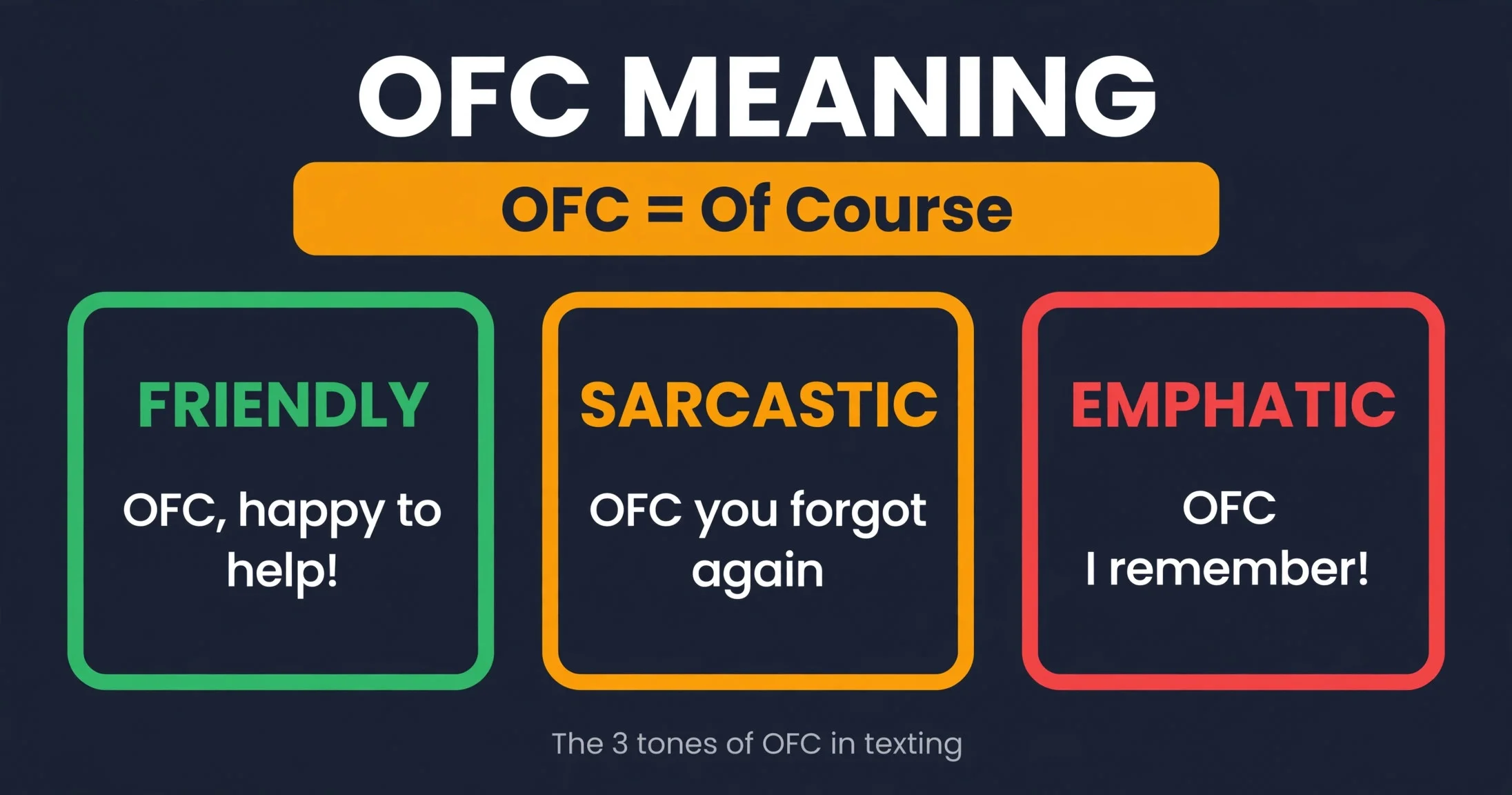
OFC is an initialism that most commonly stands for “of course” in texting and online messaging. In other words, people use it as a fast, casual way to agree, confirm, or reassure someone — the digital equivalent of nodding and saying “absolutely.” Instead of typing out the full phrase, a texter drops those three letters and keeps the conversation moving.
Think of OFC as shorthand for a whole family of responses: yes, definitely, absolutely, certainly, obviously, sure, no problem, without question. Naturally, the exact flavor depends on the conversation, but the core job is always the same — it confirms something quickly and casually.
Here is the ofc meaning in its simplest form:
- – OFC → “Of Course”
- – OFC in texting → a quick way to agree or confirm
- – OFC in chat and social media → friendly, casual, and efficient
For example, a typical exchange looks like this. Your friend texts, “Are you coming to the game tonight?” You reply, “OFC, I wouldn’t miss it!” Nobody pauses to decode it. In fact, the meaning lands instantly because OFC has become one of the most universal abbreviations in modern texting — right up there with LOL, BRB, and OMG. Clearly, that kind of instant recognition is exactly why the abbreviation stuck.
Why OFC Became So Popular
OFC rose with early SMS culture in the 2000s, when character limits and tiny keyboards rewarded every saved keystroke. Since “of course” is a phrase people type constantly, compressing it to three letters was inevitable. As texting moved to smartphones, instant messaging apps, and social media comments, OFC came along for the ride.
Today the ofc abbreviation shows up far beyond SMS. For instance, you will see it in TikTok comments, Reddit threads, YouTube replies, Twitter conversations, workplace Slack channels, and Discord servers. It survived because it fills a genuine need: a faster way to say yes that still sounds human. Unlike some slang that burns out in a year, OFC has stayed relevant for two decades because agreement never goes out of style.
What OFC Does Not Mean
Slang abbreviations sometimes sprout random new meanings, but OFC is unusually stable. In texting, it almost always means “of course.” Still, it does not commonly mean “office,” “official,” “offer,” or “online fan club” — if someone uses it that way, that meaning belongs to their specific group, not to the wider internet.
Meanwhile, the one genuine alternate meaning worth knowing is “original female character,” used in fanfiction communities. We will cover that separately below so you never mix the two up.
The 3 Tones of OFC: Friendly, Sarcastic, and Emphatic
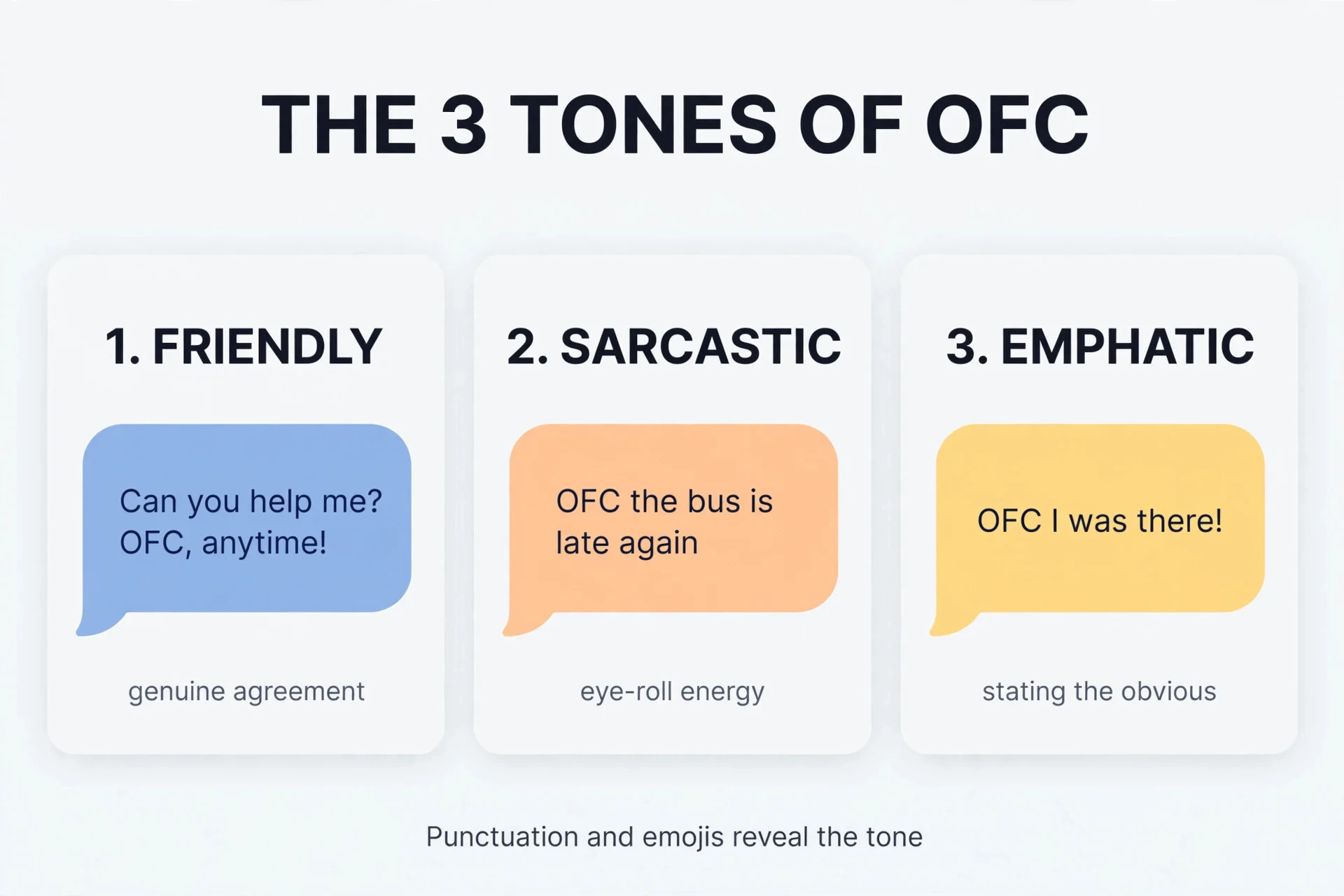
Here is what most short guides miss: OFC is not one flat meaning. In fact, the same three letters carry three distinct tones, and reading the wrong one can completely change a conversation. Fortunately, the tone is almost always visible in the punctuation, emojis, and surrounding words. Once you know the three tones, you will decode OFC in seconds.
1. Friendly OFC: Genuine Agreement
This is the default tone and by far the most common. In general, friendly OFC sounds warm, supportive, and willing. It usually comes with positive punctuation — an exclamation mark, a smiley, or just a clean sentence.
- – “Can you help me with this?” → “OFC, happy to help!”
- – “Will you join us tonight?” → “OFC!”
- – “Thanks for covering my shift.” → “OFC, anytime.”
Notice the pattern: the sender is agreeing to something and feels good about it. As a result, friendly OFC is the tone you want when you use it yourself — it makes you sound approachable and reliable.
2. Sarcastic OFC: The Eye-Roll
By contrast, sarcastic OFC means the literal opposite of agreement. It shows up when something predictable, annoying, or absurd happens, and the sender is commenting on it with dry humor. Typically, the tell-tale signs are flat punctuation, eye-roll emojis, or an obviously unfortunate situation.
- – “OFC the bus is late again.”
- – “OFC you forgot your keys.”
- – “OFC it started raining the moment we left.”
Read these with a deadpan voice in your head and the meaning clicks. In most cases, sarcastic OFC is rarely mean-spirited between friends — it is closer to a shared sigh than an insult. However, with strangers, the same message can read as passive-aggressive, so context and relationship matter enormously.
3. Emphatic OFC: Stating the Obvious
Emphatic OFC lands somewhere between confident and exasperated. In this tone, the sender is saying “of course” with extra force, as if the answer should have been obvious. Meanwhile, capitalization, exclamation marks, and short sentences amplify it.
- – “Did you finish the project?” → “OFC I did!”
- – “Do you remember her?” → “OFC I remember!”
- – “OFC that’s what I meant.”
There is also a vulgar emphatic variant where the F stands for an expletive — “of f***ing course.” You will see competitors mention it, and it is real, but it is best treated as something to recognize rather than repeat. At times it adds raw emphasis, sometimes humorous among close friends, sometimes genuinely frustrated. Because it carries profanity, keep it out of any message that matters.
How to Tell the Tone in Seconds
When you receive an OFC and feel unsure, run this three-second check. First, look at the punctuation: exclamation marks lean friendly or emphatic, flat periods lean sarcastic. Next, check for emojis: smileys warm it up, eye-rolls flip it. Finally, read the situation: is the sender agreeing to something good, or commenting on something going wrong? Together, those three signals reveal the tone almost every time.
OFC Meaning in Text vs. Other Meanings
OFC is a busy little abbreviation. While “of course” dominates texting, a few other meanings exist in specific corners of the internet and professional life. Therefore, knowing them prevents the rare but real mix-up.
The Fanfiction OFC: Original Female Character
In fanfiction and fandom communities, OFC stands for “original female character” — a character invented by the writer rather than borrowed from the original story. Indeed, this meaning is genuinely common in its niche. Writing guides, including ProWritingAid’s OFC breakdown, list it as one of the two meanings you are most likely to encounter.
Fortunately, you will almost never confuse the two in practice because the contexts barely overlap. For example, if your writer friend asks for feedback on “my OFC,” they mean their character. On the other hand, if a friend texts “OFC!” after you invite them somewhere, they mean “of course.” The surrounding conversation makes it obvious — just apply the context test: is anyone writing fiction here?
Formal and Professional OFCs
Outside casual conversation, OFC belongs to several formal terms: offshore financial centre (banking), orbitofrontal cortex (neuroscience), open-ended fund company (Hong Kong finance law), and Oceania Football Confederation (sports). These live in professional and academic contexts where nobody is texting casually. Consequently, if you encounter OFC in a finance article or a medical paper, the formal meaning applies — but that is a different world from the texting abbreviation this guide covers.
Where You Will See OFC Most: Platform Guide
OFC wears slightly different clothes on different platforms. Although the meaning stays “of course,” the flavor shifts with each app’s culture.
Snapchat and Instagram DMs
On Snapchat and Instagram, OFC is quick-fire agreement between friends. Since snaps move fast, replies shrink to the bone: “OFC,” “ofc!!,” “ofccc.” The extra letters are enthusiasm, not a typo — stretching the word is how texting shows excitement. Here OFC is almost always friendly.
TikTok and YouTube Comments
In comment sections, OFC often carries the sarcastic or emphatic tone. For instance: “OFC this blew up” under a viral video, or “OFC the algorithm hid this” under a struggling creator’s post. Because comments are public performances, the tone skews punchier than private chats.
Discord and Gaming Chats
Gaming moves at full speed, and OFC keeps up. “OFC we clutch this,” “ofc he camps mid” — here it confirms plans or states the obvious mid-match. Usually the tone is emphatic and team-oriented. After all, nobody has time for full sentences between rounds.
WhatsApp and Everyday Texting
In WhatsApp and SMS, OFC does its original job: fast, friendly confirmation. “OFC, I’ll bring snacks.” “OFC, no worries.” Above all, this is the home turf of the abbreviation — the place where its warm, reliable tone feels most natural.
How to Use OFC Naturally in Your Own Messages
Using OFC well is less about the letters and more about the landing. The abbreviation is simple; however, the social calibration around it is what separates a natural texter from an awkward one. Fortunately, these patterns will make your OFC sound effortless.
When Someone Asks for a Favor
This is OFC’s happiest home. A quick, warm confirmation makes you sound reliable without overthinking it.
- – “Can you send me those notes?” → “OFC, sending now.”
- – “Could you cover for me Friday?” → “OFC, I got you.”
- – “Mind if I borrow your charger?” → “OFC, take it.”
To begin with, add a small follow-through detail (“sending now,” “I got you”) and the reply feels complete rather than curt. A bare “OFC” works between close friends, but one extra clause warms it up for everyone else.
When Confirming Plans
In fact, plans run on confirmation, and OFC is the fastest confirm there is.
- – “We’re meeting at seven, right?” → “OFC, see you there.”
- – “You’re still coming to the party?” → “OFC, wouldn’t miss it!”
- – “Same place as last time?” → “OFC.”
Notice how naturally the exclamation mark fits here. Since confirming plans is inherently positive, the friendly tone comes free.
When Reassuring Someone
OFC shines as reassurance because “of course” is inherently comforting — in other words, it tells the other person their request was never a burden.
- – “Sorry to bother you…” → “OFC, you’re never a bother.”
- – “Are you sure it’s okay?” → “OFC it’s okay!”
- – “Thanks so much for helping.” → “OFC, anytime.”
This is the tone that builds friendships. A well-placed OFC here says “I am glad you asked” in three letters.
The Capitalization Trick
Lowercase “ofc” reads softer and more casual than uppercase “OFC.” For instance, compare “ofc, no worries” with “OFC, NO WORRIES.” The first feels like a shrug and a smile; the second feels like a declaration. Still, most everyday texting uses lowercase. Save the capitals for genuine emphasis — or expect to sound intense.
How to Reply When Someone Sends You OFC
Receiving OFC is easy; however, responding well keeps the conversation flowing. Therefore, match your reply to the tone you detected.
If the OFC Was Friendly
A friendly OFC deserves a warm acknowledgment. Keep it short and move on.
- – They say: “OFC, happy to help!” → You say: “You’re the best!”
- – They say: “OFC I’m in!” → You say: “Yesss, it’s going to be great.”
- – They say: “OFC, anytime.” → You say: “Thanks again!”
If the OFC Was Sarcastic
In this case, sarcastic OFC is an invitation to laugh together, not a problem to solve. So play along lightly.
- – They say: “OFC the wifi died during the match.” → You say: “LOL classic.”
- – They say: “OFC you’d say that” → You say: “You know me too well.”
Above all, do not get defensive. The sender is venting about the situation, not attacking you — treating it as shared humor keeps things smooth.
If the OFC Was Emphatic
Since emphatic OFC means the sender feels strongly, acknowledge the feeling, not just the words.
- – They say: “OFC I remember!” → You say: “Haha sorry, just checking!”
- – They say: “OFC that’s what I meant.” → You say: “Got it, my bad.”
A tiny bit of humility defuses the intensity. On the other hand, arguing with an emphatic OFC (“well, it wasn’t obvious to me”) turns a small moment into a real disagreement.
When NOT to Use OFC
OFC is a casual tool, and casual tools break in formal settings. Consequently, knowing where it does not belong matters as much as knowing where it does.
At Work and in Professional Messages
First of all, do not use OFC with your boss, clients, or in anything that might be forwarded. “OFC, I’ll have the report ready” reads as flippant in a professional inbox, even if you mean it warmly. Instead, spell it out: “Of course, I’ll have the report ready.” Those extra keystrokes buy you credibility.
That said, the one exception is a genuinely casual team chat where everyone already uses slang. Even then, read the room — if your manager writes in full sentences, match that energy.
With Elders and Formal Acquaintances
Many older relatives and formal acquaintances do not know texting abbreviations, and OFC will simply confuse them. Worse, it can look dismissive to someone expecting a real answer. Therefore, with grandparents, teachers, or anyone you address formally, write the full phrase.
In Serious or Sensitive Conversations
When someone shares bad news, asks something vulnerable, or discusses something important, OFC feels too light. For example, “My interview went badly” → “OFC you’ll get the next one” lands wrong. In serious moments, people deserve full sentences and real attention, not shorthand.
When the Tone Could Be Misread
Texting strips away facial expressions and vocal tone. As a result, if your relationship with the recipient is new, fragile, or purely professional, a bare “OFC” can read as curt or sarcastic when you meant friendly. When in doubt, add warmth: “OFC! Happy to help” leaves no room for misreading.
OFC vs Similar Slang: Picking the Right Shortcut
OFC lives in a crowded neighborhood of agreement slang. However, each one does a slightly different job, and mixing them up blunts your meaning.
| Short Form | Stands For | What It Signals |
|---|---|---|
| OFC | Of course | Confirms or agrees — “yes, obviously” |
| FR | For real | Emphasizes truth — “I’m serious” |
| IKR | I know, right? | Agrees with excitement — “exactly!” |
| OMG | Oh my god | Shows surprise — “wow” |
| IDC | I don’t care | Shrugs off — neutral to rude |
The practical difference is simple: OFC answers a question or confirms a plan, while FR backs up a statement’s truth. When someone asks “Are you coming?”, the natural reply is “OFC.” But when someone declares “This movie was amazing,” the better response is “FR, so good.” Meanwhile, IKR adds shared excitement that OFC lacks — hearing “This traffic is unreal” calls for “IKR?!” In short, use OFC when someone needs a yes; reach for the others when you need surprise, emphasis, or shared feeling.
For a deeper look at another agreement-adjacent shortcut, see our guide to wyd meaning in text, which covers a slang term that opens conversations rather than confirming them.
Getting the OFC Meaning Wrong: Common Mistakes
Even a simple abbreviation has its traps. Below are the mistakes people actually make.
Using OFC as a Complete Personality
Some texters answer everything with “OFC” and nothing else. At first it works; by the fifth time, however, it reads as disinterested. Think of OFC as a seasoning, not the whole meal — pair it with real sentences most of the time.
Dropping OFC Into Formal Writing
Essays, job applications, cover letters, official emails — OFC has no business in any of them. This sounds obvious, but autocorrect-era thumbs have slipped slang into serious documents before. Therefore, keep a hard line between chat language and formal language.
Assuming Everyone Knows It
OFC feels universal if you live online, but plenty of people — especially older or less digitally immersed — have never seen it. Consequently, if your recipient might not know it, the three seconds you save are not worth their confusion. When texting outside your usual circle, default to the full phrase.
Confusing the Fanfiction OFC
If you wander into a writing community and someone mentions their OFC, do not reply as if they said “of course.” Instead, run a quick context check — are these people discussing stories and characters? — to prevent an embarrassing mix-up in both directions.
Reading Every OFC as Sarcasm
Newcomers sometimes assume OFC is always snarky because they first met it in a sarcastic meme. In reality, however, the friendly tone is far more common. So default to the warm reading unless the punctuation, emojis, or situation clearly point elsewhere.
Frequently Asked Questions
Is OFC the same as “ofc” in lowercase?
Yes, the meaning is identical — only the tone shifts slightly. In general, lowercase “ofc” feels softer and more casual, while uppercase “OFC” feels more emphatic or deliberate. Most everyday texting uses lowercase, and neither version is more “correct” than the other.
Can OFC be used platonically between friends?
Absolutely — that is its most common use. For instance, friends use OFC dozens of times a day for favors, plans, and reassurance with zero romantic undertone. Like most slang, any flirty reading comes from the surrounding conversation, not from the letters themselves.
What is the difference between OFC and “obviously”?
They overlap heavily, but “obviously” can sound condescending in a way OFC rarely does. For example, “OFC, I’ll help” feels warm; “Obviously, I’ll help” can feel like an eye-roll. In other words, OFC’s casualness is actually its politeness shield.
Does OFC have an official dictionary entry?
Major dictionaries now document internet abbreviations as part of modern English, and Merriam-Webster has noted that texting abbreviations are a recognized part of informal communication. As a result, OFC’s decades of continuous use make it one of the most established examples.
Why do some people write “ofcc” or “ofccc”?
Extra letters are typed enthusiasm — the texting equivalent of stretching a word when you speak. In other words, “Ofccc!” means the same as “OFC!” but with more energy. It is deliberate, not a typo, and common among younger texters.

Conclusion
The ofc meaning in text is simple on the surface — “of course” — but genuinely useful once you see its layers. It confirms, agrees, and reassures in three letters; it shifts between friendly, sarcastic, and emphatic with nothing but punctuation and context; and it stays firmly in the casual zone where it belongs.
The practical takeaway is straightforward. First, use OFC freely with friends for favors, plans, and reassurance — that is its home turf. Next, read the tone before you react when you receive one — the punctuation tells you everything. Finally, keep it out of work messages, formal writing, and serious conversations, where the full phrase earns its keep.
Master those three habits, and OFC becomes what it was always meant to be: the fastest warm yes in texting. For more on how slang shapes digital conversations, ProWritingAid’s OFC meaning guide offers a solid second perspective from a language-focused publisher.