

If you have ever received a text that simply says “What’s your ETA?” and paused for a second, you are in good company. The eta meaning in text is one of those abbreviations that everyone else seems to understand instantly — until someone finally explains it to you in ten seconds flat.
ETA is short, practical, and everywhere: text messages, work chats, delivery apps, airport screens. Yet most people only learn half of it — the definition — and miss the part that actually matters: how to use it without confusing anyone.
Are you wondering what ETA stands for? Are you unsure whether it is okay to use it with your boss? Do you want to know the best way to answer when someone asks for yours? This guide walks you through the eta meaning step by step — what it is, where it shows up, how to use it well, and the mistakes worth avoiding.
ETA Meaning: The Direct Answer
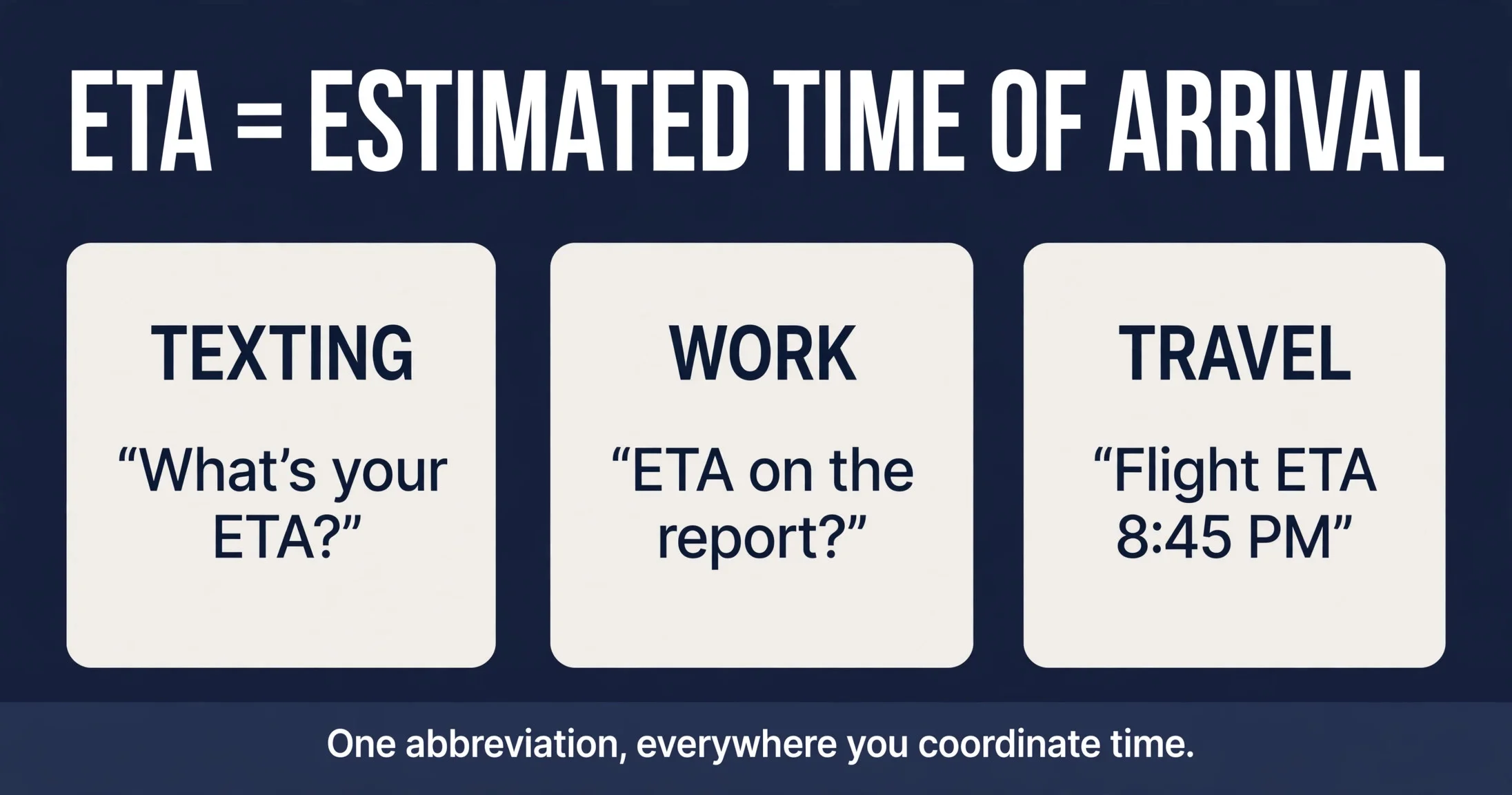
ETA stands for “Estimated Time of Arrival.” It means the time you expect someone — or something — to arrive. Not a promise. An estimate.
The most important word in that expansion is “estimated.” An ETA is your best guess based on what you know right now: the distance, the traffic, how far along the task is. Because of that, an ETA can change, and changing it is completely normal. When someone asks “What’s your ETA?”, what they really want to know is “When should I expect you?” — and they would rather have a useful answer than a perfect one.
The eta meaning is simple at its core, but the abbreviation does quiet, useful work. It turns a vague “I’ll be there soon” into something the other person can actually plan around. That is why it survived the jump from aviation radios and shipping docks all the way into your group chat. It is one of the rare abbreviations that moved from professional radio chatter into everyday texts without losing its meaning along the way.
Where You’ll See the ETA Meaning in Real Life
One reason ETA feels confusing at first is that it pops up in so many different places. The good news is that the eta meaning stays the same in every one of them: when to expect someone or something. Here are the five places you will meet it most.
In Text Messages
This is where most people encounter ETA for the first time. A friend texts “What’s your ETA?” while waiting at a restaurant, and you reply “ETA 10 mins.” It is faster than typing “I think I’ll get there in about ten minutes,” and everyone on both ends understands it. In casual texting, ETA is almost always a question about a person: when are you getting here?
In Work Chats Like Slack and Teams
At work, ETA stretches a little wider. A manager might ask “What’s the ETA on the report?” — and here it means when a task will be finished, not when a person will arrive. This usage is completely standard in professional settings. Nobody thinks twice about it, which tells you something about how deeply the abbreviation has settled into workplace language.
In Delivery and Shipping Apps
“Your driver is arriving — ETA 12:25 PM.” Food delivery apps, courier tracking pages, and online orders all show ETAs, and these update live as conditions change. This is ETA in its most literal form: a system calculating arrival from distance and speed, then adjusting the number as reality shifts.
In Travel: Flights, Rides, and Maps
Airport departure boards list flight ETAs. Ride-hailing apps show your driver’s ETA before you ever get in the car. Navigation apps display it for every route you plan. In travel, ETA is infrastructure — the number everyone from pilots to passengers organizes around.
In Gaming and Group Chats
“ETA on the next match?” Gamers and online communities use it to coordinate timing without typing full sentences. It works the same way here as everywhere else: a quick check on when something will happen so everyone can sync up.
ETA Meaning in Text vs. Work: Is It Formal or Casual?
Here is something unusual about ETA: it works in both worlds. With friends, it is casual shorthand. At work, it is standard professional language that managers use in emails and meetings without a second thought. Few abbreviations pull that off.
Still, context matters. If you are writing a formal document, a cover letter, or an email to someone you have never spoken with, spelling out “estimated time of arrival” the first time is the safer move. In a quick Slack message or a text to a colleague you know, “ETA?” on its own is completely fine.
It is also worth knowing what ETA is not. It is not flirty, not rude, and not sarcastic. The tone is neutral and functional, which is exactly why it travels so comfortably between a group chat and a boardroom. If you enjoy decoding texting abbreviations, you will find more guides like this one on MeaningSpot.
How to Answer “What’s Your ETA?”
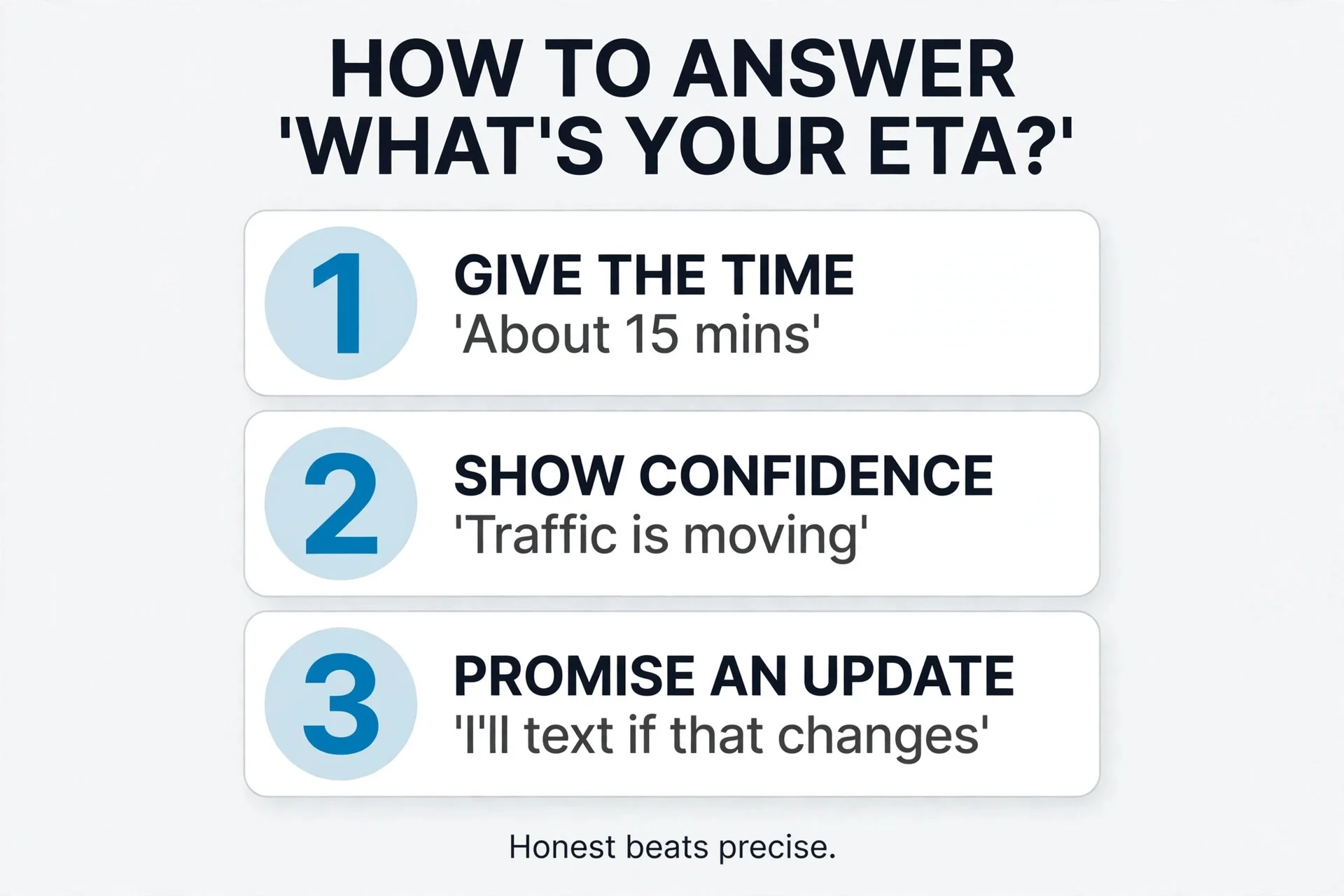
Most guides tell you what ETA means and stop there. But the real skill is answering well, because a good ETA answer builds trust and a bad one quietly destroys it. A strong answer has three parts: the time, your confidence level, and a promise to update if things change.
Answering a Friend
Keep it casual and honest: “About 15 mins — traffic’s moving, I’ll text if that changes.” Notice what this does. It gives a number, it signals why you believe it, and it removes the need for your friend to ask again. That third part is the one most people skip, and it is the most appreciated.
Answering at Work
The structure is the same; the wording gets a little more polished: “ETA is 3 PM. I’ll flag it immediately if anything slips.” At work, the update promise matters even more, because other people’s schedules depend on your number. A manager would much rather hear “ETA Thursday, will confirm Wednesday” than a confident “Wednesday!” that silently becomes Friday.
When You’re Running Late
This is where most people get ETA wrong. Do not invent precision you do not have — “ETA 7:42” when you are still on the couch helps nobody. Instead, own the delay and reset the number: “Running about 20 mins late — sorry! New ETA 7:40.” Honesty combined with a fresh estimate beats a made-up exact time every single time.
ETA Meaning vs ETD: What’s the Difference?
Sooner or later you will see ETA next to three similar letters: ETD. The difference is simple once you see it. ETA means Estimated Time of Arrival — when someone or something gets there. ETD means Estimated Time of Departure — when someone or something leaves.
| ETA | ETD | |
| Stands for | Estimated Time of Arrival | Estimated Time of Departure |
| Answers | “When will it get here?” | “When will it leave?” |
| Common in | Texts, travel, deliveries | Shipping, flights, logistics |
A memory trick that never fails: A is for Arrival, D is for Departure. In shipping and logistics, ETA has a precise technical definition — you can see it laid out in Portcast’s maritime glossary on ETA and ETD. For everyday use, though, ETA is the one you will meet ninety-nine times out of a hundred; ETD mostly lives in travel and freight contexts.
ETA Meaning Mistakes: When Not to Use It
ETA is easy to use, which means it is also easy to misuse. These are the three mistakes that cause the most confusion.
Giving Fake Precision
“ETA 7:42” sounds authoritative, but if you pulled the number from thin air, it is worse than no ETA at all. False precision sets an expectation you cannot meet, and the other person plans around a fiction. Round honestly — “about 15 minutes” from a real estimate beats “12 minutes” from a guess.
Using It Where It Confuses People
Not everyone knows the abbreviation. With grandparents, young kids, or anyone who might not text much, “ETA?” can land as gibberish. In those cases, just ask plainly: “What time do you think you’ll get here?” Matching your language to your audience is not dumbing things down; it is communicating.
Treating It as a Guarantee
An ETA is not a promise — it is a forecast. Traffic happens, tasks slip, flights delay. The mistake is not missing your ETA; the mistake is going silent when you do. Update the number the moment you know it changed, and nobody will hold the old one against you.
Other Meanings of ETA You Might Run Into
In the vast majority of conversations, ETA means Estimated Time of Arrival. But the same three letters show up in a few other places, so here is a quick map in case you meet them.
The Greek Letter Eta (η)
Eta is the seventh letter of the Greek alphabet. You will see it in mathematics, physics, and engineering contexts — never in a text about dinner plans. If the conversation is about equations rather than arrivals, this is the ETA you are looking at.
Employment and Training Administration
In U.S. government contexts, ETA stands for the Employment and Training Administration, part of the Department of Labor. You will only meet this meaning in workforce and policy documents.
“Edited to Add”
On forums and Reddit, writers sometimes add “ETA:” at the end of a post to introduce something they added after publishing. It is a niche usage, but it explains the occasional confusing comment thread.
“Exact Time of Arrival”
Some people expand ETA as “exact” instead of “estimated.” This is a common mix-up, but “estimated” is the standard expansion — and honestly, the whole point of the abbreviation is that arrival times are estimates, not certainties.
Frequently Asked Questions
Is it rude to ask someone “What’s your ETA?”
No. It is one of the most neutral questions in English — direct, practical, and free of attitude. Tone comes from context, not the abbreviation. “What’s your ETA?” with a friendly tone is perfectly polite; the same words sent coldly after a delay can feel pointed, but that is true of any question.
Can I use ETA in an email to my boss?
Yes, in most workplaces. ETA is standard business language, and managers use it themselves. For a first email to someone senior you have never met, consider writing “estimated time of arrival” once before switching to the abbreviation.
Why does my delivery app’s ETA keep changing?
Because it is a live estimate, not a schedule. The app recalculates from the driver’s current position, speed, and traffic every few seconds. A jumping ETA means the system is working — it is feeding you new information as conditions change.
Do you say each letter “E-T-A” or pronounce it as one word?
Say the letters: “E-T-A.” Unlike some abbreviations that become words, ETA is virtually always spoken letter by letter in both casual and professional settings.
What is the difference between ETA and just saying “arrival time”?
“Arrival time” sounds like a fixed fact; ETA honestly signals that the time is an estimate. That small honesty is the abbreviation’s real value — it sets the expectation that the number might move, which makes updates feel normal instead of alarming.

The Bottom Line on ETA Meaning
Now that you know the eta meaning, you can see why three small letters carry so much weight. ETA means “Estimated Time of Arrival” — and the power is all in that middle word, “estimated.” It turns a vague “soon” into information people can plan around, in texts, at work, and across every app that moves people or packages.
Use it freely, answer it honestly with a time, a confidence level, and a promise to update — and never treat it as a guarantee. Do that, and your ETA will do exactly what it was built to do: keep everyone on the same page about when things happen.