

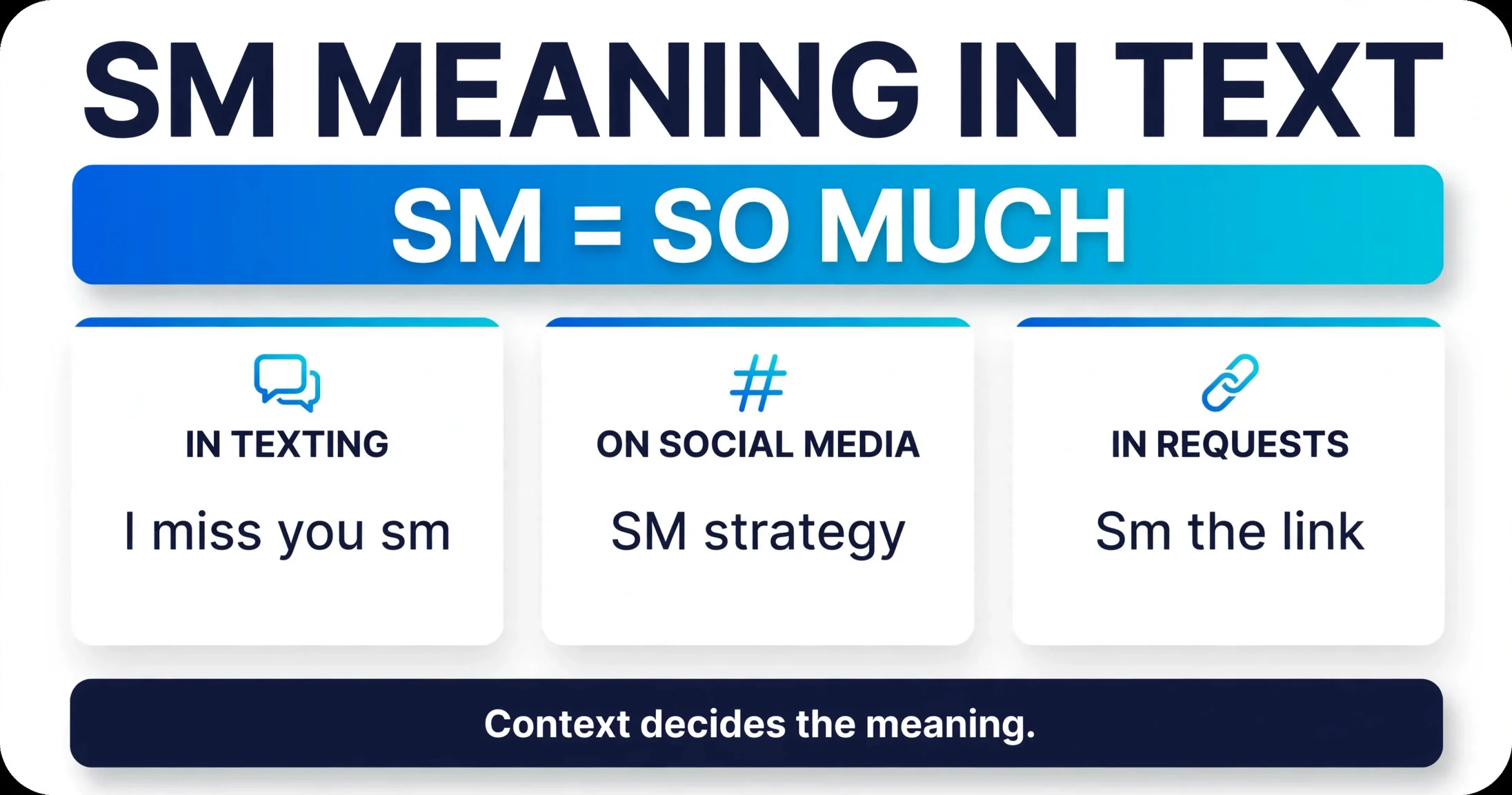
If you just received a message with “sm” in it and you’re stuck on the sm meaning text question, you’re not alone. SM is one of the most confusing abbreviations in modern texting — not because it’s rare, but because it wears so many hats. In one chat it means “so much,” in another it means “social media,” and in a third it might be a request to send something.
Did someone text you “I miss you sm” and you’re unsure what they meant? Are you seeing SM in Instagram captions and wondering if it’s the same thing? Or are you worried about using it wrong yourself? This guide walks through the real sm meaning text by texting situation, gives you a simple 3-question framework to decode it in seconds, and shows you exactly how to reply.
SM Meaning Text: The Direct Answer
Let’s start with the answer most people are looking for. In everyday texting, SM almost always means “so much.” It’s a shortcut people use to add emotion or emphasis without typing the full phrase.
For example, here are the kinds of messages where SM means “so much”:
- “I miss you sm” → I miss you so much.
- “Thanks sm for helping me out” → Thanks so much for helping me out.
- “I love this song sm” → I love this song so much.
In each case, SM works as an intensifier. It takes a feeling — missing someone, gratitude, excitement — and turns up the volume. Think of it as the texting equivalent of underlining a word. The reason the sm meaning text search is so popular is that this tiny abbreviation carries real emotional weight, and misreading it can change the whole tone of a conversation.
However, “so much” is only the beginning. SM is what linguists call a context-dependent abbreviation: its meaning shifts based on where you see it and who sent it. That’s why a single dictionary definition never feels like enough — and why the rest of this guide exists.
Why One Abbreviation Has So Many Meanings
SM didn’t start as texting slang. Dictionaries list over a dozen formal meanings for the letters SM — from “service mark” in business to “sergeant major” in the military to the chemical symbol for samarium. You can see the full range on dictionary reference pages like the Free Dictionary’s SM entry, which shows just how crowded these two letters are.
Meanwhile, texting borrowed the abbreviation and gave it a new life. Because typing fast matters in chats, “so much” got compressed to “sm.” Meanwhile, marketers shortened “social media” to “SM,” gamers and friends started using “sm” for “send me,” and K-pop fans use SM for a famous entertainment company. None of these groups coordinated with each other — they just all landed on the same two letters.
As a result, SM is genuinely ambiguous, and that’s not your fault for finding it confusing. Rather than memorizing a list, learn to read the context instead. Up next is a framework that does exactly that.
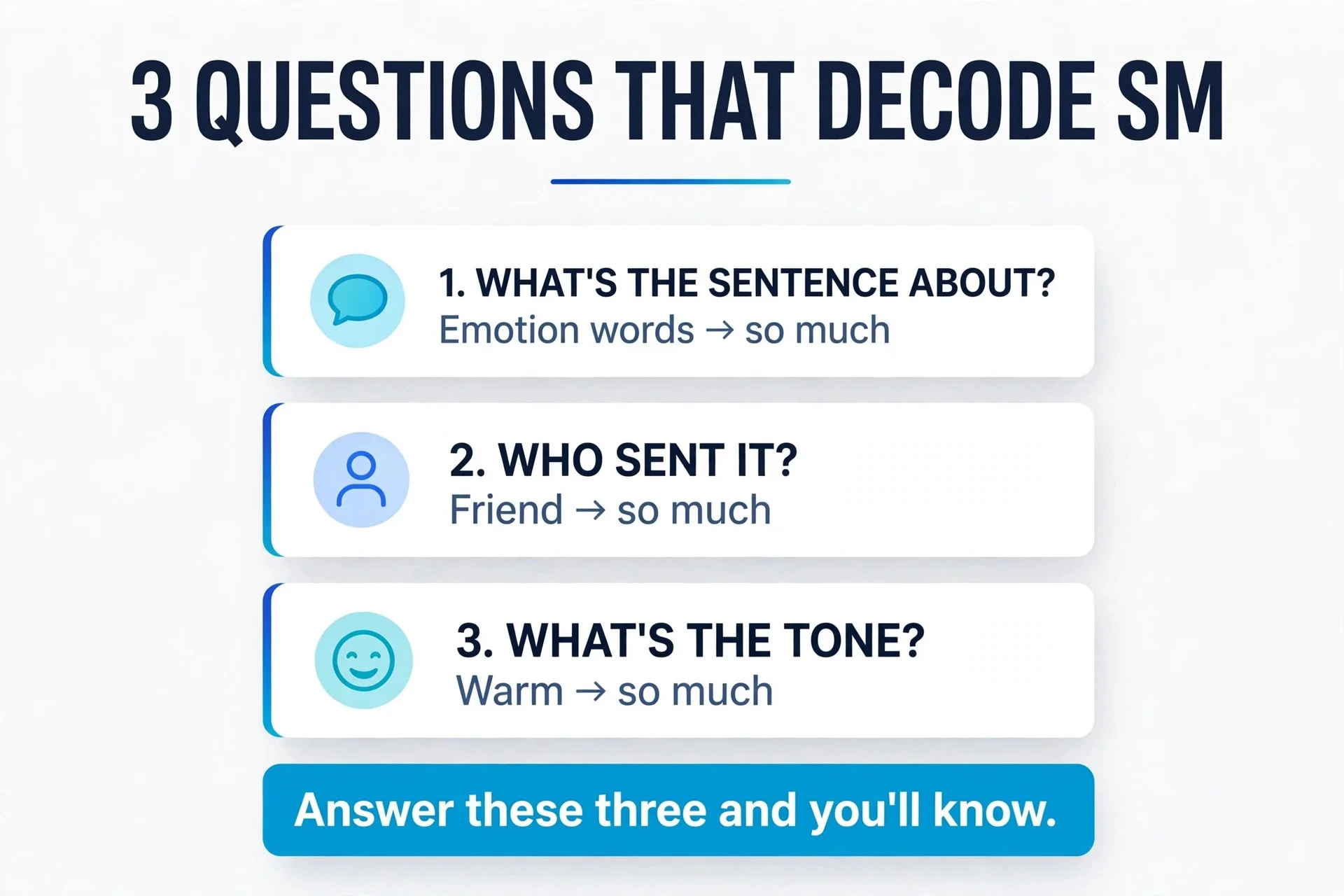
The 3-Question Framework That Decodes SM in Seconds
So instead of guessing, run any “sm” message through these three questions. In most cases, the first question alone gives you the answer.
Question 1: What Is the Sentence About?
The words around SM are your biggest clue. Look at the sentence and ask what topic it covers:
- Emotion words (miss, love, hate, thanks, care) → SM means “so much.” Example: “I hate Mondays sm.”
- Request words (send, share, drop, link, pics) → SM means “send me.” Example: “sm the address when you get it.”
- Platform or marketing words (strategy, post, growth, followers) → SM means “social media.” Example: “Our SM engagement doubled.”
- Anger words (mad, furious, annoyed, upset) → SM can mean “so mad.” Example: “I’m sm right now, don’t talk to me.”
As a result, this single question resolves the sm meaning text puzzle roughly 90% of the time. The surrounding words do the heavy lifting — SM just rides along.
Question 2: Who Sent It?
The sender narrows things further. A close friend texting late at night almost certainly means “so much.” A coworker in a marketing meeting means “social media.” A K-pop fan account on X means SM Entertainment. When the sentence alone feels ambiguous, the sender’s identity usually breaks the tie.
For example, compare “Did you see the SM announcement?” from your marketing manager versus from your friend who stans K-pop groups. Same sentence, two completely different meanings — and the sender tells you which one applies.
Question 3: What Is the Tone?
Finally, check the emotional temperature. Is the message warm, angry, professional, or playful? SM meaning “so much” shows up in warm, emotional messages. “So mad” shows up in heated ones. “Social media” shows up in neutral, professional ones. Tone is the tiebreaker when the first two questions leave any doubt.
Therefore, run a message through these three questions and you’ll decode SM faster than looking it up — and you’ll be right far more often than someone who just memorized one definition.
SM Meaning Text by Situation
Now let’s map the meanings to the places you’ll actually encounter them. Each situation below is a mini-guide to reading SM correctly there.
In Casual Texting: “So Much”
First, this is SM’s home turf. In WhatsApp, iMessage, Snapchat, and Instagram DMs between friends, partners, and family, SM means “so much” the vast majority of the time. It expresses affection, gratitude, excitement, frustration — basically any strong feeling.
For instance, here are real examples you’ll recognize:
- “That movie was sm fun” (so much fun)
- “I’m tired sm today” (so much — here it’s closer to “very”)
- “Miss u sm, call when free”
In particular, notice the pattern: SM always attaches to a feeling or an intensified statement. If you’re texting someone you care about and SM appears next to an emotion word, you can be confident about the meaning.
On Social Media: “Social Media”
On the other hand, scroll through marketing content, creator bios, or business discussions and SM flips to “social media.” You’ll see it in phrases like “SM strategy,” “SM manager,” “growing on SM,” or “taking a break from SM.”
The tell here is the topic: whenever the conversation is about platforms, posting, followers, or online presence, SM means social media. This is the dominant meaning in professional and creator contexts — and it’s the one most likely to confuse someone who only knows the texting meaning.
In Requests: “Send Me”
“Sm the link.” “Sm pics from last night.” In fast group chats — especially among friends, gamers, or coworkers sharing files — SM compresses “send me” into two letters. It’s always followed by the thing being requested, which makes it easy to spot: if SM is followed by a noun (link, pics, address, file), it’s a request.
However, one caution: this usage is very informal. Don’t use “sm” for “send me” with a boss, a client, or anyone you’re not casual with — spell it out instead.
In Gaming and Group Chats
Gaming chats move fast, so SM pulls double duty there. It can mean “so much” (“that clutch was sm good”) or “send me” (“sm the invite”). The 3-question framework handles both: check the surrounding words, and you’ll know instantly. Gaming is also where you’ll see SM mixed with other abbreviations, so reading the full sentence matters more than usual.
The K-Pop Meaning: SM Entertainment
In K-pop spaces, on the other hand, SM refers to SM Entertainment — one of South Korea’s biggest entertainment companies, home to groups like EXO, NCT, and aespa. “SM just announced a comeback” has nothing to do with texting slang. The community context makes this one obvious: if everyone around you is discussing idols and comebacks, SM is the company.
SM vs. Abbreviations People Confuse It With
In fact, part of the sm meaning text confusion comes from look-alikes. Let’s clear up the two most common mix-ups.
SM vs. SMM
In contrast, SMM (with two M’s) almost always means “social media marketing” or “social media manager” — it’s the professional/marketing term. SM alone is the casual abbreviation. If you see SMM in a job title or business context, don’t read it as texting slang.
SM vs. Spelling Out “So Much”
Similarly, some people wonder whether they should just write “so much” instead of “sm.” In casual chats, SM is perfectly natural and no one will think twice. In anything semi-formal — work messages, emails to people you don’t know well, school communication — spell it out. The abbreviation signals casual intimacy; the full phrase works everywhere.
How to Reply When Someone Texts You “SM”
As a result, once you’ve decoded it, replying is straightforward. Match the meaning:
- If SM meant “so much” (“I miss you sm”): mirror the warmth. “Miss you too!” or “Aww, thanks sm right back.”
- If SM meant “send me” (“sm the pics”): just send what they asked for. “On it, sending now.”
- If SM meant “social media” (“our SM is growing”): respond to the topic. “Nice! Which platform’s driving it?”
- If you’re unsure: it’s completely fine to ask. “Quick check — did you mean ‘so much’?” People clarify in one message and the conversation moves on. Guessing wrong creates more awkwardness than asking.
Above all, the golden rule is this: reply to the meaning, not the letters. Once you know which SM you’re dealing with, the right response is usually obvious.
Mistakes to Avoid With SM
Using SM in Formal Messages
SM is casual by nature, so dropping it into a work email, a message to a professor, or a first impression with a client can make you look sloppy — or worse, confusing. When in doubt, spell things out. “Thank you so much for your time” always works; “thanks sm” doesn’t belong in a professional inbox.
Assuming the Adult Meaning
For completeness: SM does have an adult meaning (sadomasochism) in specific mature contexts. In everyday texting, however, this meaning essentially never applies — assuming it does is the fastest way to create an excruciating misunderstanding. Unless the conversation is explicitly in that domain, read SM as one of the everyday meanings above and move on.
Treating Every SM the Same
Above all, the biggest mistake is locking onto one meaning. Someone who learned “SM = so much” and then reads “our SM strategy” as “our so much strategy” has missed the point entirely. Context always wins. When the meaning feels off, re-run the 3-question framework instead of forcing your favorite definition.
SM Meaning Text FAQ
Is SM rude or offensive?
In short, no — in its everyday texting meanings (“so much,” “social media,” “send me”), SM is completely neutral. It’s informal, but not rude. The only caution is the rare adult meaning, which doesn’t apply in normal conversation.
Can I use SM in a work message?
Generally, it depends on the workplace and the meaning. “SM” for “social media” is fine in marketing teams where everyone uses it. “SM” for “so much” or “send me” is too casual for most professional settings — spell it out instead.
What does SM mean on TikTok vs. WhatsApp?
When comparing TikTok vs. WhatsApp, the platform shapes the meaning. On WhatsApp (private chats), SM is almost always “so much.” On TikTok (public, creator-heavy), it skews toward “social media” in captions and “so much” in comments. Same letters, different neighborhoods.
Does capitalization change the meaning of SM?
No. Whether you see “sm,” “SM,” or “Sm,” the meaning is the same — capitalization just reflects typing habits or autocorrect. Don’t try to decode meaning from capital letters.
What’s the difference between SM and “smd”?
In fact, they’re unrelated. “SMD” is a separate abbreviation (most commonly “suck my d—” as an insult, or “surface-mount device” in electronics). Don’t read SMD as a variation of SM.

What to Remember About SM
Overall, the sm meaning text question has a simple core: in personal messages, SM means “so much” — an emotional intensifier that makes feelings bigger in fewer letters. Around it orbit the situational meanings: social media, send me, so mad, and a handful of niche uses.
You don’t need to memorize them all. Remember the 3-question framework — what’s the sentence about, who sent it, what’s the tone — and you’ll decode SM correctly almost every time. And when you’re the one typing it, match your audience: SM for friends, full words for everyone else.
For more texting abbreviations decoded the same way, see our guide to SOS meaning in text on MeaningSpot.