

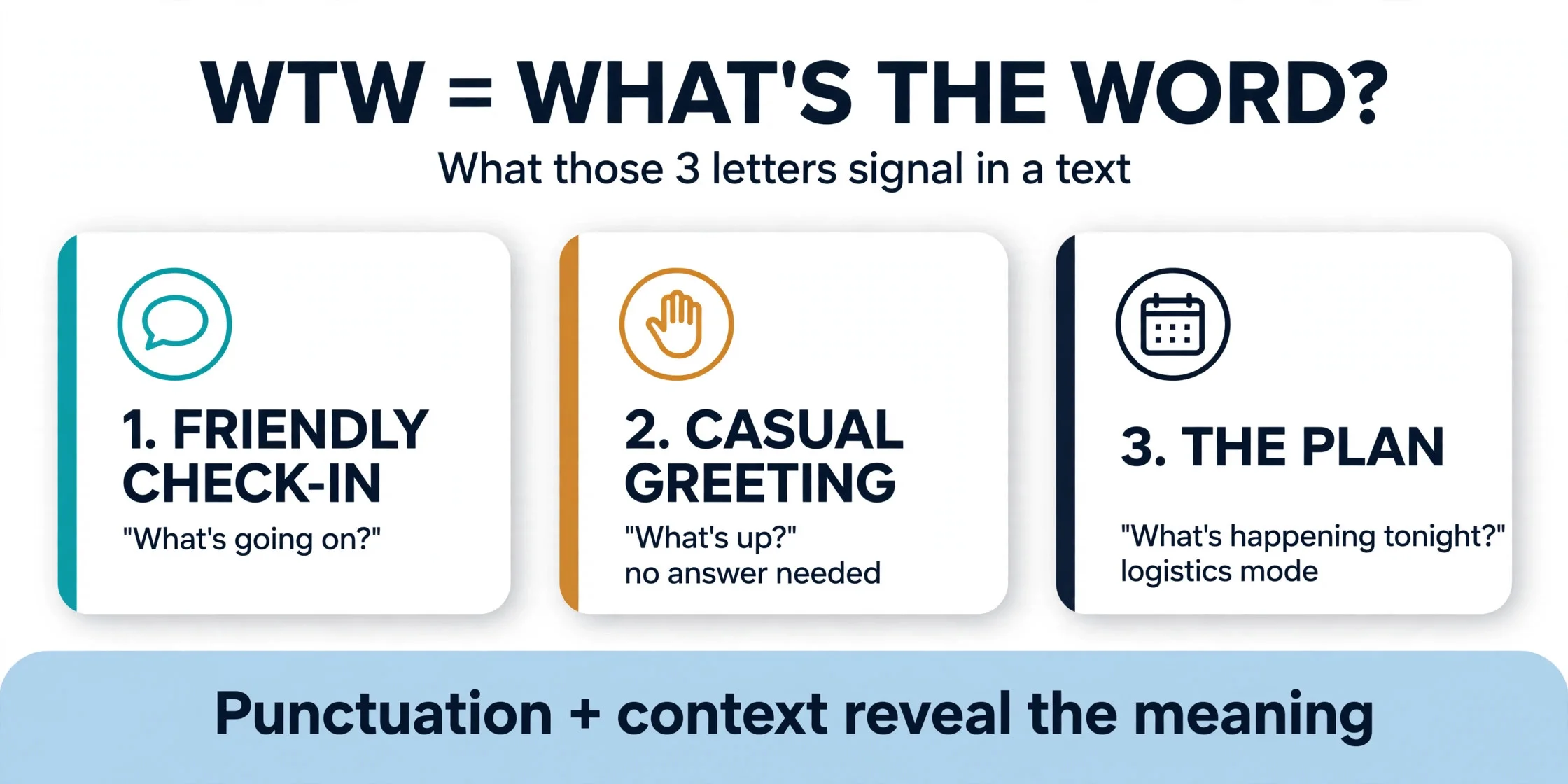
If you have ever opened a message that just says “wtw” and stared at it for a second too long, you are not alone. The wtw meaning trips up thousands of people every day, because those three little letters can ask about your day, your plans, or your reaction — all depending on context. In short, WTW most commonly stands for “What’s the word?”, which is simply a casual way of asking “What’s up?”, “What’s happening?”, or “What’s the plan?”. However, the same abbreviation can occasionally mean “What the what?!” (a surprised reaction) or, in captions, “What to wear?” / “What to watch?”. This guide decodes every meaning, shows you exactly how to tell them apart in seconds, and gives you the best replies for every situation — so you never freeze at “wtw” again.
WTW Meaning: The Direct Answer
Let us settle the wtw meaning question right away, because most of the time you only need one definition. In everyday texting, WTW stands for “What’s the word?” — a relaxed, friendly way of asking what’s going on. Language references agree: GrammarBrain’s WTW definition lists “What’s the word?” as the primary meaning, describing it as a way of saying hello and asking a question to begin a conversation. Think of it as a slightly cooler cousin of “What’s up?” with one extra shade of meaning: while “what’s up” asks about you, “what’s the word” asks about the situation — the news, the plans, what’s happening around you.
For example, when a friend texts “Yo, wtw tonight?”, they are not asking for a vocabulary lesson. They are asking whether anything is happening tonight and whether you want in. Similarly, “wtw, haven’t heard from you in ages” is simply a warm check-in, not a quiz.
What “What’s the Word?” Is Actually Asking
In fact, the phrase underneath the abbreviation does real work. “What’s the word?” is an invitation to share news — it assumes something might be going on and gives you an easy opening to mention it. Consequently, the natural replies are updates, not essays: “Not much, just chilling”, “Heading downtown later, you in?”, or even just “nm, wbu” (nothing much, what about you).
Notice how the question is deliberately open-ended. Unlike “Are you free Friday?”, which demands a yes or no, “wtw” hands you the conversational steering wheel. That openness is exactly why it works so well as a conversation starter — and also why it confuses people who expect a specific question.
Why People Type WTW Instead of “What’s Up?”
Three letters beat nine; however, there is more to it than laziness. “What’s up?” has been around so long that it can feel flat, almost automatic. In contrast, WTW carries a subtle social signal: it sounds current, a little playful, and slightly more engaged. It says “I actually want to hear what’s going on”, not just “I am filling silence.”
Additionally, WTW blends two questions into one. It can mean “how are you” and “what are we doing” at the same time, which makes it the perfect low-effort opener when you want to talk but have no specific topic. Among younger texters especially, that versatility is the whole point.
The 3 WTW Meaning Signals: How to Tell Them Apart
Here is where most guides stop at a list — but a list does not help you in the half-second before you reply. Instead, use this simple tone decoder: three quick clues that reveal which wtw meaning the sender intends.
Clue 1: Punctuation. A plain “wtw?” or “wtw” is the friendly check-in. Multiple marks — “wtw?!” — almost always signal the surprised “What the what?!” reaction instead.
Clue 2: The words around it. A time word (“tonight”, “this weekend”, “later”) points to the planning meaning. A name or term of endearment (“wtw beautiful”) leans flirty. Bad or shocking news right before it means “What the what?!”
Clue 3: Who sent it and where. A close friend in a DM usually wants to chat or make plans. A crush on Snapchat might be flirting. A hashtag (#WTW) on Instagram is “what to wear” or “what to watch” — and expects no reply at all.
In practice, run any “wtw” through these three clues and you will land on the right meaning nearly every time. Now let us look at each signal in detail.
Signal 1 — “What’s the Word?”: The Friendly Check-In
This is the default, most common wtw meaning, and your safest assumption when nothing else points elsewhere. It translates to “What’s going on with you?” or “Any news?” — warm, casual, and genuinely interested.
Typical examples: – “Hey, wtw? Long time no talk.” – “wtw with you these days?” – “Wtw, did you hear about the game?”
Therefore, the right response is any small life update. “Not much, work’s been crazy — you?” works perfectly. You do not need anything clever; the sender just opened a door, so walking through it with anything real keeps the conversation alive.
Signal 2 — “What’s Up?”: The Casual Greeting
Sometimes WTW carries no question at all — it is simply a greeting wearing a question mark as decoration. “Wtw” here functions exactly like waving at someone across the room: it acknowledges you and invites a response, without demanding information.
Fortunately, you can spot this version by its emptiness. There is no time reference, no topic, no follow-up — just “wtw” sitting alone. In that case, treat it like “hey” and answer in kind: “Hey! Not much, wbu?” Matching their energy matters more than the content of your reply.
Signal 3 — “What’s the Plan?”: The Social Coordinator
Add a time word and the wtw meaning shifts from greeting to logistics. “Wtw tonight?”, “wtw this weekend?”, “wtw for the holidays?” — each one is really asking “What are we doing?” or “Is anything happening?”
This is the most actionable version, so answer with equal directness. “Nothing yet — wanna grab dinner?” works far better than a vague “not much.” In fact, vagueness accidentally kills the planning momentum the sender was building.
The Rare Ones: “What the What?”, “What to Wear”, “What to Watch”
Three niche meanings round out the picture, and each has a telltale sign:
– “What the what?!” — a mock-shocked reaction, like a family-friendly stand-in for a stronger swear. Example: “They cancelled the concert?? Wtw?!” The giveaway is always the context: surprising news plus exclamation-flavored punctuation. – “What to wear?” — appears in fashion contexts: “WTW to the wedding next month — formal or semi-formal?” You will see this in Instagram DMs, influencer captions, and #WTW hashtags on outfit posts. – “What to watch?” — the streaming-era cousin: “WTW on Netflix this weekend? I need something new.” Common in group chats and recommendation threads.
Still, none of these expect the “what’s up” reply. For “what the what”, react to the news (“I know, right?!”). For the other two, give an actual suggestion — that is what the sender wants.
Where WTW Came From
Understanding the wtw meaning gets easier once you know it did not start as texting slang at all. “What’s the word?” has deep roots in African American Vernacular English and urban street culture, where it worked as a community check-in — essentially asking “what’s the news on the street?” Hip-hop lyrics carried it through the 80s and 90s, keeping it alive as spoken slang for decades.
From Street Greeting to Texting Shorthand
Eventually, the jump to screens happened in the late 2000s and early 2010s, when character limits and tiny keyboards punished long phrases. BlackBerry Messenger, early Twitter, and group SMS chats were ruthless editors: anything compressible got compressed. “What’s the word?” — five syllables, fifteen characters — became “wtw” almost inevitably.
However, what is interesting is what survived the compression. The abbreviation kept the original warmth. Unlike some slang that turned sarcastic online, WTW stayed friendly — a small fossil of spoken culture living inside your keyboard.
Why It Surged Again
So if WTW feels newer than its actual age, that is because it got a second wind. Short-form video — TikTok comments, Snapchat streaks, Instagram DMs — runs on exactly the kind of quick, low-friction openers WTW provides. Around 2018 it went mainstream in memes and comment threads, and it has been cycling through waves of popularity ever since, each one pulling in a new batch of confused first-timers.
Above all, that cycle is worth remembering: every few years, millions of people encounter WTW for the first time. If that is you today, you are right on schedule.
WTW Meaning in Real Conversations: 4 Scenarios
Definitions are useful, but the wtw meaning truly clicks when you see it working in real chats. Walk through these four scenarios and notice how the tone decoder from Part 1 applies each time.
Scenario 1: The Friend Check-In
Alex: yo wtw, haven’t seen you in forever
You: I know right! Work’s been insane. Wbu?
Nothing fancy happened here, yet the exchange worked perfectly. Alex used the friendly check-in signal, you answered with a small honest update and bounced the question back. In other words, this is WTW at its most common — a social ping, not a puzzle. Whenever the sender is a friend and there is no time word attached, this scenario is your default.
Scenario 2: The Flirty Opener
Sam: wtw tonight? 👀
You: Depends… what did you have in mind?
The time word (“tonight”) plus the platform (a DM, not a group chat) shifts the meaning toward interest. Here WTW is doing double duty: asking about plans and testing whether you want to spend time together. Here, your reply should match that energy — playful, a little open-ended, and honest about your interest level. If you are not interested, a warm but clear “Just chilling at home tonight, you?” closes the door without slamming it.
Scenario 3: The Group-Chat Plan
Maya: wtw this weekend?? need plans
Jordan: There’s a rooftop thing Saturday
You: I’m in if there’s food
Group chats strip away flirtation and leave pure logistics. “Wtw this weekend” here is unambiguous: what are we doing? For example, notice how the double question mark adds urgency rather than surprise — punctuation context matters. In planning mode, specific beats clever every time; name the plan, the place, or the time.
Scenario 4: The Catch-Up After Months
Chris: wtw with you these days? feel like we haven’t talked since summer
You: Honestly? New job, new city, same me. What’s new your end?
The added phrase “with you these days” stretches WTW into genuine curiosity about someone’s life. This version deserves more than “nm” — the sender explicitly referenced the gap in contact, which is an invitation to actually share something. A two-sentence life update is the perfect response length: enough to be real, short enough to keep it texting.
How to Reply to WTW
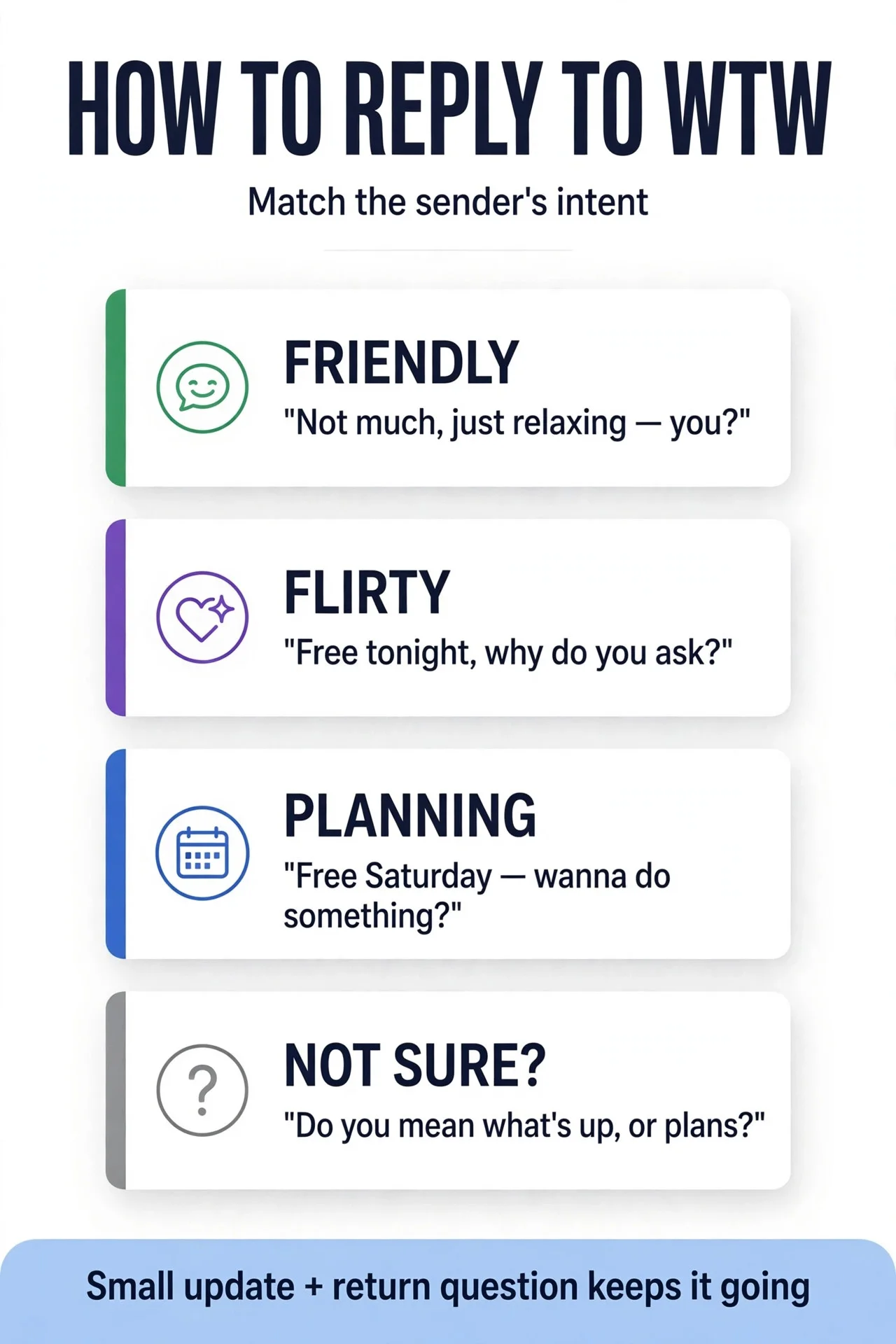
However, if scenarios feel like too much to memorize, here is the shortcut version — a reply playbook organized by the sender’s intent:
When it is friendly: Mirror the warmth. “Not much, just relaxing — you?” or “Same old! What’s new with you?” The formula is simple: small update + return question. As a result, this keeps the rally going without any pressure.
When it is flirty: Match their playfulness, but only if you feel it too. “Depends on who’s asking” or “Free tonight, why do you ask?” work well. On the other hand, if you are not interested, stay friendly but neutral: “Just winding down tonight!”
When it is about plans: Be concrete. In contrast, “Free Saturday afternoon — wanna do something?” beats “idk, wbu?” every single time. Planning-mode WTW dies when both people stay vague, so whoever gets specific first wins.
When you genuinely do not know what they mean: It is completely fine to ask. “Haha do you mean like what’s up, or do you have plans in mind?” Indeed, nobody has ever been offended by a clarification — but plenty of conversations have died from a wrong guess.
WTW vs WYD vs WYA vs SUP
WTW does not live alone — it shares the group chat with a whole family of three-letter openers, and mixing them up is half the confusion. Here is how they differ:
| Abbreviation | Full Form | What It Really Asks | Best For |
|---|---|---|---|
| WTW | What’s the word? | What’s happening / what’s the plan? | Check-ins with a social edge |
| WYD | What are you doing? | What are you up to right now? | Immediate, personal curiosity |
| WYA | Where are you at? | Where are you (literally)? | Meetups and logistics |
| SUP | What’s up? | General greeting | The safest, most neutral opener |
However, the key distinction is this: WYD asks about you, while WTW asks about the situation. “Wyd?” wants to know what you are doing this second; “wtw?” wants the news, the vibe, the plan. That is why WTW feels slightly warmer and more social — it is interested in the world around you, not just your current activity.
If you want the full breakdown of its closest cousin, read our guide on wyd meaning in text — the two get confused constantly, and knowing both makes you fluent in modern texting.
WTW Meaning on Snapchat, WhatsApp, and TikTok
The wtw meaning stays constant, but each platform bends it slightly toward its own culture.
Snapchat
Snapchat is WTW’s natural habitat: fast, visual, and streak-driven. Here it usually arrives as a snap caption or a two-word chat opener, often paired with a selfie or a Bitmoji. Because snaps disappear, the WTW here is almost always the casual greeting or the flirty opener — nobody plans a wedding over disappearing messages. Here, speed matters: a same-day reply keeps the streak energy, while a three-day-late “nm” kills it.
On WhatsApp, WTW skews a little older and a little more practical. Family group chats and old friend circles use it for genuine check-ins and weekend planning. The flirty edge mostly disappears here — “wtw” from your cousin means “what’s happening”, full stop. Replies can be longer and slower without seeming rude, since WhatsApp conversations breathe at a different pace.
TikTok
TikTok uses WTW differently from both: it lives in comments, not DMs. “Wtw with this trend??” under a video is closer to “what is going on here” — commentary, not conversation. And #WTW in captions usually means “what to wear” or “what to watch”, which expects likes, not replies. Therefore, if someone comments WTW on your video, a playful response keeps the engagement going; treating it as a personal question misses the point.
When WTW Goes Wrong
For all its friendliness, WTW has a cringe line — and crossing it is easier than you think. The abbreviation is informal youth slang with specific cultural roots, so deploying it in the wrong room lands badly.
The 4 Places to Never Use It
1. Work emails and professional chats. “WTW with the quarterly report?” reads as careless, not casual. Use “What’s the status on…?” instead — it asks the same thing without the slang tax. 2. Messages to grandparents or older relatives. They will either not understand it or, worse, try to decode it literally. “What’s the word?” as a vocabulary question is a real risk here. 3. Serious or sensitive news. Replying “wtw?!” to someone’s bad news can read as flippant, even when you mean it as shock. Match the gravity: “Oh no, what happened?” costs the same three seconds. 4. First impressions that matter. Job applications, landlord emails, professor messages — anywhere you want to seem competent, spell things out. Slang is a privilege of established relationships.
The Cringe Line
Even among friends, WTW has a dosage limit. Dropping it into every message — “wtw”, “lol wtw”, “anyway wtw” — stops sounding natural and starts sounding like a personality substitute. The slangexplained guide to WTW puts it well: the line between natural and cringe is crossed when slang is forced into conversations where a normal question would do. As a guideline, one WTW per conversation is plenty; let it open the door, then talk like yourself.
Frequently Asked Questions
Is WTW rude?
No — WTW is not rude in casual contexts. Among peers, it is a friendly, informal greeting. It only becomes rude when used in formal settings (work, elders, serious situations) where slang itself is inappropriate, not because the letters are offensive.
Is WTW flirty?
It can be, but it is not automatically flirty. “Wtw?” from a friend is just a check-in; “wtw tonight? 👀” from a crush is clearly flirting. The flirty reading depends on the sender, the platform (DMs more than group chats), and the extras — emojis, timing, and terms of endearment.
What does WTW mean from a girl?
The same thing it means from anyone: usually “what’s up / what’s the plan”. Do not overthink the sender’s gender — run it through the tone decoder instead. Punctuation, timing words, and context tell you far more than who typed it.
Can I use WTW at work?
In most workplaces, no. Even in casual offices, “wtw” in a work chat risks sounding unprofessional. The one exception is a genuinely informal team chat where everyone already talks that way — and even then, never with clients or managers.
What is the difference between WTW and WYA?
WTW asks about the situation (“what’s happening / what’s the plan?”), while WYA asks about location (“where are you at?”). “Wtw tonight?” wants plans; “wya?” wants an address. They often appear together when friends are coordinating: “wya? wtw tonight?”

Conclusion
Ultimately, the wtw meaning is simpler than it looks once you stop treating it as a code to crack and start reading it as a social signal. Nine times out of ten, it means “What’s the word?” — a warm, casual way of asking what’s going on or what the plan is. The rare exceptions (“What the what?!”, “what to wear”, “what to watch”) all announce themselves through context if you know what to look for.
So next time those three letters light up your screen, run the tone decoder: check the punctuation, check the surrounding words, check who sent it. Then reply like yourself — a small update, a real plan, or an honest question. That is all WTW ever wanted from you in the first place: a conversation.