

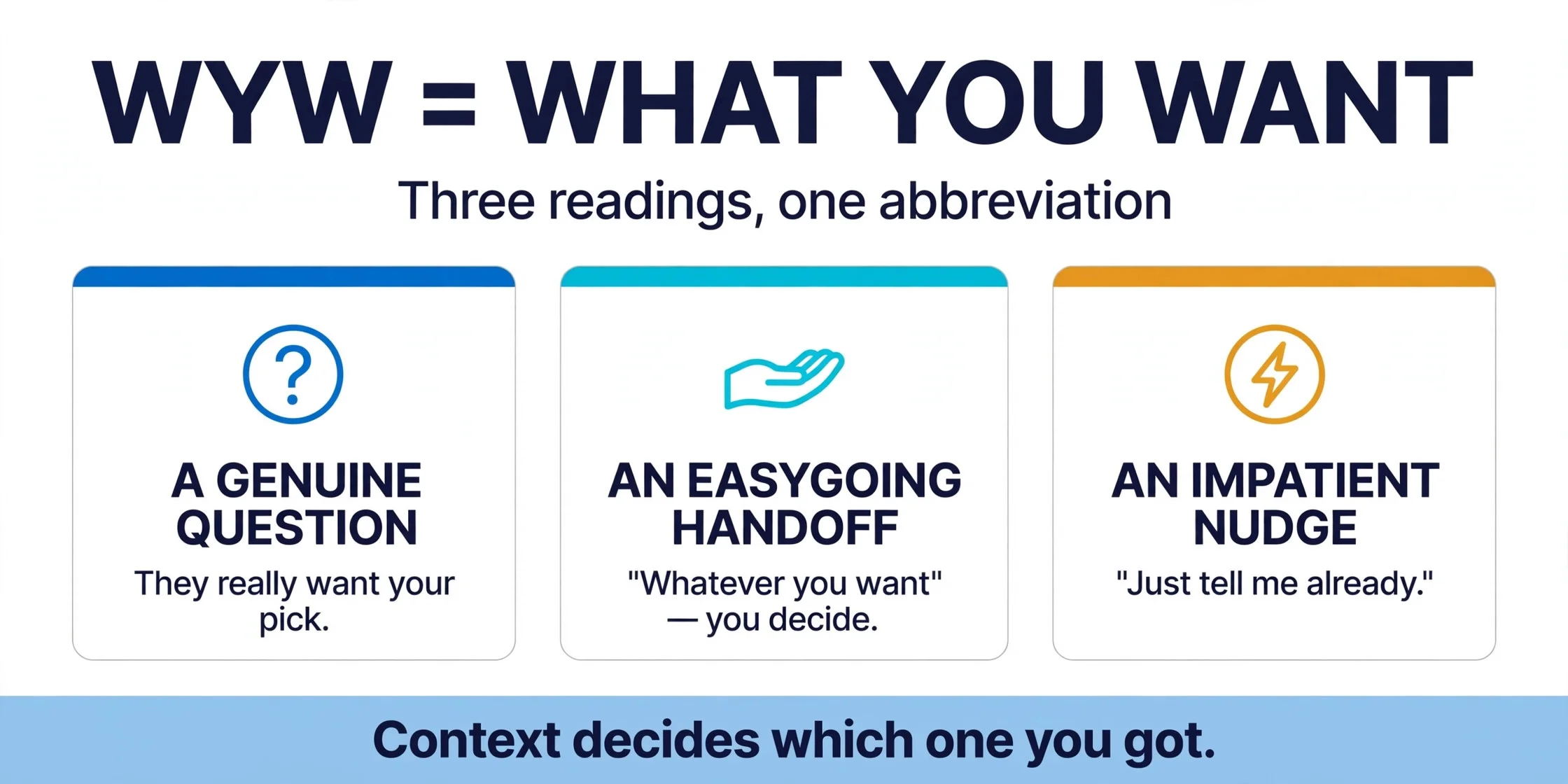
If three unexplained letters just landed in your inbox, you’re probably doing what everyone does: staring at “WYW” and trying to crack the wyw meaning in text. Is it friendly? Flirty? Rude? Or just someone too lazy to type real words? Here’s the short answer: WYW almost always means “what you want” — a compressed, casual way of asking what someone wants, needs, or is getting at.
But the same three letters can carry very different weight depending on who sent them and what came before. A lowercase “wyw?” from a friend mid-conversation reads completely differently from a cold “WYW.” at midnight. Are you wondering whether to take it as flirty, brush it off as lazy texting, or read it as passive-aggressive? This guide breaks down the real wyw meaning in text, the three things it usually signals, how formatting and tone shift it, and exactly what to text back.
WYW Meaning in Text: The Direct Answer
WYW stands for “what you want” — sometimes stretched to “whatever you want.” It’s texting shorthand for asking about someone’s preference, choice, or intention without typing a full sentence. You’ll run into it most on Snapchat, in Instagram DMs, on TikTok, in group chats, and in gaming lobbies — anywhere people type fast and keep things casual.
In real conversations, people use it in a few flavors:
- “What you want?” — the direct ask
- “What you want to do?” — when making plans
- “What you want from me?” — pointed, wants clarity
- “Whatever you want” — the easygoing handoff
The core stays the same across all of them: someone is asking what you’re after — a plan, an answer, attention, or a decision. The tone, however, is where things get interesting, which is exactly what the next section decodes.
The 3 Things WYW Usually Means
Almost every WYW you’ll ever receive falls into one of three readings. Match the message to the situation around it, and the mystery disappears.
1. A Genuine Question: “What Do You Want?”
Sometimes it’s literal. Your friend is asking for your preference because they actually want an answer. This usually happens mid-conversation, right after options come up.
Them: “Pizza or burgers tonight?”
You: “WYW?”
Here WYW is just efficient — three letters instead of “what do you want?” Nothing hidden, nothing loaded. You’ll recognize this version because it arrives with context: a question was asked, options were listed, and now someone wants your pick.
2. A Handoff: “Your Call”
This is the most common use of all. As “whatever you want,” WYW hands the decision to you — sometimes generously, sometimes lazily.
Them: “We could watch a movie or just hang out.”
You: “Wyw, I’m good with either.”
The subtext: I don’t have a strong preference, so you decide. Between friends this reads as easygoing. In a newer connection, it can read as low-effort — which is why the reply section later in this guide matters.
3. A Nudge: “Get to the Point”
After a long, vague back-and-forth, WYW can carry an edge. If someone’s been dancing around what they want for ten messages, a flat “WYW” often means okay, just tell me already.
Them: “Idk… maybe we could do something… or not… what do you think though?”
You: “WYW.”
Same letters, completely different energy. The difference is always the conversation before it — which is why reading the thread matters more than analyzing the abbreviation.
How the WYW Meaning in Text Shifts With Formatting
Here’s something most guides skip: how someone types WYW changes what it means almost as much as the context does.
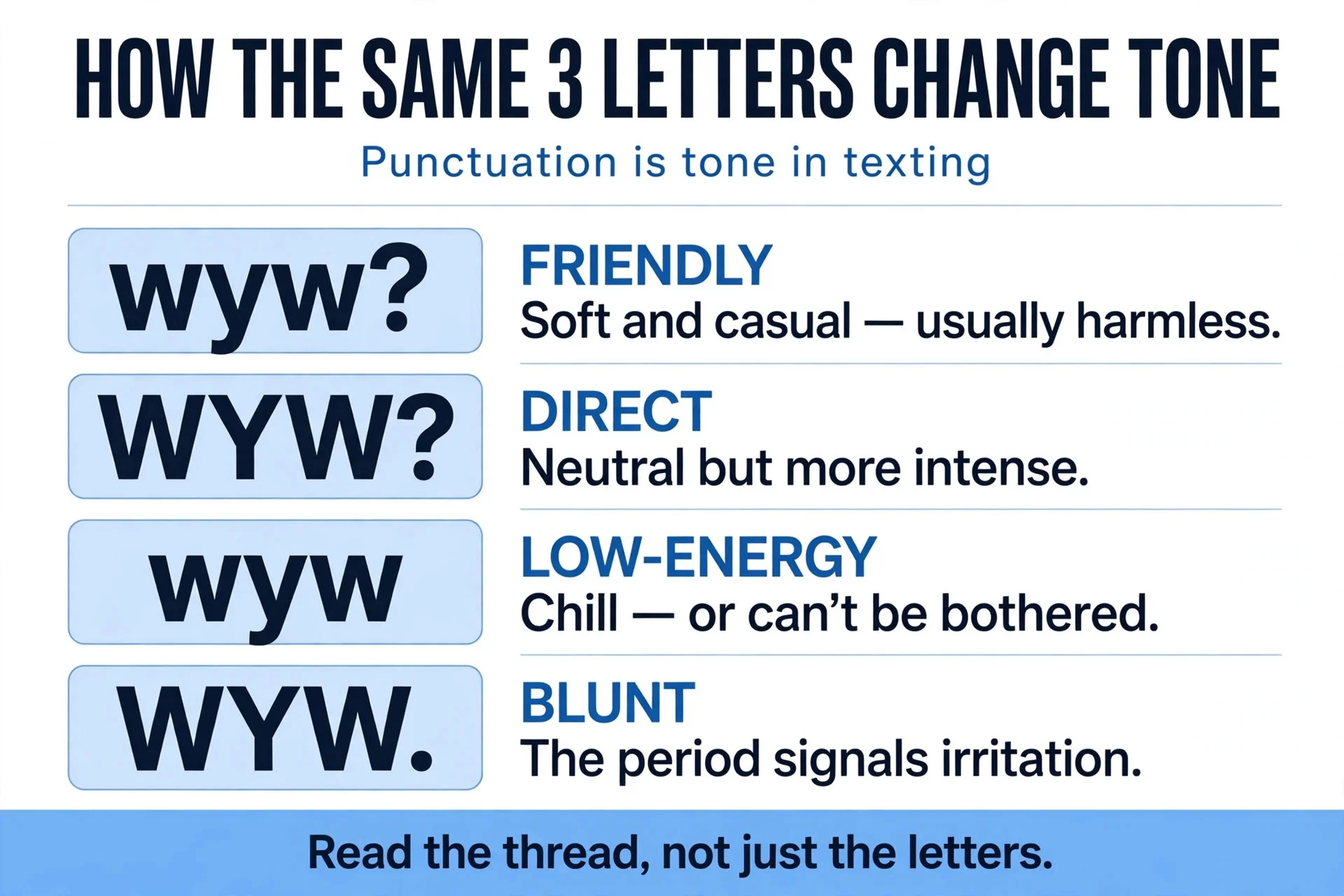
“WYW?” vs “wyw” vs “WYW.”
Punctuation and capitalization are tone in texting. Watch how the same message transforms:
- “wyw?” — lowercase with a question mark reads soft and casual. This is the friendly version, the one that usually means no harm.
- “WYW?” — capitalized with a question mark reads direct and a little more intense. Still neutral, but less cuddly.
- “wyw” — no punctuation at all reads lazy or low-energy. Could be chill, could be “I can’t be bothered.”
- “WYW.” — capitalized with a period reads blunt, even annoyed. The period is doing heavy lifting here; in texting culture, it often signals finality or irritation.
None of these rules are absolute, but together with timing they give you a reliable read on intent.
Emoji, Timing, and Other Tone Signals
A few more signals that tilt WYW friendly or cold:
Pushes it friendly:
- An emoji attached (😄, 👀, 😏)
- Sent quickly, mid-conversation
- Lowercase typing throughout the chat
- A joke or light exchange right before it
Pushes it blunt:
- No emoji, no punctuation, just the letters
- Sent after a long silence or as a cold opener
- ALL CAPS energy in the rest of the chat
- Arrives right after you asked something emotional
When in doubt, read the whole thread instead of interrogating three letters in isolation. The conversation around WYW almost always tells you what it means.
WYW Meaning in Text From a Guy: How to Read It
Since this question drives so many searches, let’s address it directly. From a guy, WYW tends to lean in one of three directions — and the surrounding context tells you which.
The Casual Check-In
Most often, it’s nothing deep. He’s asking what you’re up to or what you’re thinking, with zero hidden agenda. This version usually arrives mid-conversation, often as a reply to something you said. Treat it like “what’s up” wearing a different jacket.
The Flirty Opener
Late at night, after a story view, or in a conversation that’s already got some tension — here WYW is testing the waters. The flirty read gets stronger with an emoji (😏, 👀), quick replies, and follow-up questions. If he’s sending it cold at 1 AM, the subtext is usually are you around, or are you interested?
The Impatient Nudge
If it follows a long, meandering exchange where you’ve been vague, WYW might mean get to the point. The tell: short replies, no emoji, and a conversation that was going in circles before it landed.
The golden rule still applies — the tone tracks whatever was happening before the message. A cold, out-of-nowhere WYW reads very differently from one sent as a direct reply to your question.
WYW vs WYD vs WYM vs WYA: Don’t Mix Them Up
These four get confused constantly because they look alike and live in the same conversations. Here’s the real difference:
| Abbreviation | Stands For | What It Asks |
|---|---|---|
| WYW | What You Want | Your preference or desire |
| WYD | What You Doing | Your current activity |
| WYM | What You Mean | Clarification of something confusing |
| WYA | Where You At | Your location |
WYD is the most common of the bunch — the default casual check-in of modern texting, which we break down in our WYD guide. WYW feels more intentional because it asks about a want rather than an activity. WYM usually pops up mid-confusion or mid-argument, when someone needs a statement explained. WYA is purely logistical.
Quick memory trick: WYW = want, WYD = doing, WYM = meaning, WYA = where. One letter changes the entire question.
How to Reply to WYW: A Playbook
Don’t overthink it — match the energy of the message. Here are solid options for every situation.
If You’re Interested or Playing Along
- “You tell me 👀”
- “Depends who’s asking 😏”
- “Was hoping you’d have a plan”
- “Let’s do [something specific] — you in?”
Taking charge with a specific suggestion works especially well if the WYW felt flirty. It shows confidence instead of volleying vagueness back.
If You’re Busy or Not Interested
- “Not much, just chilling”
- “Kinda busy rn, what’s up?”
- “Nothing major — you?”
Short, polite, no new questions. You’re answering without opening a door you don’t want opened.
If There’s an Actual Decision to Make
This is where most people fumble. Someone sends WYW meaning “whatever you want,” and replying “idk, wyw” just bounces the decision back like a hot potato. Instead, break the loop:
- “I’m good with either — you pick one and I’ll go with it”
- “Let’s do pizza, I’m craving it”
- “How about [option]? Final answer 😄”
Decisiveness is attractive and practical. As slang glossary StreetSlang notes in its WYW entry, the term works best as a quick check-in that keeps things moving — so keep your reply moving too.
Nobody needs a paragraph in response to three letters. Keep it short, mirror their tone, and let the conversation build.
When NOT to Use WYW
WYW lives firmly in the casual lane. Keep it out of:
- Work chats and emails — it reads as lazy or unprofessional. Use “whatever works best for you” instead.
- Serious conversations — dropping WYW during an emotional talk signals you aren’t taking it seriously.
- With parents or older relatives — they’ll have no idea what it means, and explaining slang mid-conversation kills the moment.
- First impressions that matter — job interviews, new clients, formal introductions. Full words, always.
The rule of thumb: if you’d hesitate to say “whatever” out loud in that situation, don’t type WYW either.
The “Whatever You Want” Trap: When WYW Means “I Don’t Care”
Here’s the darker reading worth knowing. Sometimes “whatever you want” isn’t easygoing — it’s checked out. The difference:
Genuinely easygoing WYW: arrives with warmth, emojis, or quick follow-ups. The person actually is fine with anything and stays engaged.
Checked-out WYW: arrives flat, kills the planning energy, and is followed by short replies. The subtext is I’ve stopped caring about this conversation.
How to tell them apart? Look at what happens after. If they engage with whatever you suggest, it was genuine. If every suggestion gets “sure” or “idk,” the WYW was a white flag, not a green light. In that case, the healthiest reply is directness: “Seems like you’re not feeling this — want to raincheck?”
Rare Other Meanings of WYW
For completeness: Urban Dictionary lists a few fringe definitions submitted by users. These are outliers, not how the term is actually used day to day. If someone sends you WYW flirtatiously late at night, they’re using the standard “what you want” meaning with flirty intent — the letters themselves haven’t changed meaning. Don’t go hunting for secret definitions; context already told you everything.
Frequently Asked Questions
Is WYW short for “whatever you want” or “what you want”? Both — they’re the same idea in different packaging. “What you want” is the literal expansion; “whatever you want” is how it usually functions in conversation, as a handoff of the decision. Either way, someone is asking about your preference.
Can WYW sound passive-aggressive? It can, but the letters aren’t the problem — the delivery is. A warm, quick WYW with an emoji reads easygoing; a flat “WYW.” after a disagreement reads loaded. If it felt passive-aggressive, trust the conversation around it, not the abbreviation.
What’s the full form of WYW? WYW most commonly expands to “What You Want” (or “Whatever You Want”). Unlike abbreviations with formal origins, it was born in casual texting and chat rooms where brevity beat grammar.
Is it okay to use WYW with someone I just met? It’s fine in casual contexts — DMs, group chats, gaming lobbies — but read the room. If the other person types in full sentences, match their energy instead of opening with slang. Mirroring beats abbreviating with strangers.
Why do people type WYW instead of just asking normally? Speed and tone. Three letters is faster than a full question, and the casualness itself sends a message: we’re relaxed here. It’s the same reason “wyd” beat “what are you doing” — efficiency plus vibe.

Conclusion
The wyw meaning in text comes down to “what you want” — three letters doing the job of a full question. Once you see the three readings (genuine question, easygoing handoff, impatient nudge), the guesswork disappears. Read the formatting, read the thread, match the energy, and reply like a person instead of a dictionary.
Whether it lands flirty, friendly, or blunt was never really about the abbreviation — it was about the conversation around it. And now you know how to read that too.