

If you have seen the word “gyatt” flooding TikTok comments or heard a streamer shout it mid-game, you have probably wondered about the gyatt meaning. If so, you are not alone. In fact, gyatt became one of the most searched slang terms of the past few years, and it still confuses plenty of people — parents, teachers, and even regular internet users who feel like they missed a memo.
So what does it actually mean? Is it a compliment, a joke, or something you should avoid saying? And where did it even come from? This guide answers all of that in plain language. You will get the direct definition first, then the full origin story, real examples of how people use it, and honest advice about when to use it — and when to keep it to yourself.
Gyatt Meaning: The Direct Answer
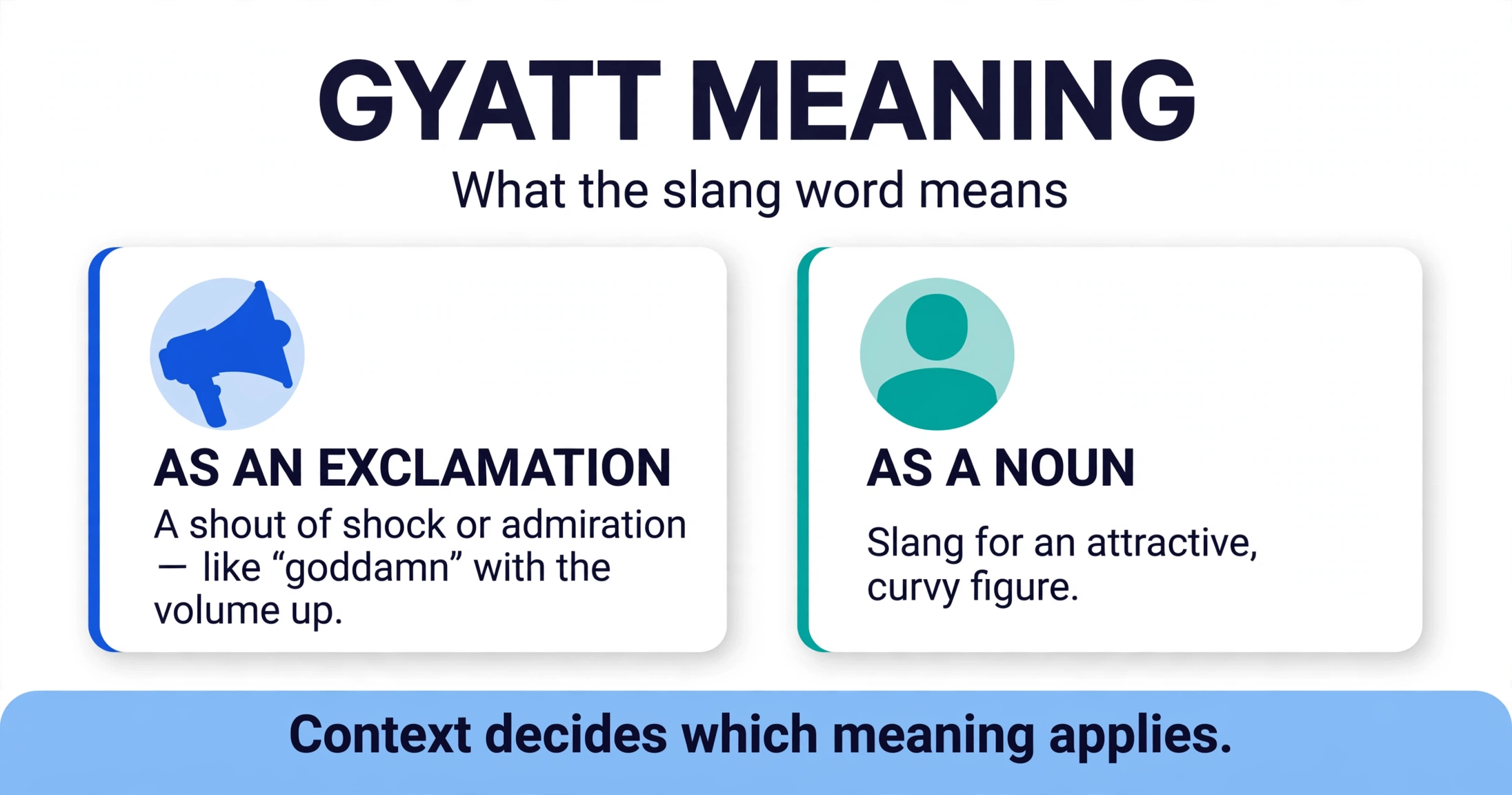
To begin with, here is the gyatt meaning in one sentence: gyatt is internet slang that works as an exclamation of shock or admiration, originally a stylized way of saying “goddamn.”
However, the word does double duty, so the exact sense depends on context:
- As an exclamation: Someone sees something surprising, impressive, or attractive and shouts “GYATT!” — the same reflex behind “whoa” or “no way,” just louder and more theatrical.
- As a noun: It can refer to an attractive figure, usually describing someone with a curvy body. For example, “she’s got a gyatt” is the noun form in action.
- As generic hype: Many younger users now employ it loosely for anything impressive — a dance move, a plot twist, a difficult video-game jump. In this sense, it simply means “that was insane.”
| Quick fact | Detail |
|---|---|
| Core meaning | Exclamation of shock or admiration (“goddamn” stylized) |
| Secondary meaning | Noun for an attractive, curvy figure |
| Origin | African-American Vernacular English (AAVE) |
| Popularized by | Streamer YourRAGE (2021), then Kai Cenat and TikTok (2022–2023) |
| Common spellings | gyatt, gyat, gyaaatt, gyatt dayum |
| Where you will see it | TikTok, Twitch, Instagram, Discord, gaming chats |
Because the word changes meaning with context, the rest of this guide breaks down each sense with examples, so you will always know which one you are looking at.
How to Pronounce Gyatt (and How to Spell It)
First, let us settle the basics. After all, there is nothing more awkward than using a slang word you cannot quite say.
Pronunciation
Gyatt is pronounced “guy-at” — two quick syllables, with the emphasis on the first. It rhymes roughly with “try that” said fast. Streamers often stretch it for comic effect: “GYAAAATT!” The longer the vowel, the more dramatic the reaction sounds.
Common Spellings
In addition, you will encounter several spellings, and they all refer to the same word:
- gyatt — the most common spelling, and the one dictionaries use.
- gyat — a shorter variant, equally widespread on TikTok.
- gyaaatt / gyaaatt — stretched spellings that mimic someone shouting it.
- gyatt dayum / gyatt damn — the fuller original phrase it grew out of.
As a result, there is no single “correct” version. Instead, pick the spelling that matches the energy of the moment — short for casual comments, stretched for dramatic effect.
Where Did Gyatt Come From? The Origin Story
Every slang word has a birthplace, and gyatt’s is more interesting than most. It did not come from a marketing team or a movie. Instead, it came from a livestream blooper.
African-American Vernacular English Roots
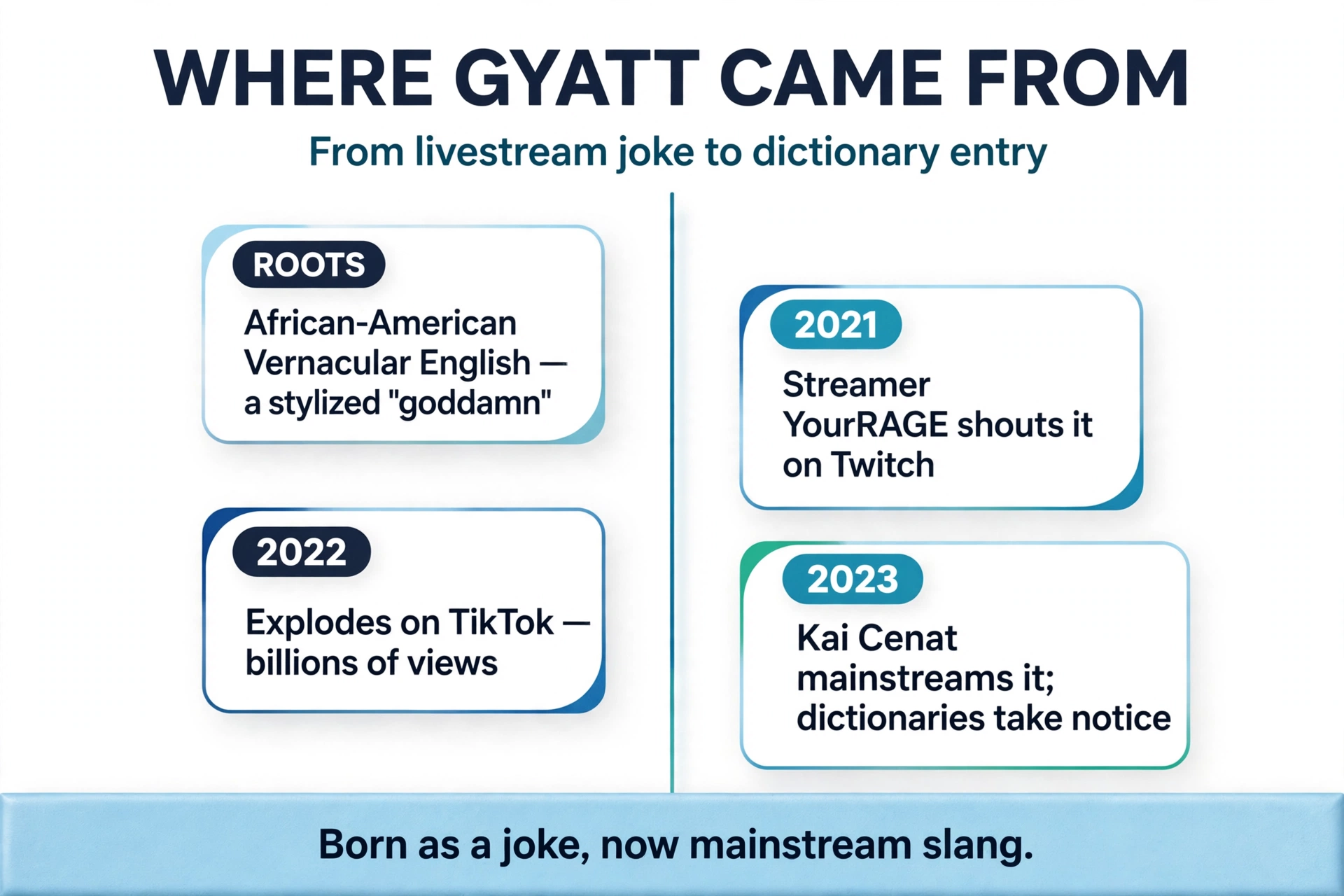
First, the roots: linguists trace gyatt to African-American Vernacular English (AAVE). According to language researchers, it evolved as a stylized pronunciation of “goddamn” — the kind of dramatic, drawn-out “gyatt damn!” you might hear as an exclamation of surprise. Similar stylized spellings, like “dayum,” work the same way: familiar words respelled for emphasis and humor.
YourRAGE and the 2021 Twitch Moment
From there, the word jumped from spoken slang to internet fame through Twitch streamer YourRAGE. In 2021, he began exclaiming “GYATT!” on stream whenever something surprising happened. His chat picked it up instantly, and clips of the moment spread. What started as a streamer catchphrase quickly became a chat-wide inside joke.
Kai Cenat, TikTok, and the 2022–2023 Explosion
After that came the explosion. In 2022, the term went viral on TikTok, and fellow streamer Kai Cenat — one of the platform’s biggest stars — used it constantly, pushing it into the mainstream. Meanwhile, the hashtag amassed billions of views. By 2023, gyatt had escaped streaming culture entirely: middle schoolers were shouting it in hallways, it was showing up in memes, and dictionary publishers took notice. In the end, it appears in the Cambridge Dictionary and Merriam-Webster’s slang coverage — a remarkable journey for a word born as a livestream joke.
The Two Meanings of Gyatt, Explained With Context
However, this is where most people get confused, so let us slow down. The gyatt meaning shifts with context, and misreading the context is how misunderstandings happen.
Meaning 1: The Exclamation
In its original and still most common role, gyatt is an interjection — a reaction word. Someone witnesses something startling or impressive and blurts it out. It carries the energy of “oh my god!” or “no way!” Consider these examples:
- A streamer watches an impossible game-winning shot: “GYATT! Did you see that?!”
- A friend sends a photo of a brand-new car: “Gyatt, that’s clean!”
- A plot twist lands in a show everyone is watching: “GYATT that ending was insane.”
Notice that none of these involve anyone’s body. Here, gyatt is pure hype — surprise and admiration with the volume turned up.
Meaning 2: The Noun
Over time, the word picked up a second job as a noun describing an attractive figure — usually a curvy body or, more specifically, a prominent backside. This is the sense most associated with the word’s viral peak on TikTok, where comments like “gyatt 😩” appear under photos and videos of attractive people.
Because this meaning comments on someone’s body, it carries more weight. Shouting it at a stranger is very different from typing it as a joke among friends, and that distinction matters. We will cover exactly where the line sits later in this guide.
The Newer Loose Sense: Generic Hype
Finally, there is also a third, newer layer worth knowing. Many younger teens who learned the word secondhand — from siblings or TikTok rather than the original streams — use it as generic hype for anything impressive, with no body-related meaning at all. “GYATT that transition was insane” under a cooking video is this sense at work.
So how do you tell which meaning applies? Look at what is being reacted to. A comment under a photo of a person almost certainly uses the body-related sense. A comment under a gaming clip, a magic trick, or a recipe video almost certainly uses the hype sense. Context is the decoder ring.
Gyatt Meaning in Real Life: Examples by Platform
While definitions are useful, slang lives in context. Here is how the gyatt meaning plays out where people actually encounter it.
TikTok Comments
To start with the biggest one: TikTok is the word’s natural habitat. Under a video of an impressive dance routine, you will see “GYATT 🔥” — pure hype. Under a selfie or fashion video, “gyatt 😩” leans toward the admiration-of-appearance sense. The video itself tells you which one the commenter means.
Twitch and Gaming Chats
Similarly, on Twitch, gyatt remains a live-reaction word. A streamer pulls off an impossible play, and chat explodes with “GYATTTT.” Here it is almost always the exclamation sense — nobody is commenting on anyone’s appearance during a speedrun. The stretched spelling matches the excitement of the moment.
Texting With Friends
Meanwhile, in group chats, gyatt usually arrives as a joke or an exaggerated reaction. A friend shares good news — “I got the internship!” — and someone replies “GYATT let’s gooo.” Among friends who share the joke, it reads as playful hype. With people outside the joke, however, it can confuse or even offend, which brings us to the next section.
Is Gyatt a Bad Word? When to Use It and When to Avoid It
This is the question parents and teachers ask most, so let us answer it honestly.
When It Is Fine
For example, among friends who understand the joke, gyatt is harmless fun — no worse than shouting “let’s go!” after a good play. In gaming chats, meme pages, and TikTok comments, it is standard internet vocabulary. Nobody in those spaces will blink.
When to Avoid It
Because one of its senses comments on someone’s body, context matters enormously:
- At school or work: Many teachers consider it disruptive, and some schools have banned it outright. In professional settings, it reads as immature at best.
- Around strangers: Shouting it at or about someone you do not know can feel harassing, regardless of intent. The line between compliment and creepiness is thin here.
- Around parents, elders, or young kids: The word’s roots are mild profanity (“goddamn” stylized), so it lands poorly in polite company.
- In formal writing: Never in essays, emails, or applications. It is slang, full stop.
A simple rule of thumb: if you would not shout “goddamn!” in that setting, do not say “gyatt” there either. The two words share DNA, and they share appropriate settings too.
Gyatt Meaning vs Other Gen Z Slang
In addition, gyatt does not live alone — it belongs to a whole family of internet slang that confuses outsiders. A quick comparison helps:
- Gyatt vs rizz: Rizz means charm or flirting skill (“he’s got rizz”). Gyatt is a reaction, not a skill. You *have* rizz; you *shout* gyatt.
- Gyatt vs skibidi: Skibidi comes from the Skibidi Toilet meme series and works as a nonsense intensifier. Both are Gen Alpha favorites, but skibidi has no real meaning at all — gyatt at least started with one.
- Gyatt vs Ohio: “Ohio” is slang for something weird or cursed (“that’s so Ohio”). It describes a vibe; gyatt expresses a reaction.
If you want to understand more of this vocabulary, our guide to WYD meaning in text breaks down another term you will see everywhere in chats and comments.
Frequently Asked Questions
Why do kids say “gyatt” so much?
Because it is short, shoutable, and funny — the perfect meme word. It spread through TikTok and gaming culture, where exaggerated reactions are the native language. For Gen Alpha especially, it has become a badge of being online and in on the joke, similar to how earlier generations adopted words like “yeet.”
Is “gyatt” in the dictionary?
Yes. For instance, the Cambridge Dictionary includes gyatt with usage examples, and Merriam-Webster covers it in its slang dictionary. That said, dictionary inclusion describes how people use a word — it does not make it appropriate for every setting.
What does “gyat” mean in Jamaican Patois?
Separately from the slang above, “gyat” in Jamaican Patois can mean “goat,” and by extension “greatest of all time” (GOAT). This is a different word with a different history that happens to share the spelling. In practice, you will almost never encounter this sense in TikTok comments — context makes the intended meaning obvious.
Can girls say “gyatt”?
Absolutely. Although the word is often described as something “guys say,” anyone can use it. Girls use it the same way — as hype, as a joke, or as admiration. The word has no gender restriction, and plenty of its viral TikTok usage comes from women.
What should I say instead of “gyatt”?
On the other hand, if you want the hype without the baggage, plenty of alternatives work: “no way,” “let’s go,” “that’s insane,” “wow,” or “unreal.” Each carries the excitement with zero risk of misunderstanding.

Conclusion
Ultimately, the gyatt meaning is simpler than the internet makes it look: it is a loud, playful exclamation that grew out of “goddamn,” picked up a second life as a noun for an attractive figure, and then loosened into all-purpose hype among younger users. As a result, its journey — from AAVE roots to a Twitch streamer’s catchphrase to TikTok ubiquity to the dictionary — shows how fast language moves online.
Above all, what matters most is context. Under a gaming clip, it is pure excitement. Under a photo, it is admiration with an edge. Around the wrong audience, it is a word best left unsaid. Now that you know all three layers — and the story behind them — you will never be confused by it again. For the full linguistic background, the Wikipedia article on gyatt documents its etymology and cultural spread in detail.