

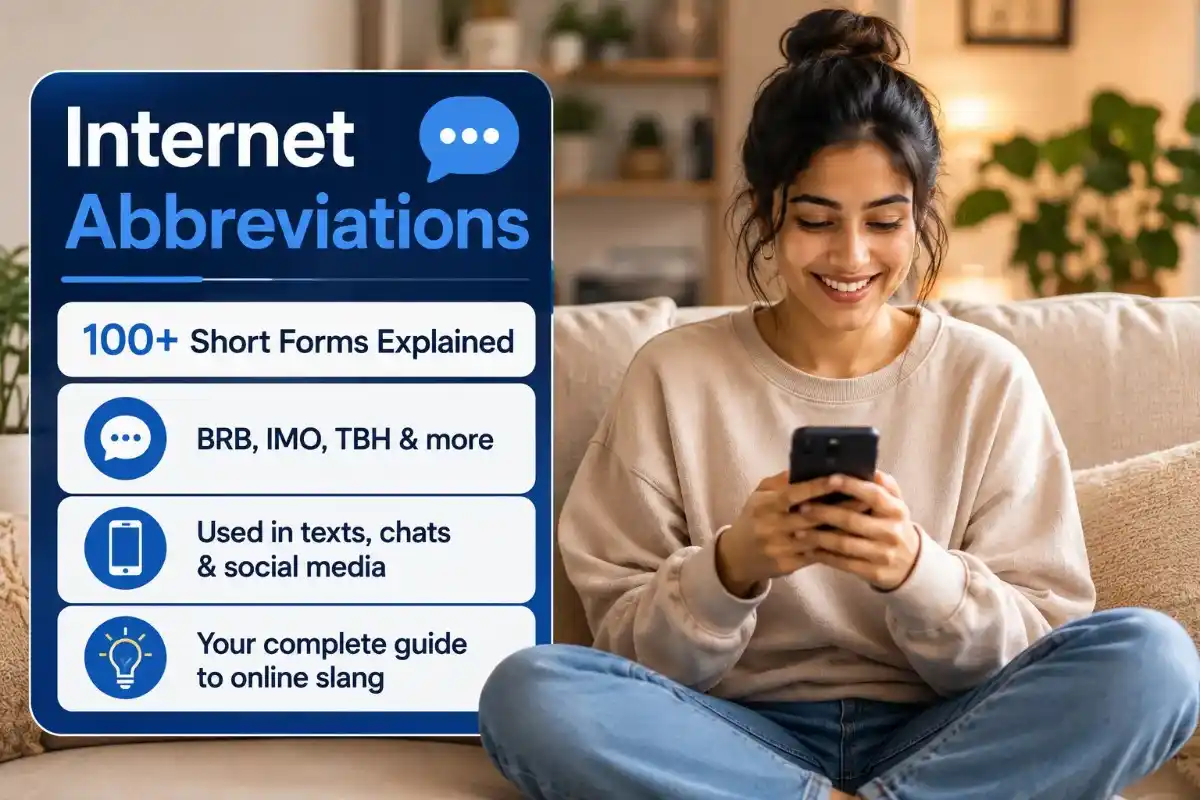
Internet abbreviations are shortened forms of common words and phrases — like BRB, IMO, or HTTP — that people use to type faster in texts, chats, and on social media. They cover everything from technical terms (HTML, VPN) to everyday chat slang (IDK, TBH) and viral social media phrases (FYP, POV). This guide explains what each one stands for and when to use it.
If you’ve ever paused mid-scroll wondering what an acronym means, you’re not alone. Every day, millions of people search phrases like “what does it stand for” or “[abbreviation] meaning,” because online conversation has developed its own shorthand — and that shorthand changes faster than most dictionaries can keep up. This guide sorts internet abbreviations into clear categories: web and technology terms, everyday messaging shortcuts, viral TikTok and Instagram slang, common U.S. life abbreviations, and workplace short forms. Overall, each entry gives you the full meaning in plain language, so you never have to guess.
Why Do People Use Internet Abbreviations?
Typing takes time, and conversations online move quickly. Internet abbreviations solve a simple problem: they let people say more with less effort. For instance, a term like “IMO” saves nine keystrokes over “in my opinion,” and on a phone keyboard, that adds up fast across a day of texting. Abbreviations also work as a kind of social shorthand — using “FR” or “NP” signals a casual, familiar tone that a formal phrase wouldn’t.
Three groups tend to use them most:
- Teens and young adults, who lean on chat and platform-specific slang (FYP, SFS, POV) that TikTok and Instagram culture shapes.
- Remote and hybrid workers, who rely on workplace shorthand (OOO, EOD, PTO) to communicate quickly across email and Slack.
- General internet users, who use foundational tech acronyms (HTTP, URL, VPN) without necessarily knowing what the letters stand for — they just know what the tool does.
Web and Tech Internet Abbreviations

These are the backbone terms of the internet itself — the acronyms that describe how websites, apps, and networks actually work. Knowing them helps beyond casual chat; they show up in tech support articles, app settings, and IT job descriptions.
Core Web and Networking Terms
| Abbreviation | Full Form |
|---|---|
| HTTP | HyperText Transfer Protocol |
| HTML | HyperText Markup Language |
| HTML5 | HyperText Markup Language, Version 5 |
| CSS3 | Cascading Style Sheets, Level 3 |
| UI | User Interface |
| UX | User Experience |
| WWW | World Wide Web |
| LAN | Local Area Network |
| VPN | Virtual Private Network |
| SMS | Short Message Service |
| MMS | Multimedia Messaging Service |
| JPEG | Joint Photographic Experts Group |
| SDK | Software Development Kit |
| OS | Operating System |
| AI | Artificial Intelligence |
| IoT | Internet of Things |
| PaaS | Platform as a Service |
| IaaS | Infrastructure as a Service |
| VoIP | Voice over Internet Protocol |
HTTP vs. HTML vs. CSS: What’s the Difference?
A few of these are worth a closer look because people often use them without understanding the distinction. HTTP is the protocol your browser uses to request a webpage from a server — it’s the “language” behind every URL you type. HTML is the markup language that structures what’s on that page (headings, paragraphs, images), while CSS controls how it looks.
UI vs. UX: Not the Same Thing
UI vs. UX trips people up constantly: UI is what you see and tap (buttons, layouts, colors); UX is how the whole experience feels to use, including things you can’t see, like load speed or how intuitive a flow is.
PaaS vs. IaaS: Cloud Terms Explained
Cloud terms like PaaS and IaaS matter more each year as more small businesses run on cloud infrastructure instead of physical servers — PaaS gives developers a ready-made platform to build on, while IaaS just rents the raw computing infrastructure (servers, storage) and leaves the rest up to you.
If you want a hands-on way to work with text formatting like this, try MeaningSpot’s Small Text Generator — useful for styling captions or bios once you know the terms behind them.
Messaging and Chat Abbreviations
These show up constantly in texting, DMs, and group chats — the everyday shorthand of casual conversation.
| Abbreviation | Full Form |
|---|---|
| BRB | Be Right Back |
| IMO | In My Opinion |
| IMHO | In My Humble Opinion |
| IDK | I Don’t Know |
| IKR | I Know Right |
| BTW | By The Way |
| TBH | To Be Honest |
| WYD | What You Doing |
| LMAO | Laughing My A** Off |
| ROFL | Rolling On Floor Laughing |
| NVM | Never Mind |
| PLS | Please |
| THX | Thanks |
| TY | Thank You |
| NP | No Problem |
| YW | You’re Welcome |
| DM | Direct Message |
| PM | Private Message |
| FYI | For Your Information |
| ASAP | As Soon As Possible |
| GTG | Got To Go |
| FT | FaceTime |
Some of these carry subtle differences worth knowing. For example, IMO and IMHO technically mean the same thing, but IMHO (“humbly”) often signals the speaker is softening a stronger or more controversial opinion. DM vs. PM is mostly platform-dependent: DM is standard on Instagram, X (Twitter), and TikTok, while PM is more common on older forums and Reddit. Getting these right matters if you manage a brand’s social accounts, since using the wrong term can subtly signal you don’t know the platform’s community.
Viral TikTok, Instagram, and Pop-Culture Short Forms

Platform culture — especially TikTok — has produced its own fast-moving vocabulary. These terms shift year to year, but the ones below have stayed consistent since going mainstream.
| Abbreviation | Full Form |
|---|---|
| POV | Point Of View |
| IG | |
| FB | |
| YT | YouTube |
| SFS | Shoutout For Shoutout |
| FYP | For You Page |
| FR | For Real |
| FRFR | For Real For Real |
| TMI | Too Much Information |
| ICYMI | In Case You Missed It |
| NF | Not Funny |
POV is one of the most-searched terms on this list, and its meaning has actually shifted since it entered slang. Originally it meant literally “point of view,” as in film or photography. On TikTok, however, it has become shorthand for a specific video format: the caption sets a scenario (“POV: you’re the last one to leave the party”), and the video puts the viewer directly into that role. FYP, the “For You Page,” is TikTok’s personalized content feed — getting a video “on the FYP” is the platform’s version of going viral. These two internet abbreviations alone drive a huge share of TikTok-related searches every month.
Everyday Internet Abbreviations in the USA
Outside of chat and social apps, these abbreviations show up in forms, banking, government paperwork, and daily errands across the United States.
| Abbreviation | Full Form |
|---|---|
| DOB | Date of Birth |
| IRS | Internal Revenue Service |
| ATM | Automated Teller Machine |
| PIN | Personal Identification Number |
| FAQ | Frequently Asked Questions |
These aren’t internet-native the way TikTok slang is, but they’ve become just as common in digital contexts — you’ll see DOB and PIN fields on nearly every signup form online, and FAQ pages are a standard fixture of almost every website (including this one).
Professional and Workplace Abbreviations
Since remote and hybrid work became standard, these short forms have become just as common in company Slack channels and email threads as texting slang is in group chats.
| Abbreviation | Full Form |
|---|---|
| OOO | Out Of Office |
| EOD | End Of Day |
| EOW | End Of Week |
| PTO | Paid Time Off |
Using these correctly matters more than casual slang does, since workplace miscommunication has real consequences. “EOD” specifically means by the end of the current business day — not literally midnight — so it’s worth confirming which time zone your team means when working across a distributed team. People typically use “OOO” as an auto-reply status, not something you’d type mid-conversation.
More Internet Abbreviations Worth Knowing
A few additional short forms round out the everyday internet vocabulary — useful to know even if you rarely use them yourself.
| Abbreviation | Full Form |
|---|---|
| LMK | Let Me Know |
| MSG | Message |
| RN | Right Now |
| ASL | Age, Sex, Location |
| CW | Content Warning |
| NSFW | Not Safe For Work |
CW and NSFW are worth knowing even if you never post them yourself, since they function as etiquette markers. A “CW” flags that a post discusses a sensitive topic, so readers can choose whether to engage, while “NSFW” warns that content isn’t appropriate for a work or public setting. Both exist to give people a heads-up before they scroll further.
How Internet Abbreviations Have Changed Over Time
Short forms aren’t new — early chatrooms and AOL Instant Messenger popularized classics like LOL, BRB, and TTYL back in the late 1990s and early 2000s, long before smartphones existed. What’s changed is the source. Back then, IM clients and early forums spread abbreviations slowly, and they tended to stay fairly stable once established. Today, however, whatever platform is culturally dominant at the moment mints new terms constantly — TikTok, in particular, has become a slang factory, turning a single viral video’s caption into a term millions of people use within days.
As a result, internet abbreviations now have a shorter shelf life than they used to. A phrase can peak in usage for a few months and then fade, and the next trend quickly replaces it. That’s partly why static, print-style slang dictionaries struggle to stay accurate, and why a page like this one needs regular updates rather than a one-time write-up. Still, the core categories — technical acronyms, chat shorthand, and workplace abbreviations — tend to stay far more stable than platform slang, since fixed institutions (the internet’s infrastructure, email etiquette) anchor them rather than a trend cycle.
How to Decode Any Internet Abbreviation You Don’t Know
- Check the context first. The same letters can mean different things — “FT” means FaceTime in a text but “Full Time” on a job listing.
- Look at the platform. DM, FYP, and POV are TikTok/Instagram-native; OOO and EOD are workplace-native.
- Search the exact phrase, including “meaning” or “in text,” rather than just the letters — this filters out unrelated results.
- Bookmark a reference list like this one for the terms you run into most often, instead of searching the same one repeatedly.
Internet Abbreviations FAQ
What does IMO mean in texting?
IMO stands for “In My Opinion.” It’s used to introduce a personal take on something without stating it as fact.
What’s the difference between POV and FYP?
POV (“Point of View”) describes a video format that puts the viewer in a specific role or scenario. FYP (“For You Page”) is TikTok’s personalized recommendation feed where those videos are discovered.
What does OOO mean at work?
OOO stands for “Out Of Office.” It’s typically used as an auto-reply status when someone is away from work and unable to respond right away.
Is BRB still commonly used?
Yes. BRB (“Be Right Back”) remains one of the most widely used chat abbreviations, especially in gaming chats and live-stream comments.
What does EOD mean in a work email?
EOD means “End Of Day” — a request or deadline to be completed before the current business day ends, typically by 5–6 PM local time.
Final Thoughts
Internet abbreviations aren’t going away — if anything, new platforms keep generating new ones every year. In short, the terms above cover the ones you’re most likely to run into, whether you’re reading a text, a TikTok caption, or a work Slack message. When you hit an abbreviation that’s not here, the fastest path is usually a quick search for the exact phrase plus “meaning” — and bookmarking a reliable internet abbreviations reference page for the next time it comes up.