

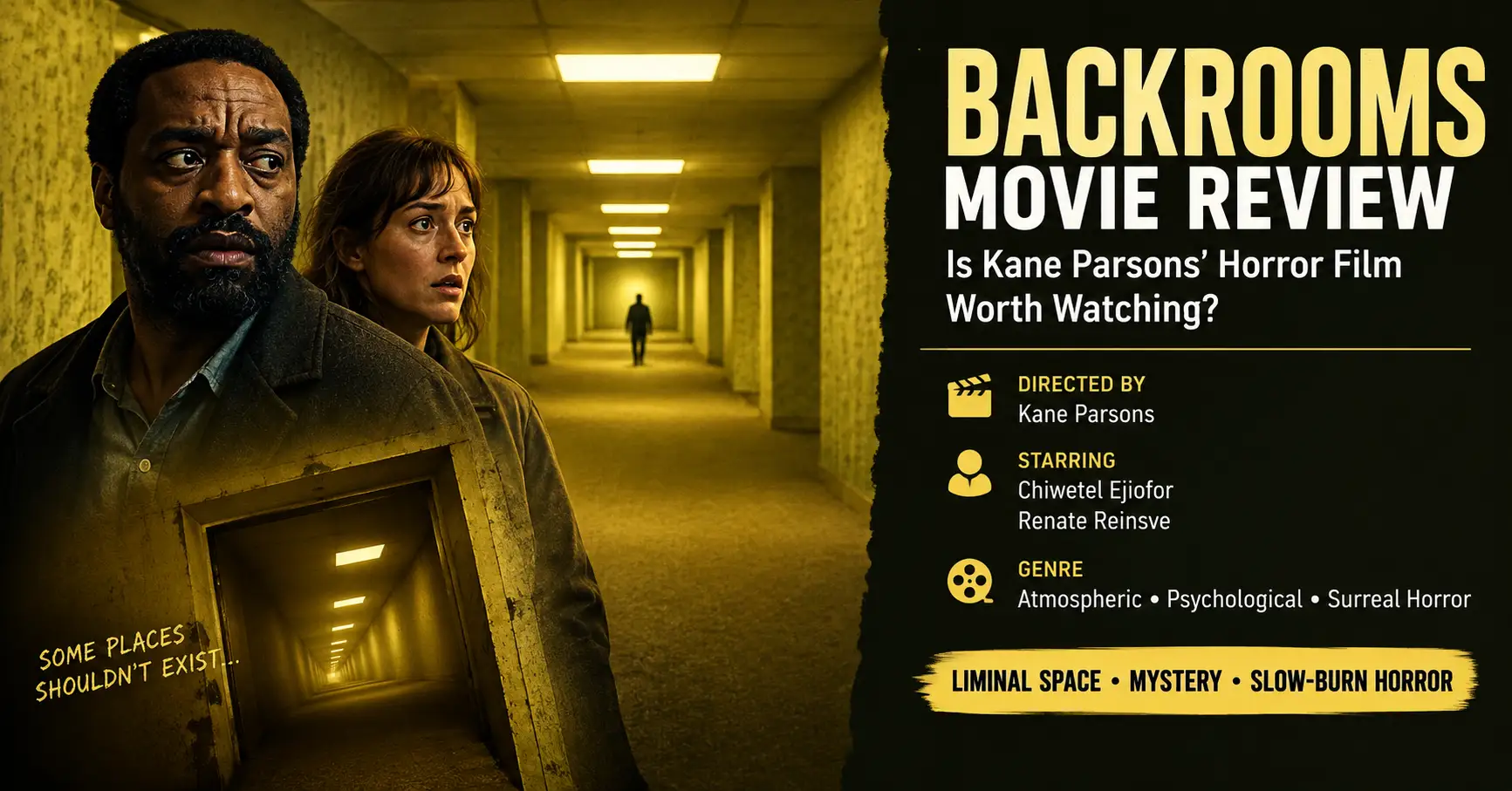
Kane Parsons’ Backrooms takes one of the internet’s strangest horror concepts and turns it into a full-length feature film. Directed by Parsons and written by Will Soodik, the 2026 movie stars Chiwetel Ejiofor and Renate Reinsve and begins with a strange doorway appearing beneath a furniture showroom.
But a strong horror concept does not automatically make a strong movie. If you are searching for a Backrooms movie review because you want to know whether the film is actually worth watching, the important question is not simply whether the yellow rooms look creepy. It is whether Kane Parsons can turn that unsettling internet idea into a satisfying cinematic experience.
The answer depends heavily on what you expect from a horror movie. Backrooms is built around atmosphere, uncertainty, strange spaces, psychological tension, and the feeling that something is fundamentally wrong with an otherwise ordinary environment. Several critics have praised those qualities, while others have argued that the film’s story and character development do not always match the strength of its central concept.
Is Backrooms Worth Watching?
If you enjoy atmospheric horror, liminal spaces, unusual visual storytelling, and movies that leave some questions deliberately open, Backrooms has plenty to offer. The film’s strongest quality is its ability to make ordinary-looking interiors feel deeply unnatural.
The concept itself is simple: a person can somehow pass through reality and enter a seemingly endless network of rooms and corridors. A24’s official synopsis describes the starting point as a strange doorway in the basement of a furniture showroom. From there, the film turns that simple idea into a much larger mystery.
What makes the movie interesting is that it does not depend entirely on explaining every rule of this strange environment. Instead, it uses uncertainty as part of the horror. You often understand that something is wrong before you understand exactly what that “something” is.
That approach has divided critical reactions. RogerEbert.com’s Brian Tallerico praised the film’s visual language and strongly directed performances, while TheWrap’s William Bibbiani argued that the impressive production design is weakened by a less convincing storyline and character psychology.
So, is Backrooms worth watching? For viewers who value atmosphere and conceptual horror, there is a strong case for seeing what Parsons has created. Viewers looking primarily for a tightly explained story or conventional horror structure may have a more mixed experience.
That distinction is important because the movie’s biggest strength and its biggest limitation come from roughly the same place: it puts enormous emphasis on the strange world it creates.
What Is Backrooms About?
At the center of Backrooms is Clark, played by Chiwetel Ejiofor. The film is set in the early 1990s and follows Clark, a struggling furniture-store owner who discovers a mysterious passage into an enormous hidden space beneath the ordinary world. Renate Reinsve plays Mary, a therapist who becomes connected to Clark and eventually enters the strange environment herself.
The important thing to understand is that the movie is not simply about someone getting lost in a maze.
The Backrooms themselves become a place where reality, memory, fear, and perception begin to blur. Screen Daily describes the central mystery through several possible interpretations, including another dimension, a scientific experiment, or something connected to the mind.
That uncertainty is intentional.
Rather than giving the viewer a straightforward explanation early on, the movie asks you to spend time inside an environment that feels familiar but is subtly wrong. The rooms resemble places you might recognize from everyday life—offices, stores, corridors, storage areas—but their endless repetition removes the comfort normally associated with those spaces.
This is one reason the Backrooms concept works so effectively as horror. Nothing has to look immediately impossible. A room can be frightening simply because it seems as though it should have an exit, but doesn’t.
The movie expands that idea into a character-driven story involving Clark, Mary, and the psychological baggage they bring with them. The Guardian’s review, for example, interprets the film through themes involving memory, reality, fear, and people becoming trapped within their own perceptions.
You do not need to know the entire Backrooms internet mythology to understand the basic movie. The feature provides its own story and characters. However, viewers familiar with Kane Parsons’ earlier work may notice how the feature expands the visual and conceptual language that made his online Backrooms videos popular.
What Kind of Horror Movie Is Backrooms?
Backrooms is best understood as atmospheric, psychological, and surreal horror with strong liminal-space elements rather than a conventional jump-scare movie.
That does not mean there are no scares. The film can use sudden shocks and disturbing imagery, but its main weapon is the environment itself.
The horror comes from questions such as:
- Where does this place actually lead?
- Why does it exist?
- Can the characters find their way back?
- What happens when familiar spaces stop behaving normally?
- How much of what the characters experience can be trusted?
Screen Daily describes the film as a slow-burn horror that combines scares with a mind-bending mystery, while The Guardian highlights its exploration of memory, reality, and fear.
That makes the movie’s pacing important.
If you expect something that constantly throws monsters or jump scares at you, parts of Backrooms may feel slower than expected. The film spends significant time establishing its spaces and allowing discomfort to build.
If you enjoy horror that makes you stare at an apparently empty hallway and wonder what might be around the next corner, the approach makes more sense.
Is It More Psychological Than Jump-Scare Horror?
For much of its runtime, the movie’s tension comes from anticipation rather than constant surprise.
The environment creates the question first; the scare comes later.
The Guardian notes that the movie gradually builds toward different kinds of scares, including jump scares and smaller unsettling moments.
That distinction matters because Backrooms is not trying to make every scene loud or immediately frightening. Its goal is often to make the viewer uncomfortable before anything obviously dangerous happens.
The result is a form of horror where an empty room can become the threat.
Why the Liminal-Space Atmosphere Matters
This is arguably the most important part of understanding why Backrooms works when it does.
The film takes spaces that normally have a practical purpose—rooms, corridors, furniture displays, office-like interiors—and removes the context that makes them feel normal.
What remains is repetition.
Yellow walls. Artificial lighting. Carpeting. Empty corridors. Familiar objects placed somewhere they do not quite belong.
Time Out describes the movie’s landscape as a huge labyrinth of harshly lit, mustard-colored rooms and corridors, while noting how its production design turns ordinary architectural elements into something unsettling.
That visual strategy is not merely decoration.
It creates the central emotional experience of the film.
You know what a room is supposed to be. You just do not know why this particular room seems endless.
And once the movie establishes that feeling, even a quiet hallway can carry tension.
Is Backrooms Actually Scary or More Unsettling?

The simplest answer is that Backrooms is often more unsettling than traditionally terrifying.
Its fear comes from isolation, uncertainty, distorted familiarity, and the possibility that the environment does not follow the rules of normal reality.
There are conventional scares as well. The Guardian specifically notes that the film builds toward jump scares, “squirm scares,” and smaller shivering moments.
But the larger effect comes from the feeling that something is wrong with the world itself.
That is why the movie’s visual design matters so much. If the Backrooms looked like an ordinary movie set, much of the concept’s psychological power would disappear.
Instead, Parsons makes the environment feel like a place you might recognize from a dream—even though you have never actually been there.
And that is where Backrooms becomes more than a simple monster-in-a-maze story.
What Works Best in Backrooms?
The biggest success of Backrooms is the world Kane Parsons has created.
The movie does not need to constantly explain why the Backrooms are frightening. In many scenes, the architecture does that work by itself. Endless corridors, strange rooms, misplaced objects, unnatural perspectives, and oppressive lighting create a space that feels recognizable enough to understand but wrong enough to distrust.
That visual approach is one of the areas where the film has received particularly strong praise. RogerEbert.com’s Brian Tallerico highlights the film’s visual language, while Screen Daily points to the extensive physical set construction used to create the Backrooms environment.
The production reportedly included around 30,000 square feet of constructed space rather than relying entirely on digital environments.
The Backrooms’ Visual Design
The production design is not simply there to make the movie look attractive.
It is part of the horror.
A normal horror location usually tells you something about where you are. A house has rooms. A hospital has recognizable departments. A forest has trees and paths. Even a haunted building normally has some kind of understandable layout.
The Backrooms deliberately removes that comfort.
A corridor can lead somewhere that makes no architectural sense. A door can appear where you would never expect one. Furniture can become part of the environment in unsettling ways. Spaces can feel both enormous and claustrophobic at the same time.
Screen Daily specifically notes details such as strangely arranged furniture, doors in unexpected positions, shoes embedded in floors, and forced perspectives.
That is why the film’s visual design is arguably more important than a simple list of monsters or scares. The location itself becomes the threat.
Kane Parsons’ Direction
Parsons also benefits from understanding where the original Backrooms concept gets much of its power: showing less than the viewer wants to see.
His direction frequently allows spaces to sit on screen long enough for the viewer to start searching the frame.
That creates a useful psychological effect.
You begin checking the background.
You notice a doorway.
You wonder whether something moved.
You start expecting the empty hallway not to remain empty.
RogerEbert.com’s review particularly praises Parsons’ visual approach, including carefully staged point-of-view sequences and a VHS-style section that changes how the audience experiences the Backrooms.
This connection to his earlier online work is important because Parsons is not approaching the Backrooms as a completely new horror setting. He is expanding a visual language that he already developed through his YouTube shorts.
Atmosphere and Sound
Sound is another major part of the movie’s effectiveness.
When characters are moving through huge spaces with relatively little dialogue, the soundtrack has to communicate what the characters cannot.
The constant hum of artificial lighting, distant noises, footsteps, and the score can make an apparently empty room feel occupied.
RogerEbert.com’s review specifically points to the atmospheric score created by Parsons and Edo Van Breemen, noting how it works underneath the recognizable hum of the fluorescent lights.
Screen Daily similarly highlights the film’s forceful score and the way its sound contributes to the strange environment.
This matters because silence in Backrooms is rarely completely comfortable.
Even when nothing is visibly happening, the soundscape can make you feel that something might happen.
The Performances
Chiwetel Ejiofor and Renate Reinsve give the movie a human center.
That is important because an endless environment can become visually impressive without necessarily giving the audience a reason to care about the people inside it.
Ejiofor plays Clark as a troubled man whose personal problems are already affecting his life before the Backrooms become part of it. Reinsve plays Mary, his therapist, with a more controlled and restrained presence.
RogerEbert.com’s review praises both performers for avoiding exaggerated “horror movie” reactions and instead allowing fear to appear through silence and restrained responses.
Screen Daily also describes the two performances as strong, emphasizing the contrast between Clark’s impulsive personality and Mary’s more controlled nature.
That restraint helps the film.
If every discovery produced screaming and dramatic reactions, the Backrooms would quickly feel less mysterious. Sometimes a character simply stopping and looking at something is more effective.
Where Does Backrooms Fall Short?
The biggest criticism surrounding Backrooms is not its visual world.
It is what happens when the movie tries to explain and dramatize that world through its story.
This is where critical responses become more divided.
RogerEbert.com’s review sees the film as an effective and promising expansion of the concept, while TheWrap argues that the production design is substantially stronger than the storyline and character psychology. The Ringer similarly argues that the film struggles when it moves from carefully maintained ambiguity toward explaining what is happening.
That difference is important for viewers because the exact thing that makes the Backrooms fascinating—the mystery—can also become difficult to manage in a feature-length story.
Does the Story Match the Strength of the Concept?
The original Backrooms idea is powerful partly because it is incomplete.
You see the room.
You know something is wrong.
But you do not necessarily know why.
A feature film has a different challenge. It needs characters, progression, conflict, and some form of narrative development.
Backrooms tries to build those elements around Clark and Mary while also expanding the mythology.
For some viewers, that expansion makes the movie richer. For others, it weakens the mystery by explaining parts of something that was more frightening when it remained undefined.
TheWrap’s review is particularly critical of the film’s exposition and argues that some explanations undermine the scarier portions of the movie.
The Ringer makes a related criticism, arguing that the film’s revelations do not always justify the ambiguity that comes before them.
This is therefore less a simple question of whether the movie “has a story” and more a question of whether the story complements the concept.
Are the Characters Developed Enough?
The performances themselves are generally one of the movie’s stronger areas, but some reviewers have questioned how much the screenplay gives those performances to work with.
TheWrap argues that Reinsve’s character is held back by the screenplay and that Clark’s development does not always feel sufficiently motivated.
That criticism should be separated from the acting.
The actors can deliver convincing performances while the script still leaves some character decisions feeling underdeveloped.
For viewers who primarily watch horror for atmosphere, this may not be a major problem.
For viewers who need strong character arcs to make a horror story emotionally satisfying, it may become more noticeable.
How Does Backrooms Compare With the Kane Pixels Series?
This is one of the most important questions for anyone who already knows the Backrooms from the internet.
The feature film is not an unrelated Hollywood movie that merely borrows the name.
Kane Parsons created the original Backrooms YouTube material, and the feature represents his move from those short-form digital productions into a large-scale theatrical production. Screen Daily describes the feature as being based on Parsons’ own YouTube shorts, while Time Out notes that the film expands his earlier analogue-style visuals with a much larger production.
The difference is scale.
The earlier videos could depend heavily on mystery, short runtime, and the power of a single disturbing location.
A feature film has to sustain that feeling for much longer.
That means Backrooms adds:
- A larger cast
- A developed human storyline
- A broader mythology
- More locations within the Backrooms
- Longer character interactions
- A conventional feature-film structure
At the same time, Parsons keeps some of the visual language associated with the original material.
The VHS aesthetic and found-footage elements are particularly important because they help connect the feature to the internet series rather than making it feel completely disconnected from its origins.
For longtime fans, this creates an interesting balance.
The movie is clearly bigger than the original videos, but it still wants to preserve the unsettling visual identity that made the concept recognizable in the first place.
Who Should Watch Backrooms—and Who Might Not Enjoy It?
The easiest way to decide whether Backrooms is for you is to think about what you want from horror.
You may enjoy it if you like:
- Liminal-space horror
- Atmospheric tension
- Psychological horror
- Surreal environments
- Mystery and ambiguity
- Experimental filmmaking
- Slow-burn horror
- Kane Pixels’ original Backrooms work
- Horror where the environment itself feels dangerous
Several reviews emphasize exactly these qualities. Time Out praises the film’s surreal visual environment, while RogerEbert.com highlights its visual language, sound design, and unusual spaces.
You may be less satisfied if you expect:
- Constant jump scares
- A simple monster story
- A straightforward explanation of everything
- Conventional horror pacing
- A tightly structured mystery with every question resolved
- Characters whose development is always clearly explained
That does not automatically make the movie successful or unsuccessful for every viewer.
It simply explains why reactions can differ.
Someone primarily interested in the experience of being inside the Backrooms may find the film’s ambiguity valuable.
Someone primarily interested in a tightly constructed narrative may focus more heavily on the screenplay’s weaker areas.
Backrooms Movie Review: Final Verdict
Backrooms is most successful when it trusts its central idea.
The endless rooms, distorted architecture, fluorescent lighting, sound design, VHS imagery, and carefully controlled camera work create a distinctive horror environment. Those elements give Kane Parsons’ feature a visual identity that goes beyond simply recreating the internet concept that inspired it.
The film becomes more divisive when it tries to explain that world and give its mystery a larger psychological and narrative framework.
Some critics have found that expansion thoughtful and ambitious. Others have argued that the explanations and character writing weaken the mystery that made the concept powerful in the first place.
So the most useful way to approach Backrooms is not to expect a conventional horror movie.
Expect an atmospheric, surreal journey into an environment designed to make familiar spaces feel fundamentally wrong.
If that sounds like the kind of horror you enjoy, the movie has a lot to explore.
If you need every mystery explained and every character decision to follow a conventional dramatic structure, some of its choices may frustrate you.
The important takeaway is that Backrooms does not succeed simply because the Backrooms are already a popular horror concept. Its strongest moments come from what Parsons does with that concept on screen—and its weaker moments appear when the feature-length story struggles to carry the same mystery that made the original idea so effective.
Frequently Asked Questions
Is Backrooms based on Kane Pixels?
Yes. The 2026 feature is directed by Kane Parsons, the creator behind the Backrooms YouTube series, and expands the concept he previously developed through his online shorts.
Who stars in the Backrooms movie?
The main cast includes Chiwetel Ejiofor as Clark and Renate Reinsve as Mary, with Mark Duplass, Finn Bennett, Lukita Maxwell, and Avan Jogia also appearing.
How long is Backrooms?
The movie has a reported runtime of 110 minutes.
Is Backrooms a jump-scare movie?
It contains jump scares, but it is not built entirely around them. Much of its horror comes from atmosphere, uncertainty, strange architecture, sound, and psychological tension.
Do you need to know the Backrooms lore before watching?
No. The feature establishes its own characters and premise, although viewers familiar with the online Backrooms material may recognize references and visual connections to Parsons’ earlier work.
Is Backrooms suitable for someone who prefers traditional horror?
It depends on what you mean by traditional horror. The movie contains conventional scares, but its primary approach is atmospheric and surreal rather than relying constantly on monsters or jump scares. Viewers expecting a straightforward horror narrative may find its ambiguity and pacing less conventional.