

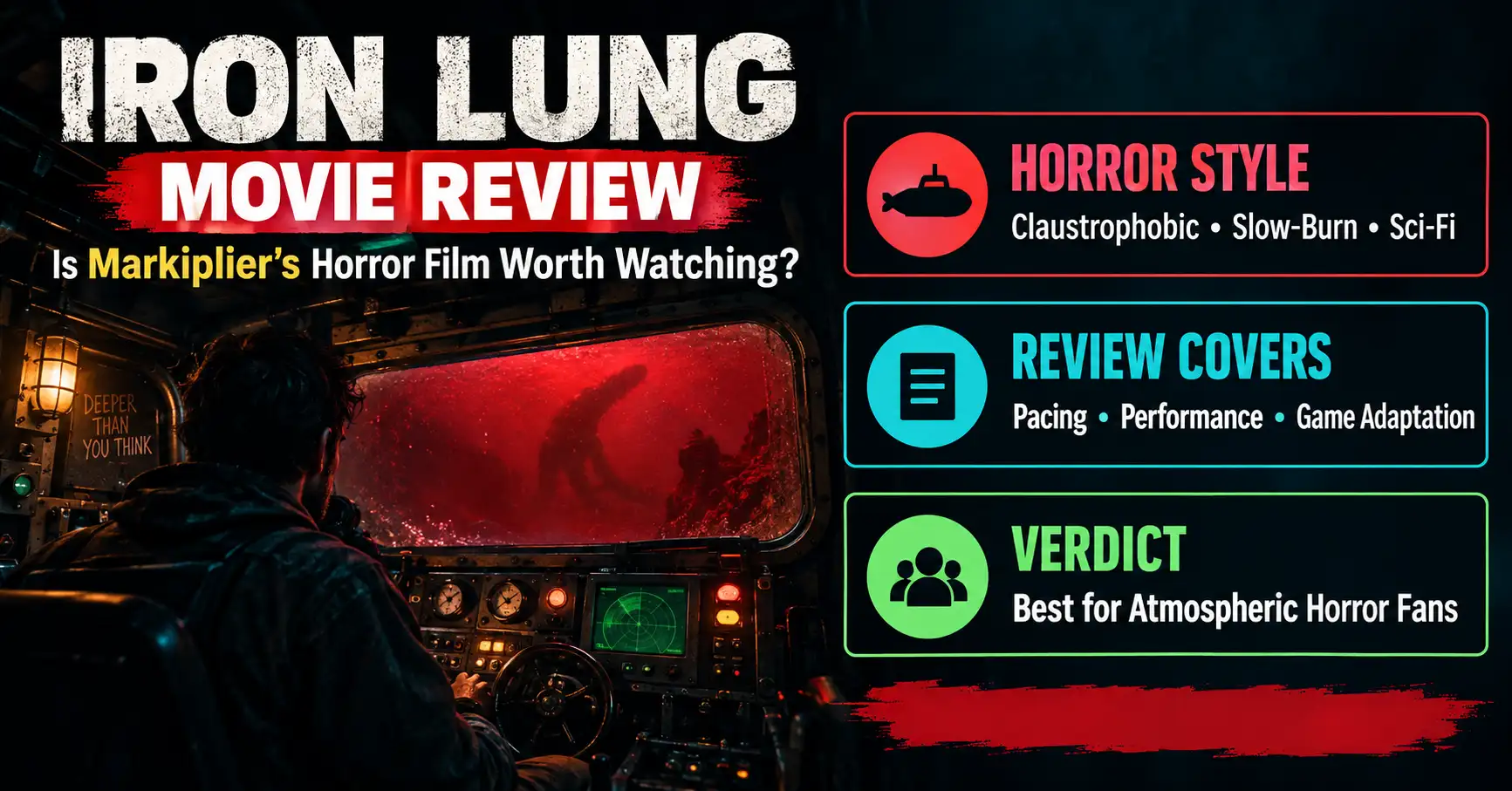
If you searched for an Iron Lung movie review, you probably want more than a basic plot summary. You want to know whether the movie is worth watching, how scary it is, whether Markiplier delivers a convincing performance, and how well the film adapts the original video game.
Iron Lung is a science-fiction horror film built around isolation, claustrophobia, and the fear of the unknown. Its confined setting creates a distinctive horror experience, but its slow pacing and deliberately mysterious storytelling may not work for everyone.
In this review, we’ll explore the movie’s strengths, weaknesses, atmosphere, performances, and connection to the game so you can decide whether it suits your preferences.
What Is Iron Lung About?
Iron Lung is a sci-fi horror movie based on the video game of the same name by David Szymanski. The story takes place in a bleak future where a mysterious event known as the Quiet Rapture has left humanity struggling to survive.
The film follows Simon, a convict sent into an ocean of blood aboard a small submarine. His mission involves exploring the environment outside the vessel, but the limited visibility and dangerous surroundings make every expedition uncertain.
Rather than relying entirely on conventional jump scares, the movie builds tension through the submarine’s confined interior and the unknown dangers beyond it. The audience experiences much of the uncertainty alongside Simon, making the environment itself an important part of the horror.
The film is also notable because Mark Fischbach, better known as Markiplier, directed and stars in it. His involvement makes the project interesting not only as a game adaptation but also as an attempt to bring an independent horror concept to the big screen.
Is Iron Lung a Good Movie?
Whether Iron Lung is a good movie depends largely on what you expect from horror.
The film focuses on atmosphere, confinement, uncertainty, and slow-building tension rather than constant action. If you enjoy horror that creates discomfort gradually, its approach may appeal to you.
However, viewers who prefer fast pacing, frequent jump scares, and continuous story developments may find parts of the movie frustrating.
The key question is not simply whether Iron Lung is scary. It is whether the film successfully turns its unusual premise into an engaging cinematic experience.
What the movie does well
One of the film’s biggest strengths is its setting. A submarine surrounded by an unfamiliar and potentially dangerous environment naturally creates a feeling of vulnerability.
The limited space also gives the filmmakers a clear way to establish tension. Characters cannot freely escape, and the audience cannot easily see what lies beyond the vessel.
The movie’s atmosphere benefits from this uncertainty. Small changes in the environment can become meaningful because viewers are already aware of how little control Simon has over his situation.
Its connection to the original game also provides an interesting foundation. The film retains the central idea of exploring an unknown environment from inside a restrictive vessel while expanding the premise into a feature-length story.
Where the movie falls short
The deliberate approach to horror can become a weakness when scenes take too long to develop.
Because much of the story takes place inside the submarine, the movie must maintain interest through performance, sound, visual composition, and gradual revelations. When those elements do not create enough momentum, the experience can feel repetitive.
The film’s mysterious storytelling may also frustrate viewers who prefer clear explanations. Some ambiguity can make horror more unsettling, but too much can leave audiences unsure how to interpret what they have watched.
These weaknesses do not necessarily make the film unsuccessful. They explain why its particular style may appeal strongly to some viewers while leaving others disappointed.
What Kind of Horror Is Iron Lung?
The horror in Iron Lung is primarily built around claustrophobia, isolation, and uncertainty.
Instead of relying exclusively on a visible monster or a series of sudden scares, the film uses its environment to make the audience feel that something dangerous could be nearby without knowing exactly what it is.
Claustrophobia and isolation
The submarine is one of the film’s most important storytelling elements.
Its narrow interior limits movement, while the surrounding ocean creates a sense of separation from the outside world. Simon cannot simply leave when the situation becomes frightening.
This restriction makes the setting feel threatening even during relatively quiet scenes. The audience understands that the character has few options if something goes wrong.
Slow-burn tension
Iron Lung allows tension to develop gradually.
Rather than immediately revealing every danger, it uses uncertainty and atmosphere to encourage viewers to imagine what might be happening outside the submarine.
This approach can be effective for people who enjoy psychological tension. However, those expecting frequent jump scares may find the horror less immediate than they anticipated.
Cosmic and body-horror elements
The movie also draws on science-fiction horror and disturbing imagery.
Its larger mystery gives the story a sense of danger that extends beyond Simon’s immediate surroundings. The horror is not just about surviving a dangerous environment; it is also about confronting something that may be difficult to understand.
These elements give Iron Lung a different feel from a conventional slasher or haunted-house film.
Is Iron Lung Too Slow?
Pacing is one of the most important considerations when deciding whether to watch Iron Lung.
The film spends considerable time establishing its environment, showing Simon’s situation, and building tension. This allows the submarine to become a familiar but increasingly uncomfortable place.
However, the same approach can make the middle portions feel drawn out.
Why the slower pacing works
The gradual pace gives the audience time to understand the submarine’s limitations and become familiar with Simon’s routine.
As the situation develops, changes to that routine can feel more significant. The film does not need to introduce a major event in every scene because the atmosphere itself contributes to the tension.
The approach also reflects the original game’s emphasis on exploration, restricted information, and uncertainty.
Where the pacing becomes a weakness
The problem arises when the atmosphere stops developing and scenes begin to feel repetitive.
A slow scene can build suspense, reveal something important, or deepen a character. When it does none of these things, it can make the movie feel longer than necessary.
If you prefer fast-moving horror, this is an important consideration. If you enjoy patient, atmospheric films, the slower sections may be easier to appreciate.
Ultimately, Iron Lung treats slow pacing as part of its horror style, but whether that choice works will depend on the viewer.
How Good Is Markiplier’s Performance and Filmmaking?

Markiplier’s involvement is one of the most distinctive aspects of Iron Lung. He takes on multiple creative roles, including directing and starring in the film.
This makes his work behind and in front of the camera important to the overall experience.
Markiplier as Simon
The role places considerable responsibility on Fischbach because the story spends much of its time following Simon in isolation.
The character must keep the audience engaged even when there are few other people on screen. That requires the performance to communicate fear, frustration, and uncertainty through dialogue, expressions, and reactions.
The confined setting also limits the opportunities for conventional dramatic interaction. Much of the emotional weight rests on how convincingly Simon responds to his circumstances.
For viewers familiar with Markiplier primarily through YouTube, the film provides an opportunity to see him in a more sustained dramatic role.
Markiplier as director
The direction has a clear challenge: making a largely confined setting visually engaging throughout a feature-length film.
The submarine’s interior helps create a consistent atmosphere, while restricted camera perspectives reinforce the character’s limited understanding of his surroundings.
However, a deliberately limited setting also creates filmmaking challenges. The director must maintain visual and narrative variety without undermining the claustrophobic atmosphere.
The effectiveness of the direction therefore depends on whether the visual choices continue to build tension or begin to feel repetitive.
How Well Does Iron Lung Adapt the Game?
The movie is based on David Szymanski’s 2022 indie horror game, but adapting a game into a feature film requires more than recreating its central setting.
A game can build tension through player control, exploration, and interaction. A movie must communicate those experiences through performance, cinematography, sound, and storytelling.
What the movie keeps from the game
The film retains the central premise of exploring a dangerous environment from inside a small submarine.
It also preserves the importance of limited visibility and incomplete information. These elements are central to the original concept and provide a natural foundation for cinematic suspense.
For fans of the game, these familiar elements help connect the movie to its source material.
What the movie expands
A feature-length narrative requires more character development and story material than a relatively short game.
The film therefore expands the world and gives the premise a broader narrative framework.
This provides opportunities to explore the setting and characters in greater detail, but it also introduces a challenge: additional material can make the story feel more substantial, or it can weaken the simplicity that made the original concept effective.
The central question is whether those additions improve the experience as a film.
For viewers who value the game’s minimalism, the expanded narrative may feel like a significant departure. For others, the additional context may make the world more engaging.
Can You Understand Iron Lung Without Playing the Game?
Yes. You do not need to play the original game to understand the basic premise of the movie.
The film presents its own characters, situation, and central conflict. New viewers can follow Simon’s experience without first learning the game’s mechanics or completing its story.
However, the movie deliberately leaves some information uncertain. That ambiguity is part of its storytelling approach, rather than necessarily being evidence that viewers are missing knowledge from the game.
What prior knowledge adds
If you have played Iron Lung, you will already understand the basic premise and may recognize how the film develops the original concept.
You can also compare the movie’s expanded narrative with the game’s more limited approach.
What newcomers should expect
If you have never played the game, approach the film as a mysterious science-fiction horror story rather than expecting every detail to be explained immediately.
You should be able to follow the main situation, but some aspects of the world and its larger mystery may remain open to interpretation.
Who Is Iron Lung Actually For?
The movie’s appeal depends on your preferences as a horror viewer.
If you enjoy atmospheric horror
The film’s claustrophobic environment, isolation, and slow-building tension may appeal to you. It places greater emphasis on atmosphere than on constant action.
If you’re a fan of the game
The adaptation gives you an opportunity to see how the original premise translates into a feature film, including the additional story material and character development.
If you’re watching because of Markiplier
The movie offers a chance to see Markiplier working as a director and lead actor. You can evaluate the filmmaking independently of your existing interest in his online work.
If you prefer fast-paced horror
The film’s deliberate pacing may be a drawback. If you want frequent scares, rapid developments, and a constantly changing environment, its restrained approach may not match your expectations.
Iron Lung Movie Review: Final Takeaway
Iron Lung builds its horror around a simple but effective idea: trapping a character in a confined environment while surrounding him with something he cannot fully understand.
Its central strengths are the submarine setting, claustrophobic atmosphere, and gradual approach to tension. Its biggest challenges are pacing and the risk that its deliberately mysterious storytelling may leave some viewers wanting more explanation.
Markiplier’s involvement adds another dimension to the film, both as a performance and as a directing project. The adaptation also raises an interesting question about how a game built around exploration and limited information can become a feature-length narrative.
Ultimately, Iron Lung is most suited to viewers who appreciate atmospheric, slow-burn science-fiction horror. If that sounds like your kind of movie, its unusual premise may be enough to make it worth watching. If you prefer fast-paced horror with frequent scares and clear explanations, you may find its approach less satisfying.
Iron Lung Movie FAQ
Is Iron Lung based on a video game?
Yes. The movie is based on the indie horror game Iron Lung, created by David Szymanski and released in 2022.
Who directed Iron Lung?
Mark Fischbach, better known as Markiplier, directed the film and also stars in it.
Do you need to play Iron Lung before watching the movie?
No. The movie provides its own narrative setup. Playing the game can give you additional context, but it is not a prerequisite for following the film.
Is Iron Lung a jump-scare movie?
Not primarily. Its horror relies heavily on claustrophobia, isolation, uncertainty, and slow-building tension rather than a constant sequence of jump scares.
Is the Iron Lung movie different from the game?
Yes. The film expands the game’s central premise into a longer narrative, adding story material and developing the world for a cinematic audience.
Is Iron Lung suitable for people who dislike gore?
Viewers who are sensitive to graphic horror should check the film’s content classification and parental guidance information before watching. The movie includes disturbing horror imagery, so it may not be suitable for everyone.
Is Iron Lung worth watching if you haven’t played the game?
It can be, particularly if you enjoy atmospheric science-fiction horror. The film can be approached as a standalone story, although some viewers may find its pacing and ambiguity challenging.