

ChatGPT is an artificial intelligence (AI) chatbot developed by OpenAI. It allows people to communicate with an AI system using normal, conversational language. Users can ask questions, request explanations, create written content, write or debug code, summarize information, generate ideas, and complete many other tasks.
ChatGPT is part of the broader field of generative AI, which means AI systems can create new content based on instructions or prompts. Depending on the tools and capabilities available, generative AI can work with different types of content, including text, images, audio and other information.
In simple words, ChatGPT is an AI assistant that understands prompts and generates responses designed to be useful and conversational.
What Does ChatGPT Stand For?
GPT stands for Generative Pre-trained Transformer.
Each part of the name describes an important part of the technology:
- Generative means it can generate new content.
- Pre-trained means the model is trained on large amounts of data before being used for tasks.
- Transformer refers to the neural-network architecture used by modern language models to process patterns in language.
The name ChatGPT therefore describes an AI system built to generate language-based responses using transformer technology.
Who Created ChatGPT?
ChatGPT was created by OpenAI, an artificial intelligence research and technology company. OpenAI launched it publicly in November 2022, and the chatbot quickly became widely known as a major example of generative AI.
Since its launch, this AI assistant has developed beyond simple text conversations. AI assistants can now support a wider range of activities, depending on the model, plan and tools available.
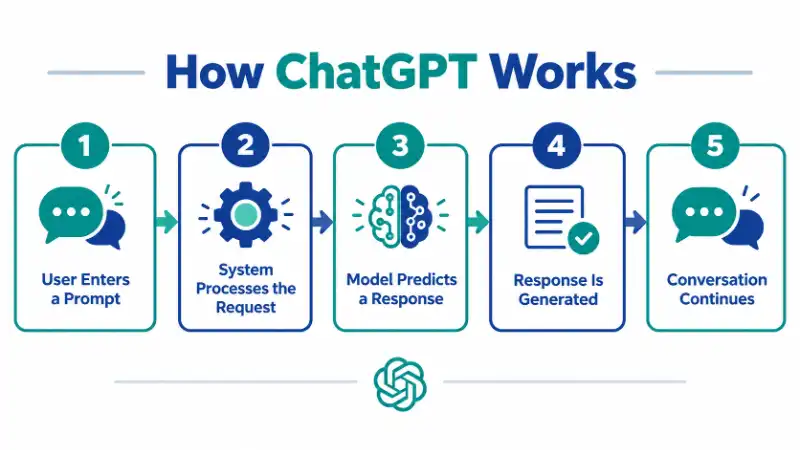
How Does ChatGPT Work?
ChatGPT uses machine learning and transformer-based language models to process user prompts and generate responses.
The process can be explained in a simple way.
1. The User Enters a Prompt
Everything starts when a person enters a question, instruction or request. For example: “Explain artificial intelligence in simple words.” The prompt provides the system with the information it needs to understand what the user wants.
2. The System Processes the Request
It analyzes the words and context in the prompt, looking at relationships between words and patterns learned during training. This allows the model to determine what type of response is appropriate.
3. The Model Predicts a Response
A language model generates text by predicting likely sequences of tokens based on the input and the context. It does not simply search a database for one fixed answer. Instead, it generates a response based on patterns learned during training and the information available in the current conversation.
4. The Response Is Generated
The system produces a response one part at a time. The result is presented as a conversational answer that can be refined through additional prompts. For example, after asking for an explanation, a user can say: “Make it easier.” The assistant can then provide a simpler version.
5. The Conversation Can Continue
One useful feature of conversational AI is the ability to continue a discussion using previous context. A user can ask follow-up questions instead of starting from the beginning every time.
What Can You Use ChatGPT For?
ChatGPT can be used for many personal, educational and professional tasks.
Writing and Editing
People can use it to:
- Write emails
- Create blog ideas
- Draft social media posts
- Rewrite sentences
- Improve grammar
- Create outlines
- Write product descriptions
- Summarize information
- Develop scripts
It can also help transform existing information into another format, such as turning notes into an organized article.
Coding and Programming
This AI tool can assist programmers with different development tasks. For example, it can help users:
- Understand programming concepts
- Write code
- Find possible bugs
- Explain errors
- Create code examples
- Improve existing code
- Learn new programming languages
However, generated code should be reviewed and tested before being used in important systems.
Education and Learning
Students and learners can use it as an interactive learning assistant. For example, someone can ask:
- “Explain photosynthesis in simple English.”
- “Give me examples of algebra equations.”
- “Explain this programming error.”
- “Create a quiz about history.”
The ability to ask follow-up questions can make complex subjects easier to understand.
SEO and Marketing
The chatbot can also support digital marketing and SEO workflows. Marketers may use it for:
- Keyword ideas
- Content outlines
- Meta description drafts
- Blog topic ideas
- Social media content
- Product descriptions
- FAQ ideas
- Content rewriting
- Search intent brainstorming
However, SEO professionals should verify facts, search intent, competition and current search trends rather than publishing AI-generated content without review.
Research and Brainstorming
It can help users organize ideas and explore a topic — generating questions, explaining concepts, comparing ideas and creating structured outlines. For current or highly specific information, users should verify important facts with reliable sources.
What Are the Benefits of ChatGPT?

This AI assistant can provide several practical benefits.
1. Saves Time — It can help with repetitive writing, brainstorming and explanation tasks, reducing the time required to create a first draft or organize information.
2. Easy to Use — Users can communicate with it using normal language instead of learning a complicated interface or programming language.
3. Helps With Learning — A user can request simple explanations, examples, step-by-step instructions and follow-up clarification.
4. Supports Different Languages — It can work with multiple languages and can assist with translation and multilingual communication.
5. Helps With Creativity — Writers, marketers and creators can use it to brainstorm ideas, titles, scripts, outlines and different approaches to a topic.
6. Improves Productivity — Businesses and individuals can use AI assistance for routine tasks, allowing people to spend more time on tasks requiring human judgment and decision-making.
7. Available for Different Types of Tasks — It can support writing, coding, education, research, brainstorming and other workflows. Its exact capabilities depend on the version and tools available.
According to TechTarget, efficiency, education, faster responses, multilingual support, personalization and scalability are also among the potential benefits of this AI assistant and similar systems.
What Are the Limitations of ChatGPT?
Although this AI tool is powerful, it is not perfect.
Incorrect Information — AI systems can sometimes generate incorrect or misleading information. A response can sound confident even when some details are wrong. For important subjects, users should verify information using trustworthy sources.
Lack of Human Understanding — It can produce natural-sounding language, but that does not mean it understands the world in exactly the same way a human does. It works through learned patterns and computational processes rather than human experience.
Outdated Information — The information available to an AI system can depend on its model, tools and access to current information. Therefore, users should not automatically assume that every response contains the latest information.
Context Problems — Sometimes an AI assistant can misunderstand what a user means or focus on the wrong part of a question. Clear prompts and additional clarification can help.
Human Review Is Important — AI-generated text may need editing for accuracy, tone, originality and context. This is particularly important for professional documents, medical information, financial decisions, legal matters and other high-impact subjects.
Is ChatGPT Safe to Use?
This AI assistant can be useful when used responsibly, but users should still consider privacy, security and accuracy.
People should avoid sharing sensitive information unless they understand how that information is handled and what controls are available. Businesses should also establish rules for using AI with confidential company information.
Another concern is the possibility of using AI to produce misleading content, impersonate people or support harmful activities. TechTarget discusses concerns including privacy, security, bias, cheating and misuse of AI-generated content.
ChatGPT and Generative AI
ChatGPT is an example of generative AI. Generative AI refers to AI technology that can create new content based on user instructions.
For example, generative AI can be used to create:
- Text
- Images
- Audio
- Computer code
- Summaries
- Other digital content
It became one of the most recognizable consumer applications of generative AI because it made conversational interaction with an AI system accessible to a large audience.
ChatGPT vs Traditional Chatbots
Traditional chatbots often rely on predefined responses, rules or decision trees. For example, a basic customer-service chatbot may provide:
User: “What are your opening hours?”
Chatbot: “We are open from 9 AM to 5 PM.”
If the user asks something outside the chatbot’s programmed options, it may struggle to respond.
This AI system uses a language-model approach that allows it to generate responses to a much wider variety of prompts, making conversational AI more flexible than many traditional rule-based chatbots.
Who Uses ChatGPT?
This AI tool can be useful for many different groups.
Students — Can use it to understand difficult topics, generate study questions and organize notes.
Teachers — Can use AI assistance for lesson ideas, examples, quizzes and educational content.
Developers — Can use it for code explanations, debugging assistance and programming ideas.
Writers — Can use it for brainstorming, outlining, editing and drafting.
Businesses — Can use AI assistants for content creation, customer support workflows, internal productivity and other tasks.
Marketers — Can use it for content ideas, SEO brainstorming, advertising copy, social media posts and other marketing tasks.
What Is the Future of ChatGPT?
It has continued to expand from a basic conversational chatbot into a broader AI assistant.
Modern AI systems increasingly support capabilities such as web research, image understanding, voice interaction, file analysis, coding and task automation, depending on the tools and model being used.
For example, OpenAI introduced agent capabilities that combine browsing, code execution and other tools to handle more complex, multi-step tasks. This suggests that AI assistants are becoming more useful not only for answering questions but also for helping users complete tasks.
Why Is ChatGPT Important?
ChatGPT is important because it changed how many people interact with artificial intelligence.
Instead of requiring technical knowledge, users can communicate with an AI system through ordinary language. A person can ask a question, request an explanation, change the format, ask for examples and continue the conversation.
This conversational approach has helped make generative AI more accessible to students, professionals, businesses, developers and everyday users.
Conclusion
ChatGPT is an AI chatbot created by OpenAI that uses language-model technology to understand prompts and generate conversational responses. It can help users with writing, coding, learning, brainstorming, research, marketing and many other tasks.
Its biggest advantages include convenience, speed, flexibility and the ability to communicate using natural language. At the same time, it can produce inaccurate information and should not replace human judgment, professional expertise or fact-checking.
The best way to use this AI assistant is as a helpful tool rather than an unquestionable source of truth. When users combine AI assistance with human knowledge, verification and judgment, it can become a useful tool for everyday and professional work.
FAQs About ChatGPT
What does ChatGPT stand for?
ChatGPT stands for Chat Generative Pre-trained Transformer. GPT refers to Generative Pre-trained Transformer, the technology behind the language model.
What is ChatGPT in simple words?
It is an AI assistant that lets people ask questions and give instructions using normal language, then generates a response based on the prompt and available context.
Who created ChatGPT?
It was created by OpenAI and launched publicly in November 2022.
What can ChatGPT do?
It can help with writing, coding, learning, brainstorming, summarizing, content creation, explanations, translation and many other tasks.
Is ChatGPT free?
It has offered free access as well as paid plans, although available features and usage limits can change over time.
Is ChatGPT the same as Google?
No. Google is primarily a search engine and technology company, while this is an AI conversational system. Depending on the tools available, it can also provide web-based information and other capabilities.
Can ChatGPT write articles?
Yes. It can generate drafts, outlines, introductions, FAQs and other forms of written content. Human review is recommended to check accuracy, originality, quality and usefulness.
Can ChatGPT write code?
Yes. It can generate, explain and help debug computer code. Developers should test generated code before using it in production systems.
Is ChatGPT always accurate?
No. It can make mistakes or generate incorrect information. Important information should be checked against reliable and current sources.
Why is ChatGPT so popular?
It made AI interaction simple by allowing people to communicate with an AI system using everyday language. Its broad range of uses has made it useful for education, writing, coding, business and many other activities.