

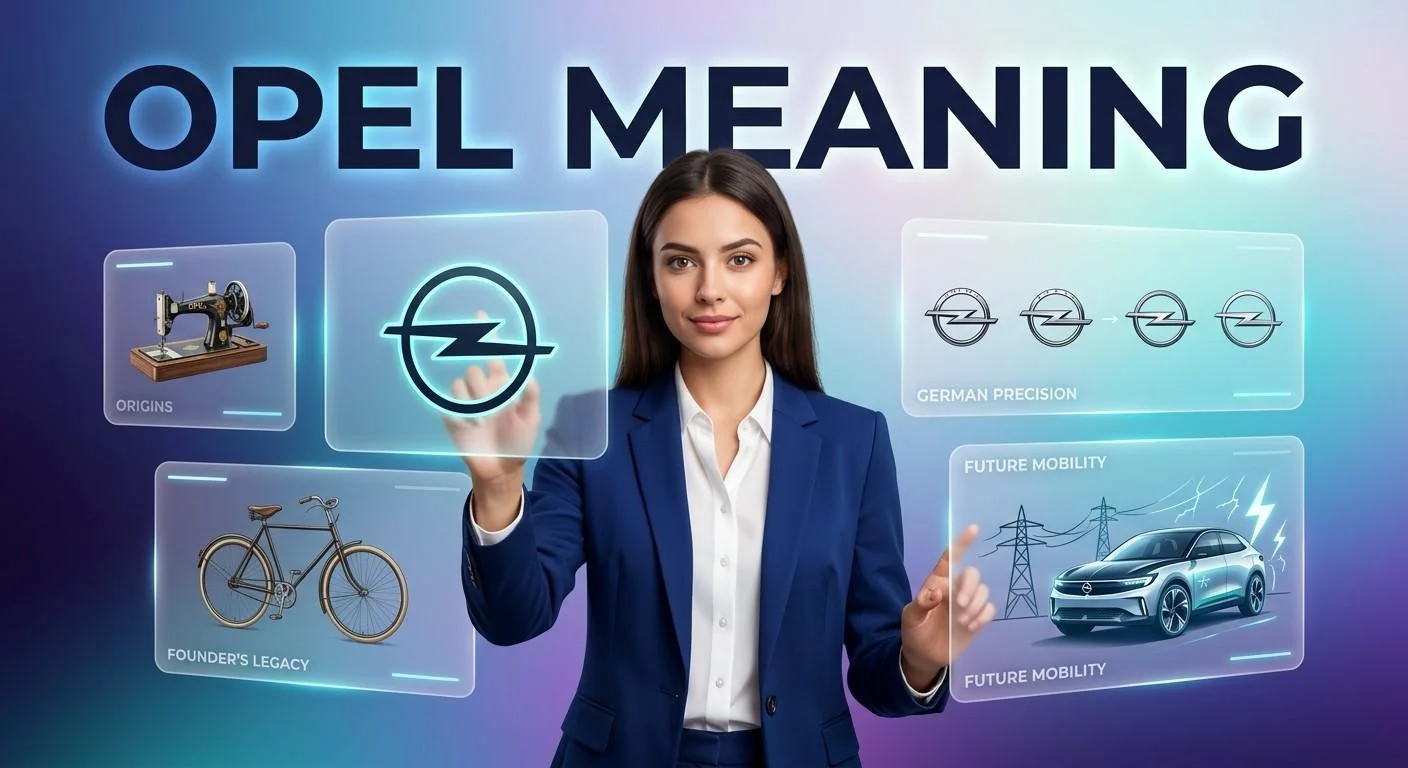
If you searched for opel meaning, you may be wondering whether it is a word, abbreviation, or something connected to cars. In most contexts, Opel refers to the well-known German automobile brand founded by Adam Opel. Its name comes from the Opel family rather than from an acronym. This guide explains the name, history, logo, pronunciation, and what Opel represents today in simple language.
⚡ Quick Answer
Opel meaning refers primarily to the name of a German automobile brand. The name comes from Adam Opel, who founded the original company in Rüsselsheim, Germany, in 1862. The business first made sewing machines before moving into bicycles and automobiles. Opel produced its first automobile in 1899 and later became one of Germany’s best-known car manufacturers. (Encyclopedia)

What Does Opel Mean?
- Opel is primarily the name of a German automobile brand with a long industrial history.
- The name comes from Adam Opel, the founder of the original business in Rüsselsheim.
- Unlike many modern abbreviations, Opel does not traditionally stand for a phrase or sentence.
- When people ask what Opel means, they usually want to understand the brand behind the name.
- The company began in 1862, long before automobiles became common transportation.
- Adam Opel originally focused on manufacturing sewing machines rather than cars.
- The company later expanded into bicycles, which helped prepare it for the automotive industry.
- Opel eventually entered automobile production near the beginning of the twentieth century.
- That transition helped turn a family business into a major European automotive name.
- Today, Opel is strongly associated with German automotive design and everyday mobility.
- The brand name therefore carries historical meaning rather than a hidden acronym.
- Many people recognize Opel through its distinctive lightning-bolt emblem.
- The name can also appear alongside model names such as Corsa, Astra, Mokka, and other vehicles.
- Its meaning becomes clearer when you look at the story of the Opel family.
- The brand’s history shows how one workshop gradually became an automobile manufacturer.
- That makes the name interesting even if you are not particularly interested in cars.
- In simple terms, Opel means the automotive brand that grew from Adam Opel’s original enterprise.
- So, if someone mentions Opel in a conversation, they are usually talking about cars, not slang.
Where Did the Opel Name Come From?
- The Opel name comes directly from the surname of Adam Opel, the company’s founder.
- Adam Opel established his first manufacturing business in Rüsselsheim, Germany, in 1862.
- His early work focused on sewing machines, which were important industrial products at the time.
- The company grew as demand for its products increased.
- Adam Opel later became interested in bicycles through his family and changing consumer interests.
- Bicycle manufacturing gave the business experience with mechanical production and transportation products.
- His sons eventually helped move the company toward automobile manufacturing.
- This family connection explains why the Opel surname became attached to the automobile business.
- The name was therefore not invented as a modern marketing abbreviation.
- It developed naturally from the family name of the company’s founder.
- This is similar to many famous brands whose names originally came from their founders.
- Understanding this background removes much of the mystery surrounding the word Opel.
- Historical records identify Adam Opel as the founder of the company in 1862.
- His original workshop eventually developed into a much larger industrial operation.
- The Opel family continued shaping the company after Adam Opel’s death.
- His five sons played an important role in moving the business toward automobiles.
- The surname eventually became recognized far beyond the German city where the company began.
- Today, the Opel name remains closely connected with European automobile manufacturing. (Encyclopedia)
How Opel Started as a Sewing Machine Company
- One surprising fact is that Opel did not begin as a car manufacturer.
- Adam Opel started producing sewing machines during the nineteenth century.
- His first machines were reportedly made by hand in a small workshop.
- The business grew quickly enough to move into larger manufacturing facilities.
- Sewing machines helped establish the company’s early reputation for mechanical production.
- At that time, automobiles were still experimental and far from everyday transportation.
- The idea of building cars came much later in the company’s development.
- Opel’s expansion into bicycles created another important step toward mobility products.
- The company eventually became a major bicycle manufacturer in Germany.
- Opel bicycles gained attention partly because Adam Opel’s sons competed successfully in bicycle races.
- Those experiences gave the family greater confidence in transportation manufacturing.
- After Adam Opel died in 1895, his sons began exploring new opportunities.
- The automobile industry looked increasingly promising at the end of the nineteenth century.
- The brothers decided that cars could become an important part of the company’s future.
- They brought in outside expertise to help develop their first automobile.
- This decision marked a major turning point in the company’s history.
- The journey from sewing machines to automobiles was gradual rather than sudden.
- That unusual beginning is one reason Opel has such a fascinating automotive history. (Encyclopedia)
When Did Opel Start Making Cars?
- Opel entered automobile manufacturing at the end of the nineteenth century.
- The company’s first automobile was produced in 1899 with the help of Friedrich Lutzmann.
- Lutzmann was an experienced inventor and metalworker who brought valuable automotive knowledge.
- The first Opel automobile looked very different from today’s streamlined vehicles.
- It used a simple design with a rear-mounted one-cylinder engine.
- Its maximum speed was only around 20 kilometers per hour.
- Compared with modern cars, that performance seems remarkably slow.
- Yet early automobiles represented an exciting technological breakthrough.
- Opel continued developing vehicles after its first automobile appeared.
- The company later worked with the French manufacturer Darracq.
- Opel eventually began producing cars designed more independently.
- By the early twentieth century, Opel had already established itself in automobile manufacturing.
- Its vehicles also gained attention through motorsport competitions.
- Racing success helped increase public awareness of the Opel name.
- The company gradually expanded its range of automobile models.
- It also worked to make cars more accessible to ordinary buyers.
- This focus helped Opel become an important name in Germany’s developing car market.
- The company’s first automobile therefore represents the beginning of a much larger automotive story. (Encyclopedia)
What Does the Opel Logo Mean?
- The Opel logo is instantly recognizable because of its distinctive lightning-bolt shape.
- Opel officially calls its modern emblem the Blitz, which means “lightning” in German.
- The lightning symbol creates an immediate impression of energy and movement.
- It also connects naturally with the company’s modern focus on electrification.
- Opel says its redesigned Blitz represents an electrifying future for the brand.
- The emblem has changed visually over the decades while keeping its recognizable identity.
- Its simplicity helps the logo remain visible on vehicle grilles and digital platforms.
- A strong automotive logo needs to work equally well on cars and screens.
- The Blitz accomplishes that with a clean and memorable shape.
- The logo also supports Opel’s contemporary visual identity.
- Today, the emblem appears across Opel vehicles, communications, and brand experiences.
- Its lightning imagery makes the logo particularly suitable for electric vehicles.
- This connection has become more relevant as automotive companies move toward electrification.
- Opel describes the Blitz as representing energy, confidence, and a forward-looking direction.
- The symbol therefore has more meaning than simple decoration.
- It visually connects Opel’s heritage with its newer technology-focused identity.
- If you see the lightning-bolt badge on a European car, Opel may be the brand behind it.
- The official Opel site describes the current Blitz as a symbol of its electrifying future. (Opel)
Why Is Opel Considered a German Brand?
- Opel has deep roots in Germany because Adam Opel founded the business in Rüsselsheim.
- Rüsselsheim remains strongly associated with the company’s identity and history.
- German engineering has also played an important role in Opel’s brand image.
- The company developed many vehicles for everyday European driving conditions.
- Opel’s history includes manufacturing facilities and engineering operations across Europe.
- Its German origins remain an important part of how people understand the brand.
- However, modern automotive companies operate through international partnerships and ownership structures.
- Therefore, being a German-origin brand does not mean every component comes from Germany.
- Modern Opel vehicles reflect international automotive supply chains and technologies.
- The brand continues to maintain its headquarters in Rüsselsheim.
- Opel Automobile GmbH is officially registered in Germany.
- The company’s official website lists Rüsselsheim as its headquarters location. (Opel)
- That connection gives the Opel name strong historical ties to German manufacturing.
- Many European drivers recognize Opel as a familiar part of Germany’s automotive landscape.
- The brand has also built a substantial presence across multiple European markets.
- Its history demonstrates how local manufacturing can eventually develop global reach.
- This background adds useful context when researching the Opel name.
- So, the simplest description is that Opel is a German-origin automotive brand with an international history.
What Kind of Cars Does Opel Make?
- Opel has produced a wide variety of passenger vehicles throughout its history.
- Its modern lineup includes compact cars, crossovers, SUVs, and electric models.
- The exact lineup can vary by country and can change as new vehicles arrive.
- Popular Opel names have included the Corsa, Astra, Mokka, and other models.
- The Corsa became especially well known as a practical small car.
- The Astra has served as another important name within Opel’s passenger-car range.
- The Mokka represents the company’s modern crossover direction.
- Opel has also explored performance-oriented vehicles through its GSe branding.
- Electric technology has become increasingly important to the company’s future strategy.
- Opel says it is working toward an all-electric passenger-car range in Europe by 2028.
- That ambition gives the historic brand a noticeably modern direction.
- The company’s vehicles generally target drivers who value practicality and contemporary design.
- Model availability depends heavily on the country where you live.
- A vehicle sold in Germany may not have exactly the same specifications elsewhere.
- Opel itself recommends checking local specifications with authorized retailers.
- That matters when comparing engines, equipment, trims, and available technologies.
- The brand therefore covers more than one type of driving lifestyle.
- From compact city cars to electric performance concepts, Opel continues to evolve.
Is Opel Still Relevant Today?
- Opel remains an established automotive brand with a substantial European presence.
- Its long history gives it recognition that many newer car companies cannot easily replicate.
- The brand is also adapting to major changes within the automobile industry.
- Electric vehicles are becoming an increasingly important part of Opel’s strategy.
- The company has publicly emphasized electrification and modern vehicle technology.
- Opel’s Experimental concept provides a glimpse into its future design direction.
- The concept combines digital technology with a cleaner, more streamlined visual identity.
- Opel also continues to promote its distinctive Vizor front design.
- These developments show that the brand is not relying only on nostalgia.
- Instead, Opel is trying to connect its heritage with newer automotive expectations.
- Its participation in motorsport also keeps the brand visible among performance enthusiasts.
- Opel recently expanded its motorsport activities into Formula E.
- That move reinforces its growing relationship with electric performance technology. (Opel Motorshow)
- The company’s future will depend partly on how successfully it handles electrification.
- It will also need to respond to changing customer expectations and competition.
- A historic name alone cannot guarantee long-term success in modern automotive markets.
- Opel’s current strategy suggests it is actively preparing for that changing environment.
- For many European drivers, the name remains familiar, practical, and relevant.
What Makes Opel Different From Other Car Brands?
- Opel stands out partly because of its unusually long journey from sewing machines to cars.
- Few automotive brands can point to such a dramatic change in their original business.
- Its German roots also give the brand a distinctive historical identity.
- Opel has traditionally focused heavily on practical vehicles for everyday drivers.
- That practical reputation helps separate it from brands focused mainly on luxury.
- Its model history includes small cars, family vehicles, sporty models, and commercial vehicles.
- Opel has also experimented with new manufacturing methods throughout its history.
- The company adopted assembly-line production during the 1920s.
- That change helped Opel produce vehicles more efficiently and at lower prices.
- The company’s history therefore includes important lessons about automotive manufacturing.
- Its distinctive Blitz emblem provides another recognizable point of difference.
- Modern Opel design combines sharp styling with relatively clean visual forms.
- The brand is also increasingly connecting its identity with electric mobility.
- This creates an interesting bridge between historical manufacturing and future transportation.
- Opel’s story is therefore about more than individual car models.
- It is also about adaptation during major technological and economic changes.
- That adaptability has helped the name survive for more than a century.
- For anyone researching opel meaning, that history provides much more context than a simple dictionary definition.
How Do You Pronounce Opel?
- The pronunciation of Opel can vary slightly depending on the speaker’s language.
- In English, people commonly pronounce it with two syllables.
- The first syllable sounds similar to “oh.”
- The second syllable has a short sound similar to “pull” in many English accents.
- German pronunciation can sound slightly different from casual English pronunciation.
- If you are discussing the car brand, context usually makes the meaning obvious.
- You do not need a complicated pronunciation guide for everyday conversation.
- Saying the brand name clearly is generally enough when talking about cars.
- German speakers may naturally use a pronunciation closer to the original language.
- English-speaking drivers may adapt the pronunciation to their local accent.
- Neither variation changes the identity of the automotive brand.
- Pronunciation can also vary naturally between countries.
- If you are reading an automotive article aloud, a clear two-syllable pronunciation works well.
- The name should not normally be treated like an abbreviation.
- It is a proper brand name derived from the Opel family surname.
- That distinction helps prevent confusion with unrelated acronyms.
- When someone says Opel in a car-related discussion, they almost certainly mean the manufacturer.
- So, pronunciation is simple once you know that the word is a family name.
Common Questions People Have About Opel
- One common question is whether Opel is an abbreviation, but it is primarily a family-derived brand name.
- Another question concerns its origin, which traces back to Adam Opel in Germany.
- People also sometimes assume Opel started by making cars, although it originally produced sewing machines.
- The company’s move into bicycles came before its automobile manufacturing era.
- Another interesting detail is that Opel’s first automobile appeared in 1899.
- Some readers wonder whether the lightning logo has a deeper meaning.
- The Blitz symbol represents lightning and fits Opel’s modern focus on energy and electrification.
- Drivers also ask whether Opel is still active as a vehicle manufacturer.
- Yes, Opel continues developing and selling vehicles, particularly across European markets.
- Its current strategy increasingly emphasizes electric mobility and modern technology.
- Model availability can differ between countries, so local Opel sources remain useful.
- People also confuse Opel’s brand name with individual model names.
- Corsa, Astra, and Mokka are examples of vehicle names associated with Opel.
- The brand itself is separate from each individual model.
- Another common misunderstanding involves assuming every Opel vehicle has identical specifications worldwide.
- Automotive equipment can vary according to market, trim, engine, and model year.
- That is why checking official specifications matters before making a purchasing decision.
- For trustworthy brand information, the official Opel website is the best starting point.
Why the Opel Name Still Matters
- Brand names often become more meaningful when you understand the people behind them.
- Opel is a strong example of a family name becoming an international automotive identity.
- Adam Opel began with a modest manufacturing idea more than a century ago.
- His company later moved through several major industries before focusing heavily on automobiles.
- That journey reflects how businesses must adapt when technology and customer needs change.
- Opel survived wars, economic crises, changing markets, and major shifts in transportation.
- Its history therefore contains both impressive successes and difficult periods.
- The company also influenced German automotive manufacturing during important stages of industrial development.
- Its adoption of assembly-line methods was an important step in its growth.
- Opel’s vehicles eventually became familiar to millions of European drivers.
- The brand now faces another major transformation through electrification.
- Its Blitz logo makes that transition especially easy to understand visually.
- The lightning symbol connects the company’s established identity with an electric future.
- This combination of heritage and change keeps the Opel story interesting.
- For readers searching opel meaning, the most useful answer is therefore more than “a car brand.”
- It is the story of a German family name that became a major automotive identity.
- Understanding that background makes the name much easier to remember.
- And sometimes, knowing the story behind a name makes an ordinary word surprisingly fascinating.
Conclusion
The simplest opel meaning is the name of a German automotive brand that grew from Adam Opel’s nineteenth-century manufacturing business. Its journey from sewing machines to bicycles and automobiles makes the name surprisingly rich. Today, Opel combines its German heritage with modern design and electric mobility. At MeaningSpot, we aim to make confusing words and names easier to understand. For more clear explanations, keep exploring MeaningSpot and discover the stories behind familiar names.
❓ FAQs
Q: What does Opel mean?
A: Opel is mainly the surname-derived name of a German automobile brand founded by Adam Opel. It is not normally an abbreviation.
Q: Who founded Opel?
A: Adam Opel founded the original company in Rüsselsheim, Germany, in 1862. The business initially manufactured sewing machines. (Encyclopedia)
Q: When did Opel start making cars?
A: Opel produced its first automobile in 1899 with assistance from Friedrich Lutzmann. The early vehicle was very different from modern cars.
Q: What does the Opel lightning logo mean?
A: The lightning emblem is called the Blitz, meaning “lightning” in German. Opel connects the symbol with energy and its electric future. (Opel)
Q: Is Opel a German car brand?
A: Yes. Opel has German origins and its company headquarters are in Rüsselsheim, Germany. Its operations and markets, however, are international.
Q: Is Opel still making cars today?
A: Yes. Opel remains an active automobile brand and is increasingly focusing on electric vehicles and modern automotive technology.