
If you have ever paused mid-scroll wondering about the op meaning slang, you are in good company. Those two little letters pop up everywhere online — Reddit threads, TikTok comments, gaming chats, Discord servers — and they can mean two completely different things depending on where you spot them.
Are you trying to figure out whether someone means “original poster” or “overpowered”? Did a comment like “OP is wild for this” leave you guessing? Maybe a teammate typed “that weapon is so OP” and you nodded along without really knowing. This guide walks you through both meanings step by step, shows you how to tell them apart in seconds, and gives you real examples so you never feel lost again.
OP Meaning Slang: The Short Answer
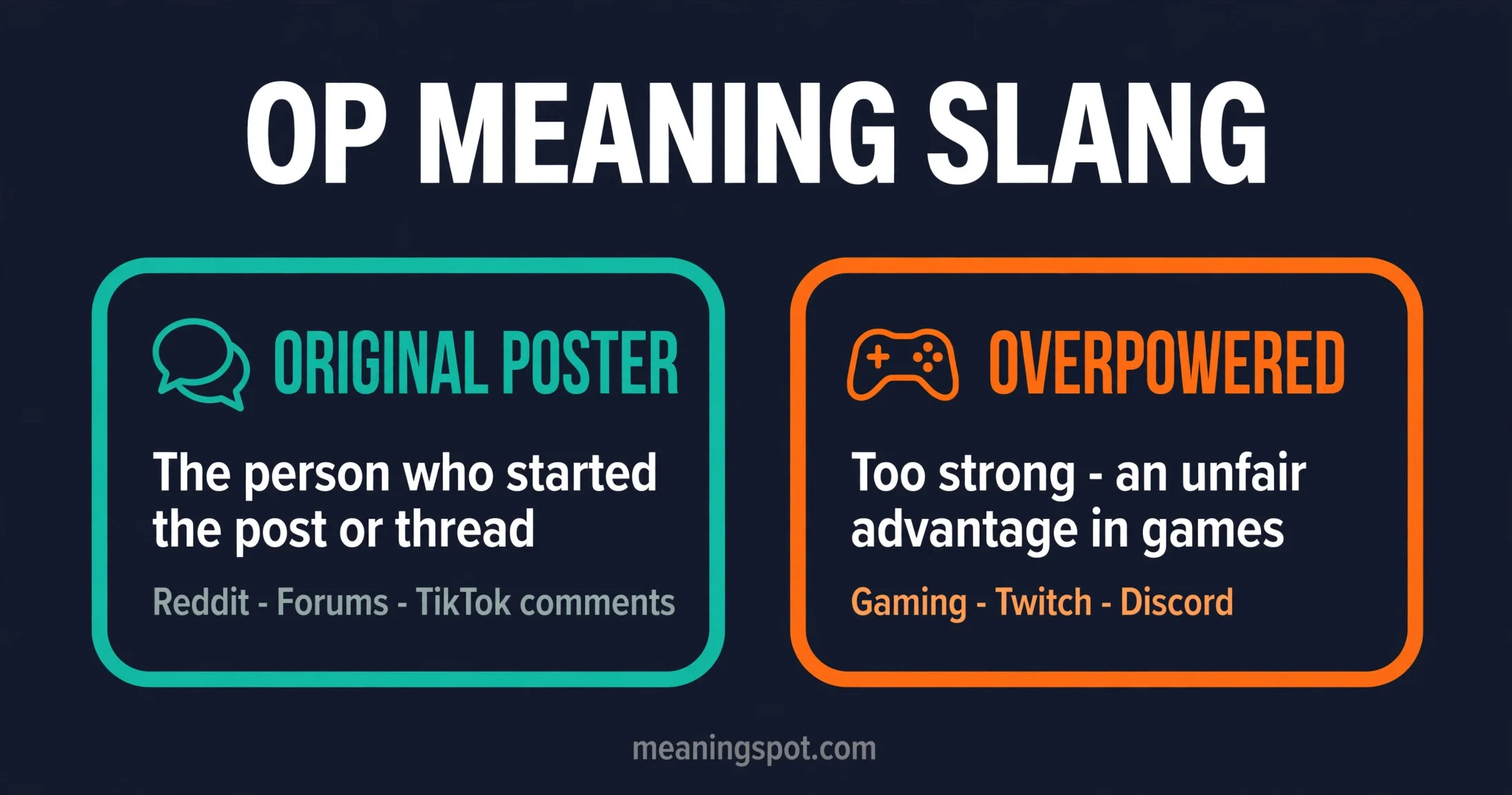
In slang, OP almost always means one of two things. First, “original poster” — the person who started a post, thread, or discussion. Second, “overpowered” — a game character, weapon, or strategy so strong that it feels unfair. Context decides which meaning applies, and once you know the clues, telling them apart takes about three seconds.
Think of OP as a shape-shifter. On Reddit and forums, it points at a person. In gaming chats, it describes power. The letters never change, but the job they do changes completely. That is exactly why so many people search for the op meaning slang after seeing it used in a way that does not match what they expected.
Most of the confusion comes from the fact that both meanings are extremely common. Neither one is rare or outdated. You will genuinely encounter both in a normal week of scrolling, which is why learning the difference pays off fast.
OP Meaning Slang as “Original Poster”
On discussion platforms, OP stands for “original poster.” It refers to the person who created the post, asked the question, or started the thread that everyone is now replying to. Instead of typing out a username every time, commenters just write OP.
This usage grew out of old internet forums in the early 2000s. Back then, long discussion threads could run for hundreds of replies, and people needed a quick way to refer to whoever had started it all. “Original poster” was accurate but clunky, so it got shortened. Reddit later made it mainstream, and today the habit has spread to TikTok comments, Instagram threads, and Facebook groups.
Where You See This Meaning
You will run into this usage most often on Reddit, where entire comment sections revolve around the OP. In a story thread, someone might write, “OP handled that really well,” meaning the person who posted the story. Advice threads work the same way. A member asks for help, and replies say things like, “OP, what did you decide in the end?”
Facebook groups follow the same pattern. Meanwhile, TikTok and Instagram comments have picked up the habit too. When a creator’s video sparks a debate, commenters refer to the creator as OP: “OP knew exactly what they were doing with this one.” On Discord, discussion channels use it the same way.
Real Examples of “Original Poster”
- “Does anyone know if OP ever posted an update?” (Did the person who started the thread come back with more?)
- “OP is not wrong here.” (The original poster has a point.)
- “Thanks for sharing, OP.” (Thanking the person who made the post.)
- “OP deleted the post after all the comments.” (The thread starter removed it.)
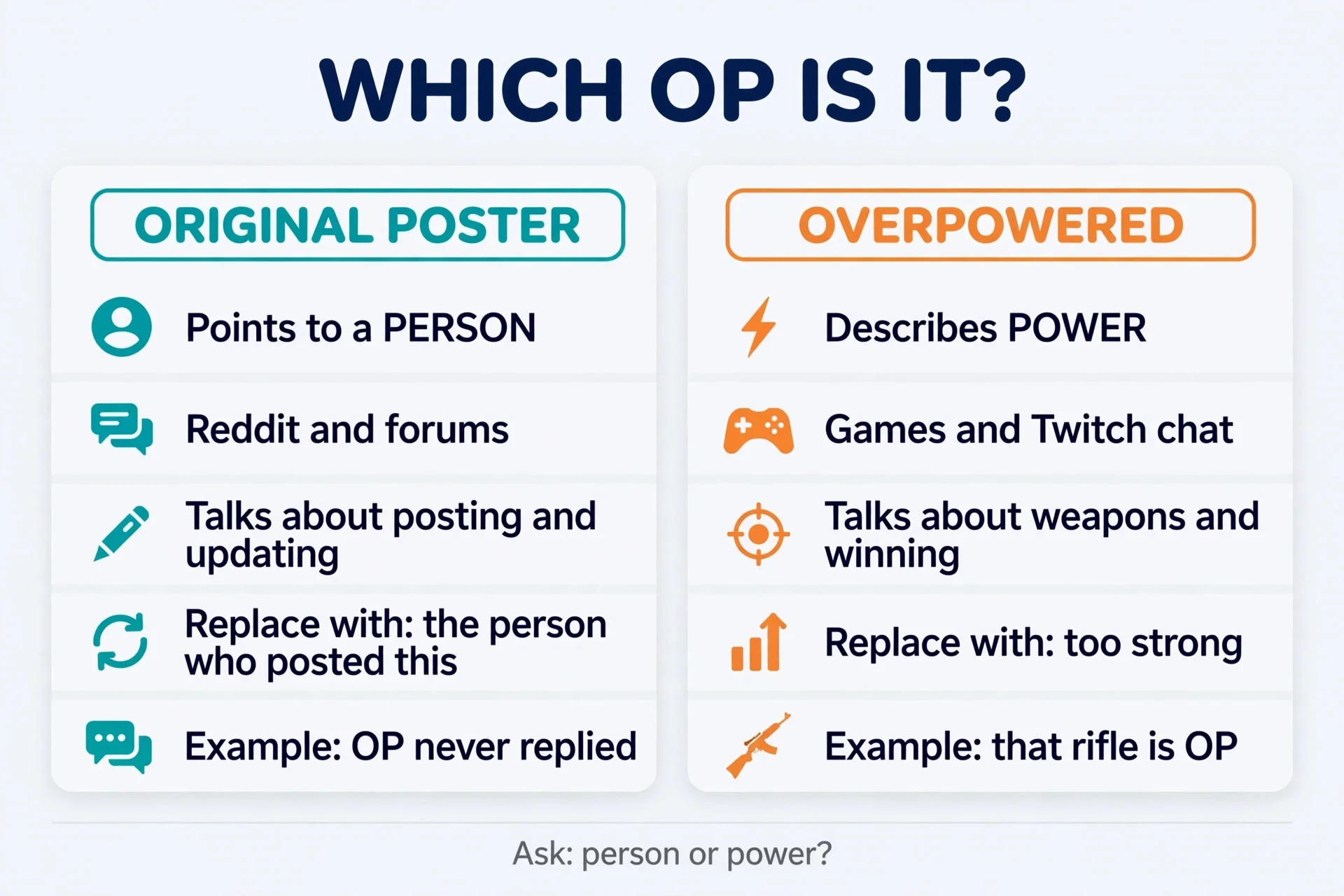
Notice the pattern across every example. In each case, OP points to a human being — the one who started the conversation. Here is a simple test you can use anywhere: if you can replace OP with “the person who posted this” and the sentence still makes sense, you have found this meaning.
OP Meaning Slang as “Overpowered”
In gaming, OP means “overpowered.” It describes a character, weapon, ability, or strategy that is so strong it gives an unfair advantage. When players say something is OP, they usually mean it needs to be weakened — what gamers call a “nerf.”
This meaning is older than many people realize. Tabletop gamers were calling things overpowered back in the 1980s, and video game magazines picked it up in the 1990s. However, it truly exploded with competitive online gaming and live streaming, where thousands of viewers hear streamers call weapons and characters OP every single day.
What Counts as OP in a Game
A new champion launches with abilities far stronger than older ones. A sniper rifle eliminates opponents with one shot from across the map. Some strategies win nearly every match with little effort. Players call all of these OP. The word usually carries a complaint inside it. Saying “that build is OP” is rarely pure praise; more often it means “this is too strong and it is ruining the balance.”
Game developers take these complaints seriously. When enough players call something OP, developers typically release a balance patch that reduces its power. Because of this cycle, you will often see OP and “nerf” in the same conversation: “This gun is so OP, it is getting nerfed next patch for sure.”
Real Examples of “Overpowered”
- “That new shotgun is so OP, it needs a nerf.” (The weapon is unfairly strong.)
- “He is playing an OP character, no wonder he keeps winning.” (The character gives an unfair edge.)
- “This strategy is OP on this map.” (The tactic is too dominant here.)
- “I finally beat that boss — my build was a little OP though.” (Playful admission of having an advantage.)
Here OP describes power, not a person who posted something. Apply the mirror-image test: if you can replace OP with “too strong” or “unfairly powerful” and the sentence still works, this is the meaning in play. For a deeper look at gaming slang, the gaming term “NPC” follows a similar journey from games into everyday chat, as explained in our guide to NPC meaning.
How to Tell Which OP Meaning Slang Applies
This is the skill that matters most, because the two meanings live in overlapping spaces. A gaming forum can easily use both in a single thread. The good news is that a simple framework sorts them out every time.
The Three-Second Context Test
Ask yourself one question: is OP pointing at a person who wrote something, or describing how strong something is? If the sentence talks about posting, updating, deleting, or explaining, it means original poster. If it talks about weapons, characters, winning, balance, or nerfs, it means overpowered. That single question resolves the vast majority of cases.
Platform Clues That Give It Away
The platform itself is often the biggest hint:
- Reddit comment sections usually mean original poster.
- In-game voice or text chat usually means overpowered.
- TikTok or Instagram comments usually mean original poster (the creator).
- Twitch chat during gameplay usually means overpowered.
- Discord depends on the channel: gaming channels lean overpowered, discussion channels lean original poster.
- WhatsApp or Snapchat messages from friends could be either, so use the context test.
When Both Meanings Collide
Sometimes one conversation uses both meanings at once. Imagine a gaming subreddit thread where someone writes: “OP says this sword is OP.” The first OP is the original poster (the person who started the thread). The second OP means overpowered (the sword is too strong). It looks confusing at first glance, but the context test sorts it out instantly. Situations like this are rare, yet knowing they exist keeps you from second-guessing yourself.
Other Meanings of OP Worth Knowing
While the two main meanings cover the vast majority of what you will see, OP has a few niche uses worth a quick mention. In Minecraft and game-server communities, OP can mean “operator” — a player with admin privileges, from the /op command that grants them. Some people also use OP for “out of place” in casual chat, though this is rare and fading. News and blog comments occasionally use it for “opinion piece.” You do not need to memorize these. Just knowing they exist keeps a strange usage from throwing you off, and you can safely assume one of the two main meanings unless the context clearly says otherwise.
OP vs Opp: Do Not Mix Them Up
One common mix-up deserves its own warning. The two terms look similar but mean completely different things. OP is original poster or overpowered. Opp, usually spelled with two p’s, is short for “opposition” — rivals, enemies, or opponents — and comes from hip-hop and street slang. “Watch out for the opps” has nothing to do with posting or gaming power.
This confusion trips up a lot of readers because search results for the two terms overlap. Remember the spelling rule: one P at the end points to internet and gaming slang, while two P’s point to rivals. If you see “opp” with the double p, you are in different territory entirely.
How to Use OP Naturally (and When Not To)
When OP Works Fine
Use OP in casual online spaces where the audience knows internet slang: Reddit comments, gaming chats, Discord servers, TikTok comments, and group chats with friends. Match the meaning to the setting — original poster in discussions, overpowered in games — and you will sound natural. Most native users of the slang never think twice about it; it is simply part of the vocabulary.
When to Avoid OP
Skip it in professional emails, formal writing, school assignments, and conversations with people unfamiliar with internet slang. Writing “the original author” or “highly effective” gets the point across without any confusion. Older relatives and non-gamers will likely misread it, so plain language wins there. As a rule of thumb, if you have to wonder whether your audience will understand it, choose the clearer wording.
How to Reply When Something Is Called OP
Your reply depends on which meaning just landed on you. If a teammate says your weapon or character is OP, a light response keeps things friendly: “Haha, just lucky,” or “All skill, no nerf needed.” There is no need to get defensive — in gaming, being called OP is half complaint and half respect.
If someone addresses YOU as the OP in a thread (“OP, any updates?”), they are talking to you directly. They usually want an answer, an update, or a reaction to the discussion. Respond to the actual question and you will fit right in.
Finally, if a friend says your outfit, meme, or idea is OP, take it as a compliment. Outside gaming, the overpowered meaning has softened into general praise for anything impressive. A simple “thanks” or a laughing emoji is a perfect reply.
For reference on how gaming media itself explains the term, Dot Esports has a clear breakdown of what OP means in gaming and how it relates to balance patches.
FAQ
Is OP always a compliment?
Not exactly. As “overpowered,” it is often a complaint about game balance, although friends use it playfully as praise. As “original poster,” it is neutral — simply a convenient way to refer to someone. The tone always comes from the surrounding conversation.
Can OP mean something rude or offensive?
No. Neither of the two main meanings is rude, vulgar, or offensive. OP is safe, everyday internet slang that you can use around anyone who understands it. The only risk is confusion, not offense.
Why do non-gamers get so confused by OP?
Because the two meanings grew up in different corners of the internet. Gamers learned “overpowered” from years of play, while forum users learned “original poster” from years of threads. Most confusion disappears the moment you apply the context test from this guide.
Is OP used outside English-speaking countries?
Yes. Gaming communities around the world use OP, especially for the overpowered meaning, since competitive games are global. The original-poster meaning is strongest in English-language forums like Reddit, but it travels wherever those platforms are popular.
Should I use OP in a work email or school paper?
Better not. It is casual internet slang, and formal readers may not know it or may see it as unprofessional. In work or academic settings, write out the full phrase — “the original poster” or “highly effective” — instead.

Conclusion
OP is one of those rare slang terms with two equally important lives. In discussions, it points to a person — the original poster who started it all. In games, it describes power — something so strong it bends the rules. The confusion around the op meaning slang is completely normal, because both meanings are everywhere and the letters never change.
You now have everything you need: the two definitions, real examples of each, a three-second context test, platform clues, and reply ideas for every situation. The next time you see OP in a comment or chat, pause for one second, ask whether it points to a person or describes power, and you will know exactly what it means.