

If you have ever come across the letters FWB in a text message, a dating profile, or a group chat and stopped to look up the fwb meaning, you are far from alone. The abbreviation shows up everywhere in modern dating culture — Snapchat stories, Tinder bios, WhatsApp chats, TikTok comments — and it carries far more weight than its three letters suggest.
At its simplest, FWB stands for “friends with benefits.” However, that short definition hides a surprising amount of real-world nuance. For example, people use the term to describe a specific kind of arrangement, to set clear boundaries, or to signal exactly what they are — and are not — looking for.
Are you trying to figure out what someone meant when they suggested being FWB? Are you wondering how it differs from dating, or from similar terms like NSA and “situationship”? Or do you simply want to understand the slang before you reply to a message? This guide walks through the fwb meaning step by step — what it signals, how people actually use it in texts and on apps, where the misunderstandings come from, and what to know before you respond — so nothing is left ambiguous.
FWB Meaning: The Direct Answer
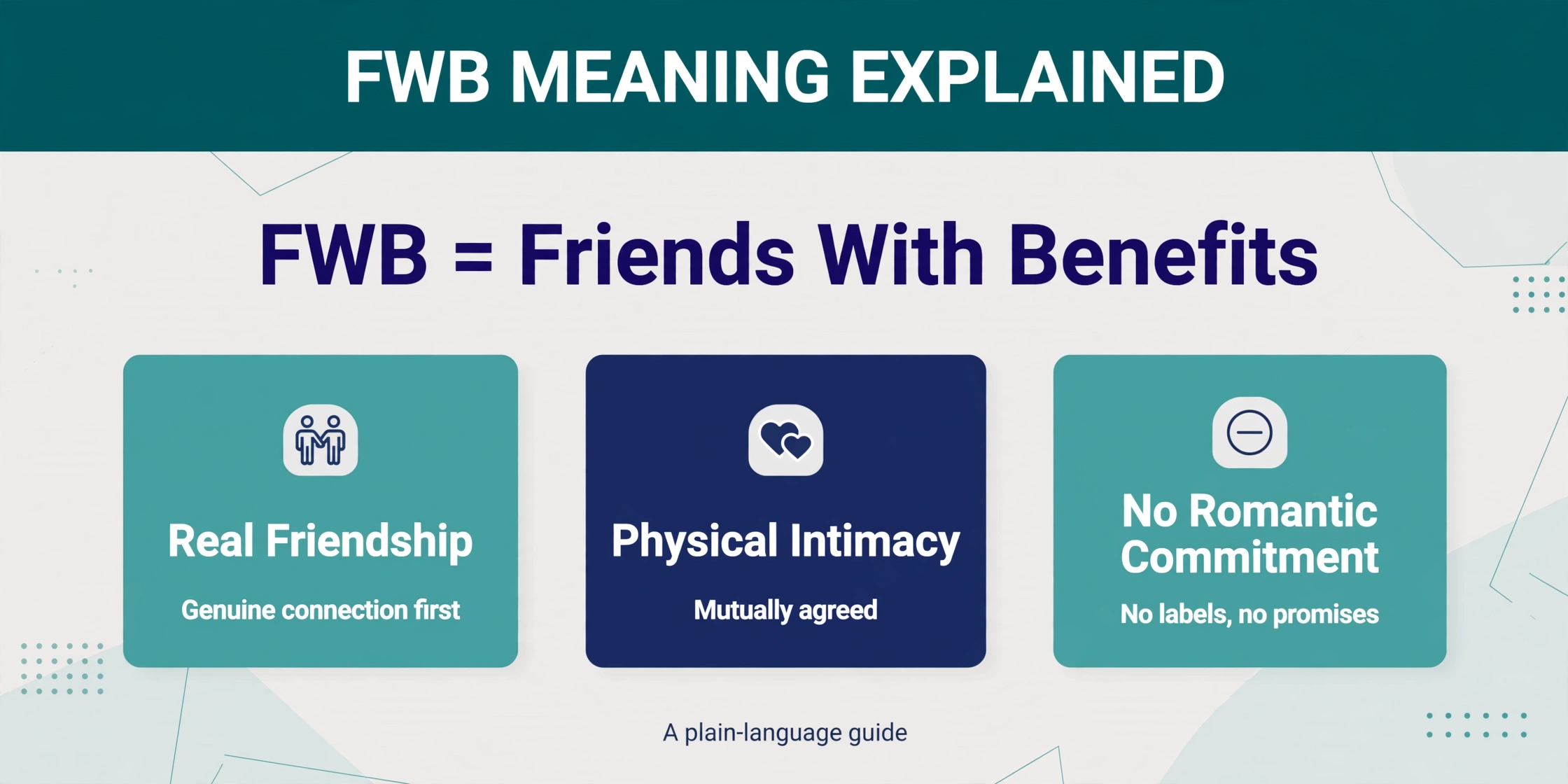
FWB stands for “friends with benefits.” It describes an arrangement between two people who are friends and also share physical intimacy, without romantic commitment and without the label of a committed relationship.
Three things define it:
- Friendship comes first. In most cases, the two people were already friends — or at least friendly — before anything else developed. The connection is genuine, not anonymous.
- Both people agree on the terms. An FWB arrangement is, by definition, mutual. Both sides understand that romance and long-term commitment are off the table.
- There is no romantic label. They do not call each other boyfriend, girlfriend, or partner, and they do not make the promises that usually come with those titles.
In other words, it sits in the middle ground between “just friends” and “a couple.” The friendship is real, the physical side is consensual, and the romantic expectations are deliberately set to zero. Of course, human feelings do not always follow neat definitions — which is exactly why this topic generates so much confusion, and why the rest of this guide exists.
What an FWB Arrangement Actually Looks Like
However, definitions are tidy while real life is not. To understand the fwb meaning in practice, it helps to see how these arrangements typically play out day to day.
It Usually Starts With Friendship
Most FWB arrangements grow out of an existing friendship rather than starting from scratch. Two people get along well, enjoy each other’s company, and at some point acknowledge a mutual physical attraction. Instead of turning it into a romance — which neither person wants — they agree to keep the friendship and add intimacy to it.
In fact, this is one of the biggest differences between FWB and a random hookup. There is history, trust, and genuine liking involved. The two people text about normal life, hang out in groups, and treat each other like friends — because they are friends.
Both People Agree on the Terms
The single most important feature of a healthy FWB arrangement is explicit agreement. Both people say, out loud or in clear messages, that they want the same thing: friendship plus intimacy, minus romance and commitment.
Still, problems almost always start when this step is skipped. If one person secretly hopes the arrangement will turn into a relationship while the other believes everything is casual, someone is going to get hurt. Clear, honest conversation at the beginning is not awkward — it is the entire foundation the arrangement stands on.
There Is No Romantic Label
Generally, people in FWB arrangements deliberately avoid the language of committed relationships. They do not introduce each other as partners, do not celebrate anniversaries, and do not make long-term plans as a couple. Dates may still happen — dinner, movies, hanging out — but they are framed as two friends spending time together, not as romantic milestones.
Of course, this does not mean the connection is cold or careless. Many people in these arrangements care about each other deeply as friends. The distinction is about expectations: neither person expects the relationship to escalate into romance.
It Ends When Someone Wants More — or Less
Every FWB arrangement has a natural lifespan. It ends when one person develops romantic feelings, when one person meets someone they want to date seriously, or when the dynamic simply stops working. Mature handling of that ending — honest conversation rather than ghosting — is part of what separates a respectful arrangement from a messy one.
FWB Meaning in Text, Snapchat, and Dating Apps
Meanwhile, the fwb meaning shifts slightly depending on where you encounter it. Context changes the tone, so reading the setting correctly matters as much as knowing the definition.
In Texting and DMs
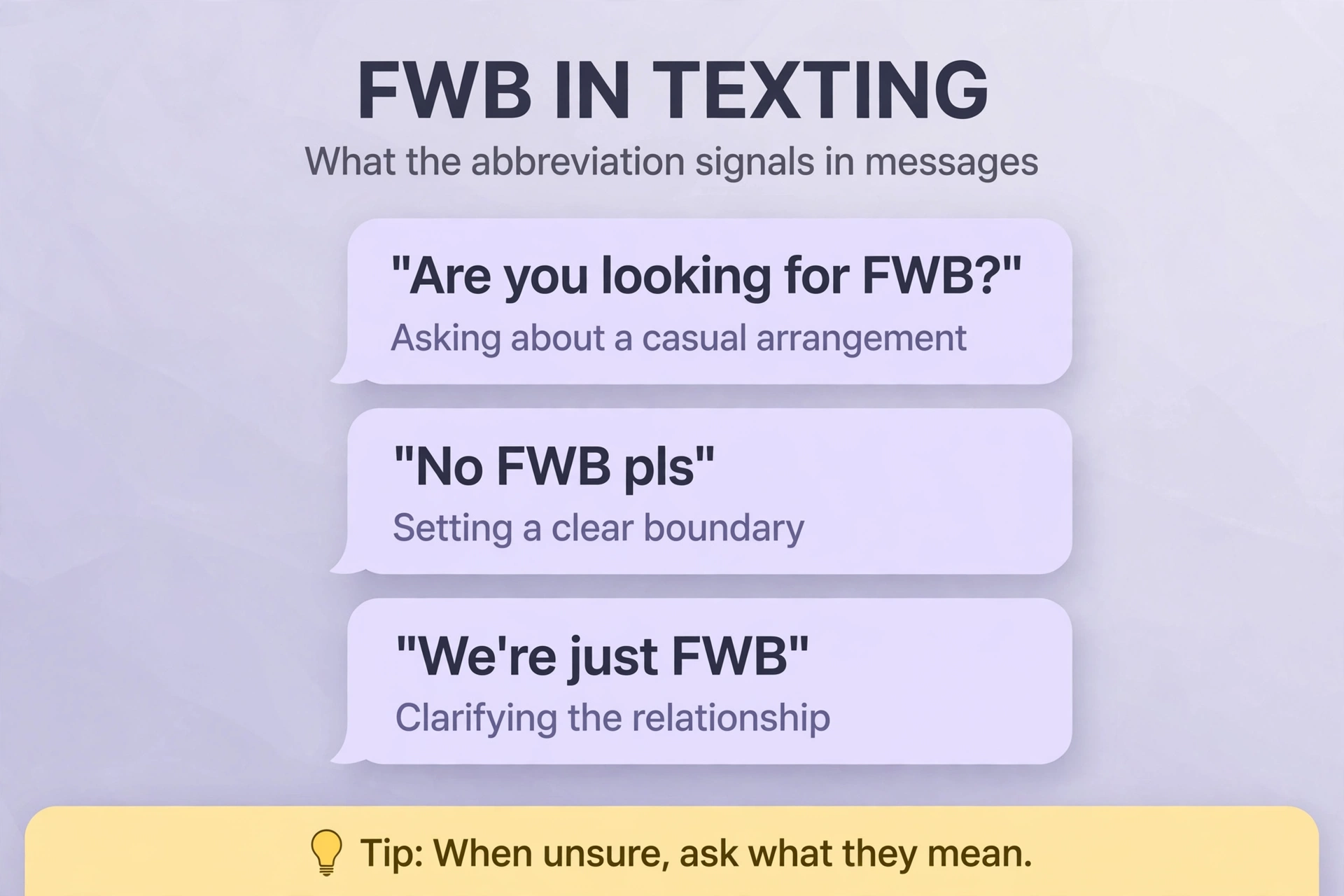
In a private message, FWB is usually direct and practical. Someone might ask, “Are you looking for FWB?” — which is a straightforward question about whether you want that kind of arrangement. Or a friend might say, “We’re just FWB,” to clarify the nature of an existing connection to someone else.
Because texts lack tone of voice, the same three letters can feel blunt, playful, or serious depending on the conversation around them. If you are unsure what someone intends, the safest move is also the simplest: ask them what they mean by it.
On Snapchat and Instagram Stories
Similarly, on visual platforms, FWB often appears in captions, stories, or bios rather than in conversation. A story that says “looking for FWB” is a public signal about what kind of connection the person wants. Meanwhile, “no FWB” in a bio is the opposite signal — a boundary, stated upfront, telling viewers that casual arrangements are not welcome.
Snapchat’s casual, disappearing-message culture made it a natural home for this kind of shorthand. The term lets people communicate something sensitive without spelling it out in full sentences for everyone to see.
In Dating App Bios
In fact, dating apps are where FWB appears most strategically. Profiles on Tinder, Bumble, Hinge, and similar apps routinely include lines like “FWB only,” “not looking for FWB,” or “FWB-friendly.” Here the term functions as a filter: it tells potential matches what the person wants before either side invests time in chatting.
Reading these bios carefully saves everyone effort. If your goals do not match what a profile states, moving on is kinder — and faster — than trying to change someone’s mind.
FWB vs. Similar Relationship Terms
Indeed, part of the confusion around the fwb meaning comes from how many similar-sounding terms exist. Each one describes a slightly different arrangement, and mixing them up leads to mismatched expectations.
FWB vs. NSA
NSA stands for “no strings attached.” On the surface it sounds identical to FWB, but there is a meaningful difference: friendship. An FWB arrangement includes a genuine friendship — the two people like each other, hang out, and talk about real life. NSA, by contrast, is purely about physical encounters with minimal emotional or social connection. In other words, FWB includes the “friends” part, while NSA deliberately leaves it out.
FWB vs. Situationship
A situationship is a romantic-ish connection that has never been defined. Two people act like a couple — texting constantly, spending most weekends together, possibly meeting friends — but nobody has said what they are. The defining feature of a situationship is ambiguity. FWB is the opposite: it is defined from the start. Both people know exactly what the arrangement is and is not. If you find yourself constantly wondering “what are we?”, you are probably in a situationship, not an FWB arrangement.
FWB vs. Casual Dating
Casual dating means going on dates without exclusivity or serious commitment. The key difference is intent and trajectory. Casual daters are usually open to something developing — they are exploring romantic possibilities, just without pressure. In an FWB arrangement, both people have agreed in advance that romance is not the goal. Casual dating leaves the door open; FWB has agreed to keep it closed.
The Unwritten Rules People Actually Follow
Still, no official handbook exists — yet years of dating culture have produced a set of widely understood ground rules. People who navigate FWB arrangements successfully tend to follow most of them.
Be Honest About What You Want
First, state your expectations clearly and early. If you only want something casual, say so. If you are open to more, say that too — before anything starts, not after feelings get complicated. Honesty at the beginning prevents the most common source of hurt later.
Keep Communication Open
Check in with each other regularly. A simple “is this still working for you?” every so often keeps small issues from becoming big ones. The arrangements that last longest are usually the ones where both people feel comfortable speaking up.
Respect the Friendship
Remember the first word in the phrase: friends. Treat the other person with the same consideration you would give any good friend — reliability, kindness, and respect for their time and boundaries. An arrangement that damages the friendship has failed at its own premise.
Know When to Walk Away
If you develop romantic feelings, if jealousy appears, or if the dynamic starts causing more stress than enjoyment, it is time for an honest conversation about ending it. Walking away from an arrangement that no longer works is not failure; it is the responsible move. As relationship writers often note, the healthiest casual arrangements are the ones where both people can exit gracefully — a point echoed in guides like YourTango’s breakdown of the FWB dynamic.
Common Misunderstandings About FWB Meaning
“It Means No Feelings at All”
This is the most common myth. FWB does not mean the absence of all feeling — it means the absence of romantic expectations. Friends with benefits usually like, trust, and care about each other as friends. Expecting zero emotion of any kind is unrealistic, and pretending otherwise is how people get blindsided.
“It Always Turns Into a Relationship”
Sometimes it does — but “always” is a stretch. Plenty of arrangements run their course and end amicably without either person wanting more. The outcome depends entirely on the two people involved, their honesty, and their circumstances. Assuming it must become a relationship (or assuming it never will) are both mistakes.
“It Is the Same as a One-Night Stand”
A one-night stand is a single encounter, usually between strangers or near-strangers, with no ongoing connection. FWB is an ongoing arrangement built on an existing friendship. The two have almost nothing in common beyond the absence of commitment.
Frequently Asked Questions
What does “FWB-friendly” mean on a dating profile?
It means the person is open to a friends-with-benefits arrangement but is not necessarily limiting themselves to one. Unlike “FWB only” — which rules out anything serious — “FWB-friendly” signals flexibility: casual is fine, and something more could be fine too, depending on the connection.
Is FWB the same as a booty call?
Not quite. A booty call is typically a late-night message aimed at a single encounter, often between people who are not really friends. FWB describes an ongoing arrangement rooted in friendship. A booty call can happen inside an FWB arrangement, but the terms are not interchangeable.
Can you be FWB with an ex?
It happens, but most relationship writers advise against it. Exes carry romantic history, which makes the “no romantic expectations” rule much harder to maintain. Old feelings tend to resurface, and the arrangement often becomes a confusing middle ground instead of a clean friendship. If you try it, the need for brutal honesty is even greater than usual.
Do people use FWB the same way in every country?
The abbreviation is widely recognized in English-speaking countries and across global dating apps, but cultural attitudes toward casual arrangements vary enormously. In some places the concept is openly discussed; in others it carries heavy stigma or is simply not part of dating culture. The letters travel easily — the social meaning does not always follow.
What does “FWB only, no drama” mean in a bio?
It is a boundary statement with two parts. “FWB only” means the person wants a casual arrangement and nothing serious. “No drama” means they expect emotional maturity — no jealousy, no games, no blurred lines. Together, the phrase asks for something casual but respectful. For readers who enjoy decoding this kind of internet shorthand, meaningspot.com covers similar slang terms in the same plain-language style.

Conclusion
The fwb meaning is simple to state — friends with benefits, a friendship that includes physical intimacy without romantic commitment — but it takes care to navigate well. The difference between an arrangement people look back on fondly and one they regret almost always comes down to the same few things: honesty at the start, clear boundaries, ongoing communication, and the willingness to walk away when it stops working.
If you encountered the term in a message or a bio, you now know exactly what it signals — and, just as importantly, what questions to ask before you respond. Understanding the slang is the easy part; using that understanding to protect your own boundaries is what actually matters.